

ChatterBait Anatomy

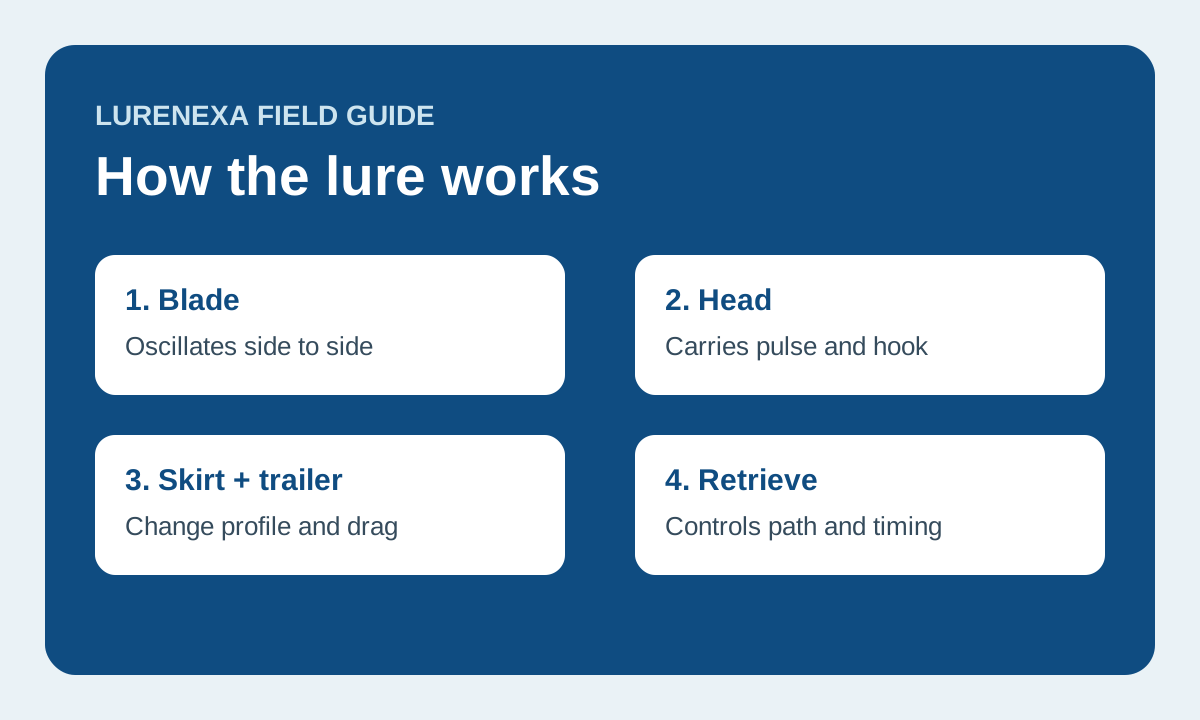
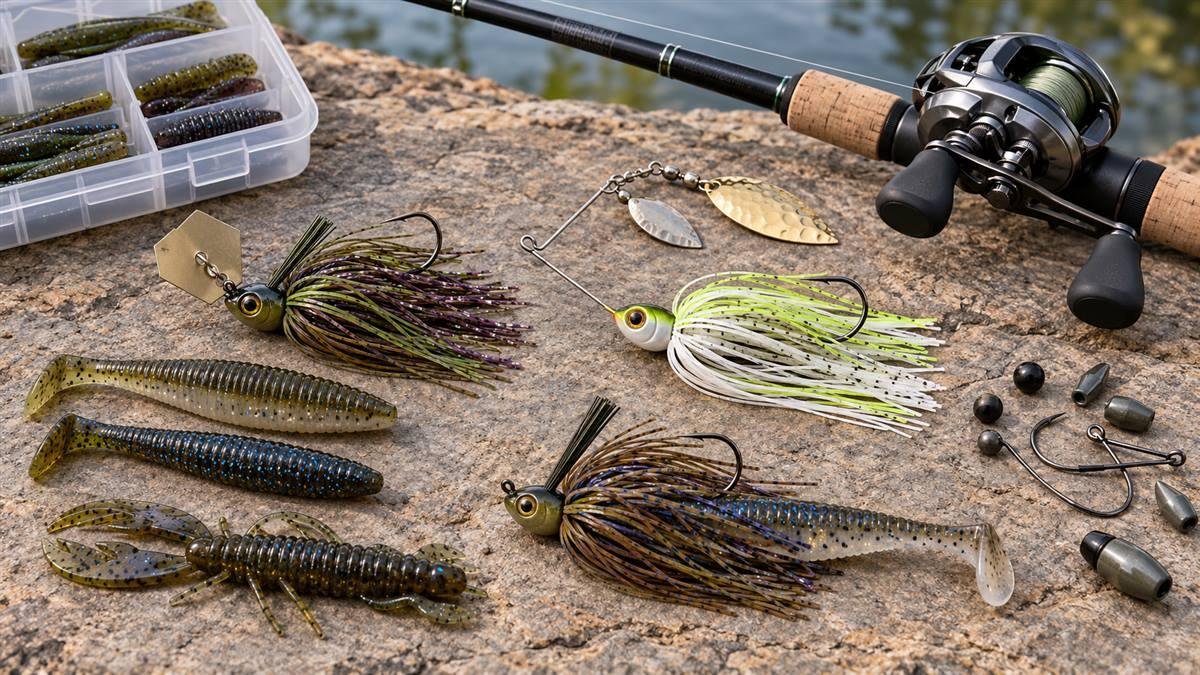
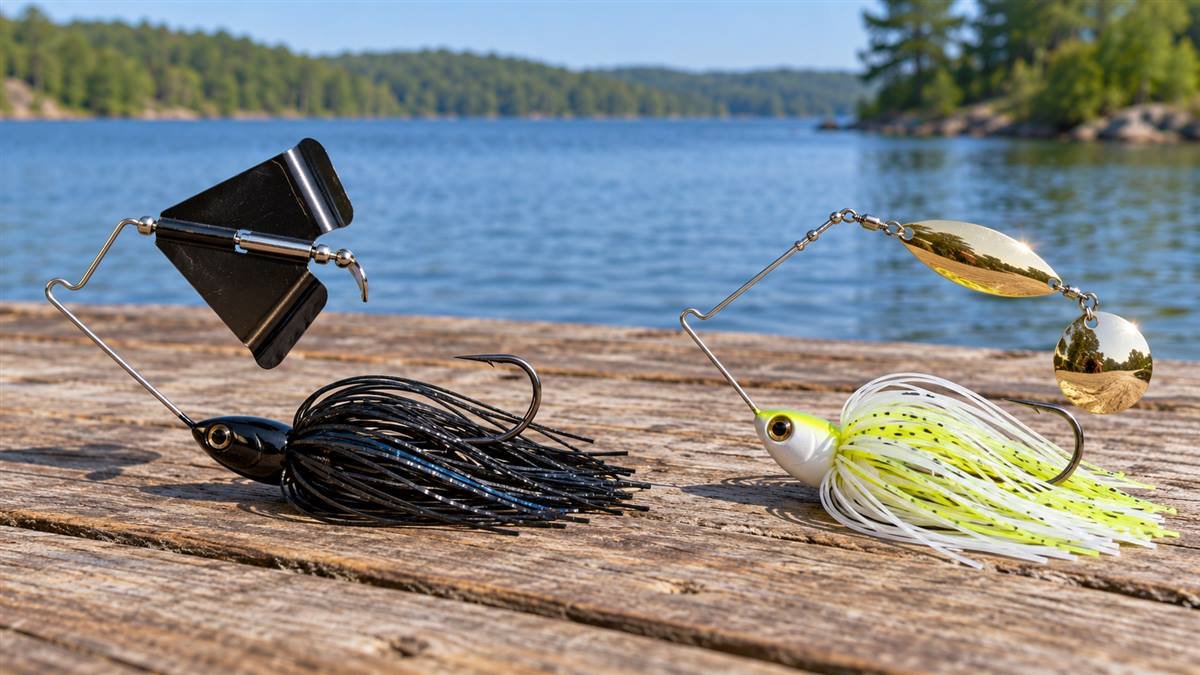
Blade and connection. A thin metal blade sits at the front of a traditional ChatterBait-style jig. Its shape, thickness, and attachment points influence how readily it starts and the character of its vibration. Z-Man's Original ChatterBait has a direct head-to-blade connection; other products can use different links and blade shapes. The line clip attaches at the blade, so line pull, water pressure, and the blade joint work together.
Head and hook. The jighead supplies weight and balance and holds a single exposed hook. Its shape affects tracking and contact with cover. A heavy head can help the bait stay lower, but trailer drag, line angle, and speed also influence depth. Inspect the blade attachment, snap, hook point, and head for bends or wear before fishing.
Skirt and trailer. Silicone strands add bulk and flowing movement around the hook. A molded keeper holds an optional soft-plastic trailer behind the skirt. The trailer can be a straight-tail minnow, paddle-tail swimmer, craw-style bait, or another compatible shape. A crooked trailer can roll or dampen the action, so thread it straight and keep it clear of the blade and hook point.
| Part | Main job | Check |
|---|---|---|
| Metal blade | Oscillates in water | Flat and freely moving |
| Link and clip | Connects blade, head, line | Secure and unbent |
| Weighted head | Balance and hook support | No cracks or deformation |
| Silicone skirt | Flowing outline | Even, untangled strands |
| Single hook | Holds fish | Sharp and unobstructed |
| Trailer and keeper | Profile and added motion | Straight rigging |
How the Blade Creates Vibration

The angler starts reeling, putting tension in the line. Water then pushes against the blade's broad face while the blade is constrained by its connection to the jighead. Instead of continuing in one fixed alignment, it pivots repeatedly from one side to the other. That rapid side-to-side cycle is oscillation. Its movement changes local water pressure and tugs on the weighted head, creating vibration that can be felt through the line and rod.
The blade is not a free propeller. It does not spin continuously around a central shaft like an inline spinner blade. Blade shape, hinge geometry, head position, retrieve speed, and water flow determine its range and tempo. A faster retrieve often strengthens the sensation until a model begins to track poorly; a slower retrieve can still work if the design starts reliably at that pace.
Feel is useful feedback, but it is not a scientific frequency meter. A missing pulse can mean grass on the blade, slack line, the lure touching cover, or a bite. Bring the bait back and inspect it if the sensation fails to return. Testing it on a short visible retrieve gives a baseline for what that particular model should feel like.
| Stage | What happens | Angler observation |
|---|---|---|
| Line pull | Lure advances | Retrieve begins |
| Water pressure | Blade pivots repeatedly | Pulse starts |
| Head connection | Motion reaches the jig | Head and skirt move |
| Line and rod | Movement travels to hand | Regular tactile rhythm |
| Speed change | Forces change | Rhythm may strengthen or fade |
Blade, Jighead, and Clacking

The attachment between blade and head does more than hold two parts together. It defines the blade's pivot range, its distance from the head, and the angle at which the lure pulls. Small geometry changes can affect startup, balance, vibration strength, and whether the bait tracks straight or shifts sideways. Z-Man specifically identifies the direct connection as a feature of its Original ChatterBait; generic bladed jigs need to be judged individually.
On selected models, the oscillating blade repeatedly strikes the jighead. That impact produces a separate clacking sound in addition to the blade's movement through water. Z-Man describes a designed head groove on its JackHammer that positions the blade for contact. Another jig may use a different contact point, create less sound, or keep the blade away from the head. Do not infer clacking just from the word “vibrating.”
Fast startup matters when the useful lane is short: beside a dock post, at the edge of an isolated grass patch, or near the bank. A lure that begins pulsing quickly spends more of that brief path working as intended. Check how the blade responds after splashdown and after each pause. If it takes several feet to start, inspect fouling and rigging before concluding the lure design is at fault.
| Feature | Possible result | Model-specific check |
|---|---|---|
| Pivot geometry | Changes blade travel | Starts on short retrieve? |
| Head clearance | May allow a clack | Listen and inspect contact |
| Head shape | Affects balance and tracking | Runs upright? |
| Clip and hardware | Transfer line pull | Secure and free-moving |
Vibration, Sound, Flash, and Displacement

Vibration is mechanical movement of the blade and the rest of the lure. Water displacement is the moving water and pressure variation around it. Clacking is a potential impact sound when blade and head meet. Flash is reflection from the blade when light reaches it. They can occur together, but one is not proof of another. A matte or translucent blade, for example, may show less flash without eliminating movement.
Bass can detect water movement through sensory structures, including the lateral line, and can also see a lure under suitable light and clarity. That does not mean every fish is attracted primarily by vibration. Location, prey, light, water temperature, and fish activity shape the response. A blade may help a bait become noticeable in stained water, but it cannot make a lure effective where bass are absent.
Compare cues by changing one factor at a time. A blade finish changes reflected light; a trailer can change outline and drag; a different head or connection can alter pulse and sound. Avoid assuming that a louder or more forceful presentation is always better. An angler should first put the lure in a useful depth and travel lane, then refine its cues.
| Cue | Source | What changes it |
|---|---|---|
| Vibration | Blade oscillation and head movement | Speed and geometry |
| Water movement | Blade and body displacing water | Blade area and retrieve |
| Clack | Blade contacting head in some models | Connection and head design |
| Flash | Light reflecting from blade | Finish and illumination |
What Hunting Action Means

A steady-running lure generally follows the line of the retrieve, even though its blade oscillates rapidly. “Hunting” describes a wider, occasional side-to-side deviation of the whole lure. The two motions operate on different scales: blade movement is repeated and quick, while the complete jig may briefly dart left or right before returning to its path.
Blade geometry, the blade-to-head joint, head shape, weight distribution, trailer drag, and retrieve changes can all influence hunting. Some designs advertise it as an intentional feature; others are tuned for a straighter path. A turn near grass or a piece of wood can also redirect the bait, but that does not prove a designed hunting action. Watch a short retrieve beside clear water before making claims about a model.
A slight unexpected direction change can resemble prey avoiding a predator, yet more movement is not automatically better. An unstable lure that rolls, exposes the hook awkwardly, or stops pulsing is not simply “hunting harder.” If a bait repeatedly runs off to one side, check for a bent blade, twisted clip, uneven skirt, or misaligned trailer. Use speed changes to explore action, then keep the version that tracks cleanly through the strike zone.
| Observation | Possible meaning | First check |
|---|---|---|
| Tight regular pulse | Blade oscillating | Maintain useful path |
| Brief left-right veer | Possible hunting or deflection | Repeat in open water |
| Constant pull to one side | Rigging or damaged hardware | Straighten trailer and inspect blade |
| Rolling or dead pulse | Too fast, fouled, or mismatched setup | Slow and inspect |
Skirt and Trailer Effects

The skirt forms a moving outline around the head and hook. Its strands flare, compress, and trail with the lure's motion and water flow. It can help suggest a fuller baitfish or other prey shape, but it is not the primary source of blade vibration. A skirtless bladed jig can still oscillate if its blade and connection are designed to do so.
A straight-tail minnow often adds a slender profile without a strong independent tail kick. A paddle-tail swimmer adds its own rhythmic movement and resistance. A craw-style trailer contributes claws and a wider silhouette; a thin pintail may offer relatively little additional motion. These are general tendencies. Tail thickness, material softness, length, buoyancy, and how the bait is threaded can change the outcome considerably.
Added drag can alter lift, running depth, startup, and how strongly the head responds to the blade. A large paddle tail may overpower or dampen the high-frequency blade feel on one model, while a smaller tail works well. Bassmaster anglers describe contrasting reasons for choosing paddle and straight tails, illustrating that there is no universal winner.
Rig the trailer straight along the hook shank, seat it against the keeper, and ensure the tail is free to move. If the bait rolls or its pulse becomes faint after a trailer change, compare it with no trailer, then try a shorter or slimmer one. Make one substitution at a time so the result means something.
| Trailer | Common contribution | Check |
|---|---|---|
| Straight-tail minnow | Slim profile, subtle tail | Does blade pulse stay clear? |
| Paddle tail | Independent kick and drag | Does bait rise or roll? |
| Craw style | Wider shape and claws | Does it fit cover and depth? |
| Thin pintail | Low-profile movement | Is the silhouette sufficient? |
| No trailer | Direct baseline | Is hook and keeper clear? |
Speed, Rod Angle, and Weight

A slow retrieve may keep a working blade near a deeper grass edge or along a hard-bottom contour. A medium pace is a practical starting point because it makes the pulse easy to feel and gives time to notice a change. A faster retrieve can keep some setups higher and cover water quickly, but some lures begin to roll or lose their clean blade action above a certain speed. Watch the actual bait rather than applying a fixed rule.
Rod-tip position changes the pull angle. Raising the tip can help guide a jig over short vegetation; lowering it can encourage a lower path. Jighead weight also matters: a heavier model often resists lift and reaches depth more readily, while a lighter one may suit shallow cover. These effects interact with line diameter, current, blade shape, and trailer resistance, so the listed ounce weight alone cannot predict an exact running depth.
Count a jig down before beginning the retrieve if the water is open and you know the bottom clearance. Then reel just fast enough to maintain the pulse. If the bait rises too high, reduce speed, lower the tip, select a slimmer trailer, or test a heavier head. If it drags or fouls constantly, do the opposite or choose a safer travel lane.
| Control | Likely influence | Field check |
|---|---|---|
| Retrieve speed | Pulse strength and travel path | Tracks without rolling? |
| Rod angle | Pull direction | Clears grass tops? |
| Head weight | Sink and depth tendency | Matches water and rod rating? |
| Trailer drag | Lift and stability | Compare two shapes |
| Line/current | Angle and contact | Repeat from same direction |
Five Useful Retrieves
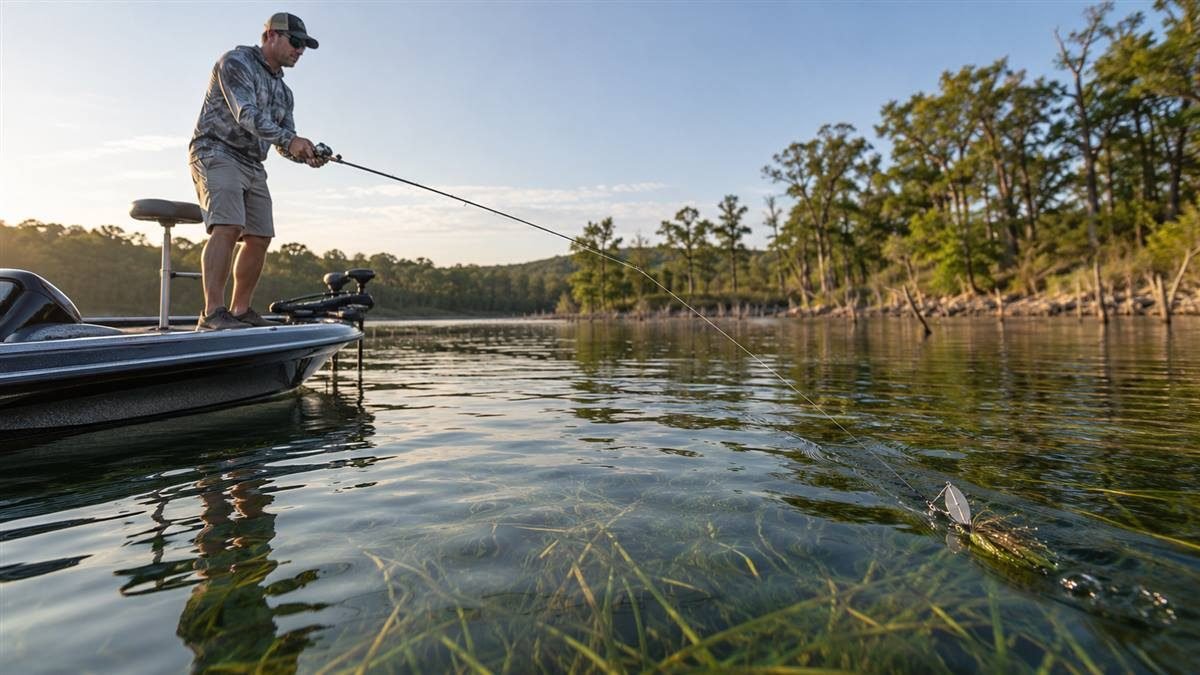
Steady retrieve. Cast past the target, allow the lure to settle to a useful level, and reel at a pace that produces a consistent pulse. This establishes a baseline for speed and depth. If the pulse stops abruptly, pause your assumption of a bite and check for cover or a line issue.
Slow roll. Use a measured retrieve near the bottom or along an outside grass edge, keeping the blade working without burying the hook. A head and trailer combination that maintains motion at lower speed is useful here. Touching a hard spot can be informative, but dragging into a rock crevice is not the goal.
Stop and go. Briefly pause, let the lure drop or glide according to its setup, then restart. Watch for a strike during the transition and confirm that the blade resumes immediately. Long pauses in dense cover may simply bury an exposed hook.
Speed changes. Alternate a few handle turns of moderate and quicker reeling while keeping the bait in the same zone. This changes blade forces and can make the entire jig surge or veer. Avoid accelerating so much that it rolls onto its side.
Contact and release. Let the blade or head graze sparse grass or selected cover, then lift or snap it clear and resume. The blade may briefly stop and restart. If the hook catches repeatedly, adjust angle or switch to a different lane; the bait is not a substitute for a fully weedless lure.
| Method | Primary change | Use with care |
|---|---|---|
| Steady | Stable blade rhythm | Open lanes |
| Slow roll | Longer time lower | Avoid bottom snags |
| Stop and go | Fall and restart | Watch for slack |
| Speed change | Acceleration and possible hunt | Keep bait upright |
| Contact and release | Deflection and restart | Only sparse cover |
Grass, Wood, and Hard Cover

Submerged grass is a familiar setting because bass can hold near its top and edges. Choose a path that passes above the canopy or beside an opening. Light blade or head contact can interrupt the pulse; a short lift may clear strands and let the lure restart. Repeatedly collecting weeds around the blade or hook means the presentation is too deep, too slow, or too far inside the vegetation.
At a laydown or dock post, approach from an angle that lets the jig pass beside the cover rather than bury its exposed hook in it. The blade and head may deflect after light contact, but a single hook can still snag. Keep the line under control so you can feel the difference between a momentary deflection and an extended foul. If wood is too dense, use a more suitable lure.
On rock or shell, a slow roll may keep the lure near a hard spot. The blade can momentarily change rhythm on contact. Check for chipped head paint, bent blade edges, or damaged line after repeated taps. Vibration disappearing is information, not a diagnosis: it may mean a fish, grass, wood, bottom, a slow retrieve, slack line, or failing hardware. React by maintaining contact, then inspect when the lure returns.
| Cover | Useful path | Warning sign |
|---|---|---|
| Sparse grass | Above tops or along edge | Blade continually fouls |
| Wood or dock | Beside structure | Hook buries on every cast |
| Rock or shell | Controlled near-bottom pass | Line abrasion or repeated wedging |
| Dense mat | Use another approach | No clear travel lane |
Why Bass May Respond

A bladed jig can offer several signals at once: a moving baitfish-like silhouette, water displacement, skirt flow, tail action, possible flash, and a changing swimming path. Bass use vision and water-movement sensing in feeding and orientation, but which cue matters most depends on light, clarity, cover, prey, and the fish's state. It is better to ask whether the lure is passing a bass at a useful speed and depth than to claim its vibration forces a reaction.
Slightly stained water can make a strong moving signal a useful search option, especially along vegetation or windblown edges. Clear water can still produce bites, but natural finishes, a slimmer trailer, more distance, or a subtler blade might be worth testing. In colder water, a model that starts reliably at a measured pace may maintain contact with the strike zone. Seasonal labels are starting points, not rigid rules.
Fish location governs every presentation. A good vibration pattern cast well away from baitfish and bass may accomplish little. Cover parallel to a grass edge, aim past a dock corner, or trace a hard-bottom transition. When a bite occurs, note the depth, speed, trailer, and whether the blade had just restarted after contact. Repeat the condition before changing several variables.
| Condition | First test | Observe |
|---|---|---|
| Stained grass edge | Steady pulse near cover | Depth and contact |
| Clear open lane | Natural finish, slimmer profile | Followers or bites |
| Cold deeper edge | Measured slow roll | Blade still starts? |
| Active baitfish | Long casts through their level | Repeatable strike zone |
Blade Size, Rod, Reel, and Line

Blade size and geometry influence water resistance and the sensation through the rod, but size alone does not tell the whole story. Connection and head design matter just as much. Compare the manufacturer's intended retrieve range and whether the blade starts at the speed you need. A quarter-, three-eighths-, or half-ounce head may suit different cover and depth, but the same stamped weight can fish differently with another blade or trailer.
A rod needs enough power for a single-hook jig and for clearing light vegetation, while its action should give the fish a moment to take the lure before the hookset. Some anglers prefer a moderate or composite rod; others use a more responsive graphite setup in heavier grass. Choose a rod rated for the lure's total casting weight, including its trailer, and for the cover you expect.
The reel should maintain a controlled retrieve and pick up slack after contact. A very fast ratio is not required to create vibration; match speed to the lane. Fluorocarbon is common where abrasion resistance and line control are important. Braid supplies direct feedback and strength around grass, but its low stretch can encourage an overly violent hookset. Match diameter, leader choice, and drag to the hook and cover.
Keep the blade and clip free, the trailer straight, and the hook sharp. On a strike, continue reeling until the rod loads, then sweep firmly. A sudden loss of pulse deserves attention, but do not swing instantly at every touch of grass.
| Item | Purpose | Check |
|---|---|---|
| Blade and head | Working action | Unbent and freely moving |
| Rod | Casting and hookset | Matches total weight and cover |
| Reel | Controlled retrieve | Smooth line pickup |
| Line | Contact and abrasion control | No frays at cover |
| Trailer | Profile and drag | Straight on keeper |
| Hook | Penetration | Sharp and exposed |
Why the Blade Stops Vibrating

Grass or debris. A strand around the blade, clip, or jighead can halt its swing. Retrieve and clear it rather than repeatedly pulling harder. Weed pieces on the trailer may also change drag enough to upset the bait.
Speed, slack, and depth. Some models need a little forward speed to start. Too much slack may hide the pulse even while the blade moves. Bottom contact or a pause can stop it temporarily. After a pause, reel just enough to reestablish line tension and confirm the blade resumes.
Hardware and alignment. Inspect a bent blade, distorted snap, damaged connection, uneven skirt, and crooked or oversized trailer. A trailer threaded off-center can make the jig lean; a large paddle tail can mask its blade feel. Test the bait briefly without the trailer to isolate the cause, then re-rig it carefully.
A possible bite. A bass can take the lure and change the feedback, but a missing pulse alone is not proof. Keep contact, watch the line, and feel for weight. If the rod loads, sweep. If not, keep retrieving and inspect at the end. The best diagnostic habit is to know the clean lure's usual rhythm before fishing complex cover.
| Symptom | Possible cause | First action |
|---|---|---|
| Sudden stop near grass | Blade fouled | Inspect and clear weeds |
| Weak pulse all cast | Too slow or excess trailer drag | Test speed and smaller trailer |
| Pulls sideways | Crooked rig or bent hardware | Align and inspect |
| Stops after a pause | Blade has not restarted | Resume with line tension |
| Stops with added weight | Possible fish | Keep reeling, then sweep |