
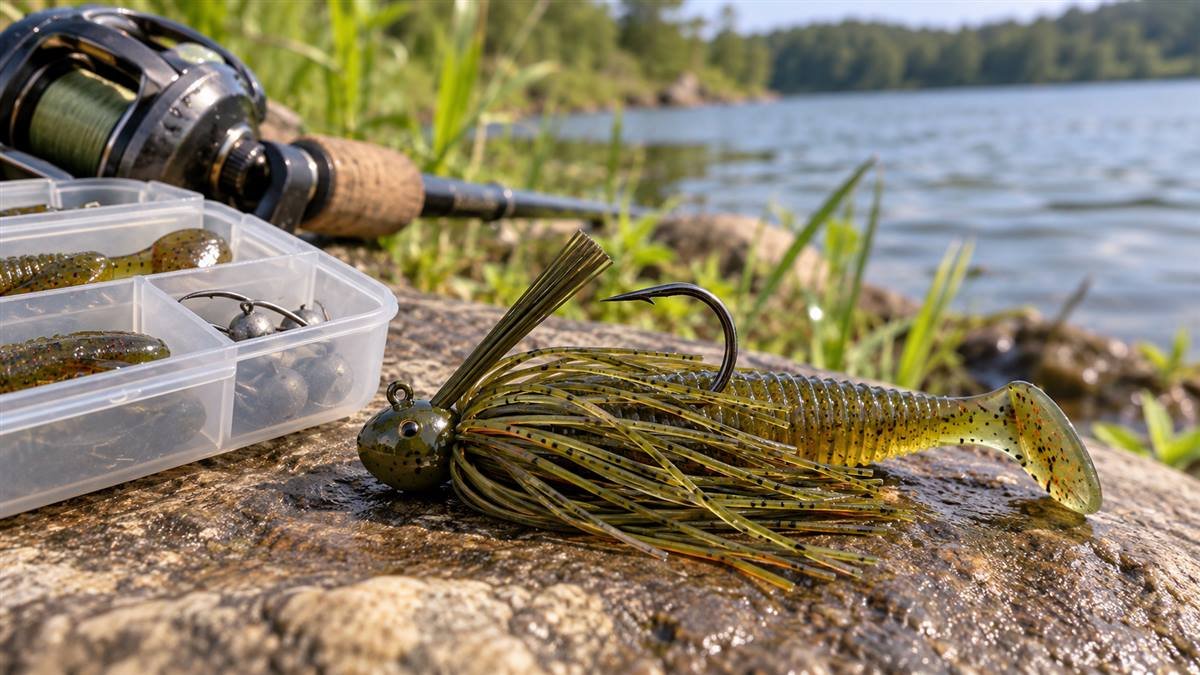
Casting Jig Anatomy
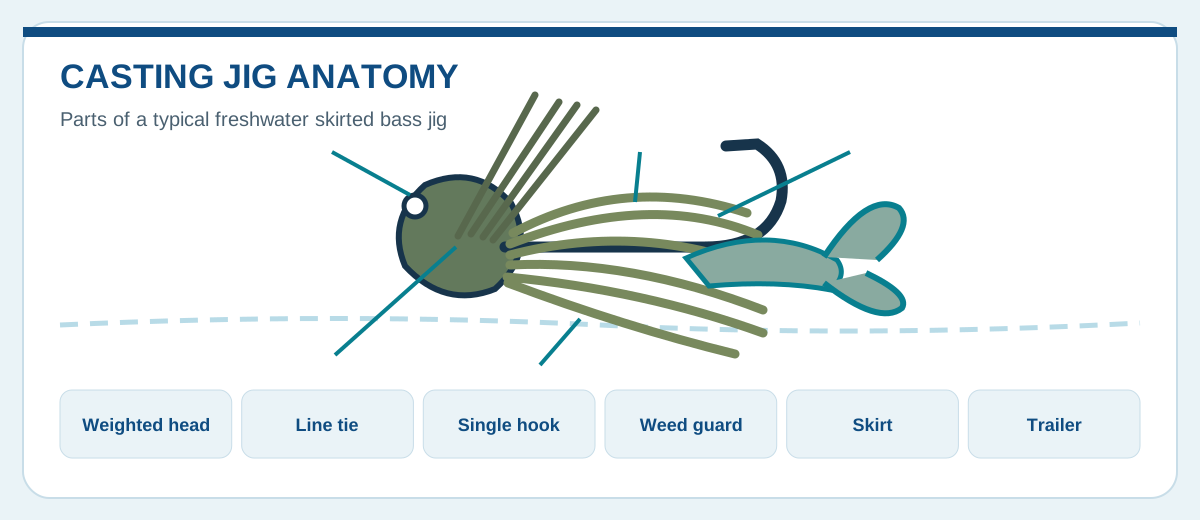
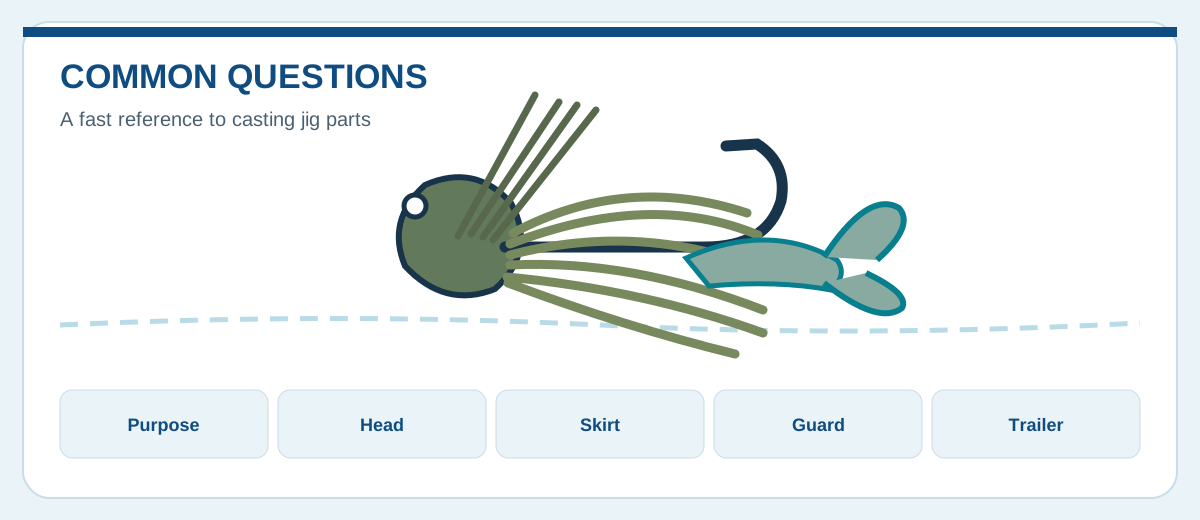
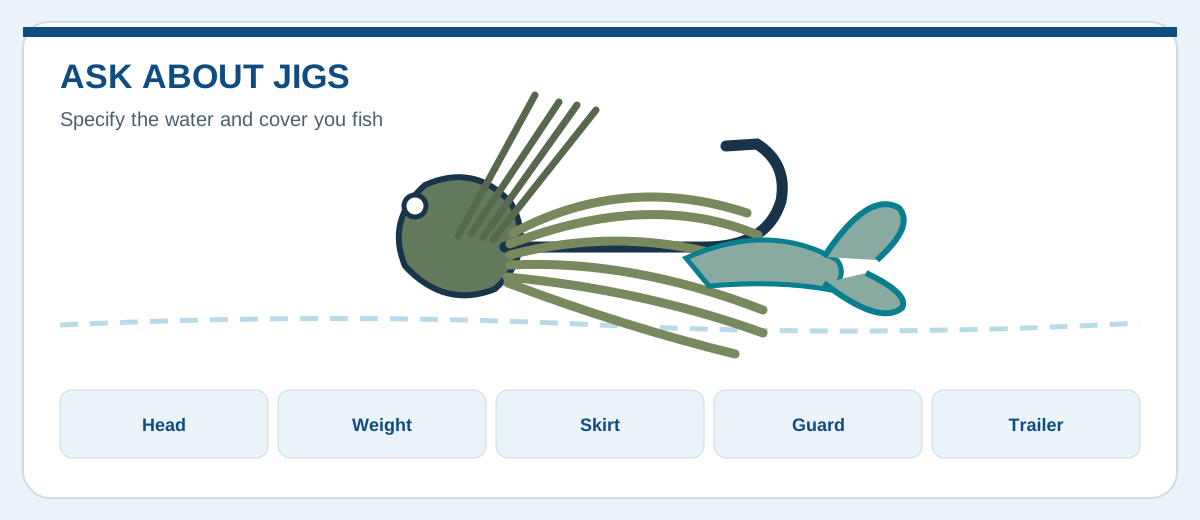
Weighted head. The compact head provides most of the lure’s mass. Lead, tungsten-based compounds, and other materials are used; a denser material can make a similarly weighted head more compact if the design permits. A rounded, teardrop, or Arkie-style form changes how the jig tips, slides, or wedges against cover. It does not make every bottom equally snag-free.
Line tie and hook. The front eye connects the line and influences the pulling angle. A single hook is molded or secured into the head, with its point facing above the skirt. Hook wire and gap should suit the trailer and fishing line. A sturdy hook helps around cover, but a needlessly heavy hook may be difficult to drive home at the end of a long cast.
Weed guard and skirt. Fiber bristles or a similar guard sit ahead of the hook point to deflect some vegetation and wood. The guard bends when a fish compresses the lure; it cannot prevent every snag. Silicone or rubber strands move as the jig falls, rests, and starts again. A collar or hand tie holds the skirt in place; inspect it for slipping or decay.
Keeper and trailer. A molded barb or double-spike keeper helps hold soft plastic on the shank. A craw, creature, compact chunk, or paddle-tail trailer changes bulk, movement, and falling speed. Rig it straight so the jig tracks cleanly. Some anglers fish a bare skirt, but a trailer is common and often improves the intended profile.
| Part | Main job | Check |
|---|---|---|
| Head | Weight and bottom contact | Shape and paint |
| Line tie | Connects the pull | Open or bent eye |
| Single hook | Holds fish | Point and gap |
| Weed guard | Deflects cover | Alignment |
| Skirt and collar | Flexible outline | Secure strands |
| Trailer keeper | Holds plastic | Grip |
| Soft trailer | Profile and motion | Straight rigging |
How a Casting Jig Works Underwater
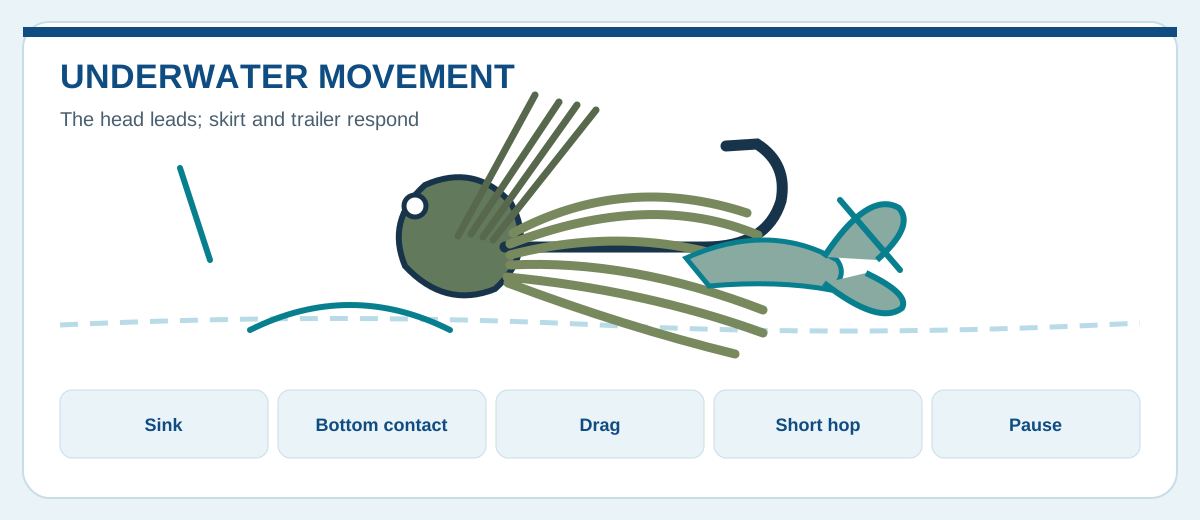
After splashdown, gravity pulls the weighted head downward. The line angle, jig weight, trailer drag, and current determine whether the lure falls nearly vertically or swings toward the angler. A compact trailer may fall more quickly than a broad flapping one on the same head. Watch for line movement or an early stop: a bass can pick up the jig before it reaches bottom.
On bottom, a short rod movement shifts the head across gravel or rock. The skirt may flare when the jig rests and pulse when it moves. A craw trailer’s appendages can move as the jig rises or settles; a straight chunk offers a quieter profile. These motions depend on the specific material and how fast the lure travels. The jig does not create one automatic swimming action by itself.
A drag keeps the head in contact with bottom. A hop briefly lifts it, followed by another fall. Shaking with mostly slack line moves the skirt or trailer without pulling the head far from its spot. A steady reel can swim a suitable casting jig horizontally, though one designed primarily for swimming may track more smoothly through vegetation.
| Phase | Jig behavior | Angler cue |
|---|---|---|
| Fall | Head leads downward | Watch line |
| Contact | Head meets bottom | Feel texture |
| Drag | Head travels near bottom | Maintain light contact |
| Hop | Brief lift and fall | Track the line |
| Pause | Skirt and trailer settle | Check for movement |
Head Shape, Hook, and Weed Guard

An all-purpose casting head often has a compact rounded or teardrop outline. Arkie-style heads are another common example; their flattened surfaces can help some jigs skip or move over mixed cover. Labels are not standardized, and the exact eye position, balance, and hook size matter as much as the category name.
A football head is broader across its sides and can help a jig stand or resist rolling on relatively open rock and gravel. It can also wedge into cracks or snag vegetation. A narrower pointed head is often chosen to move through grass; that does not make it the best option for wood or jagged rock. Compare designs in the intended cover rather than assuming one profile wins everywhere.
The weed guard should generally cover the hook point without blocking it so firmly that a fish cannot compress the guard. Guard stiffness, length, and number of fibers differ by model. A too-stiff guard may reduce hook penetration; a too-weak one may snag more. Any trimming should be conservative and checked against the fishing situation.
| Feature | May help | Tradeoff |
|---|---|---|
| Compact head | Mixed cover and casting | Model dependent |
| Football head | Open rock contact | May wedge in cracks |
| Pointed head | Sparse vegetation | May catch hard cover |
| Lighter hook | Long-cast penetration | Less strength in heavy cover |
| Stiffer guard | More deflection | More pressure to expose hook |
Casting Jig vs Other Bass Jigs

Flipping jig. This is commonly built for short presentations into heavier cover. It often has a stout hook, robust guard, and secure trailer keeper. A casting jig can be pitched to a target, but a lighter or more compact casting design should not be treated as a replacement for a specialized heavy-cover jig in every mat or brush pile.
Football jig. The wide head is often selected for dragging relatively open rock, gravel, or shell. Some football jigs can be cast long distances and used like casting jigs. The distinction is emphasis: bottom contact on open hard structure versus an all-purpose head that can move around mixed targets. A football shape can wedge in tight rock.
Swim jig. Its head and line tie are commonly shaped to travel through vegetation on a more continuous horizontal retrieve. A casting jig may also be swum, especially over sparse grass or along a bank, but a dedicated swim jig may clear stalks and maintain a level path more consistently.
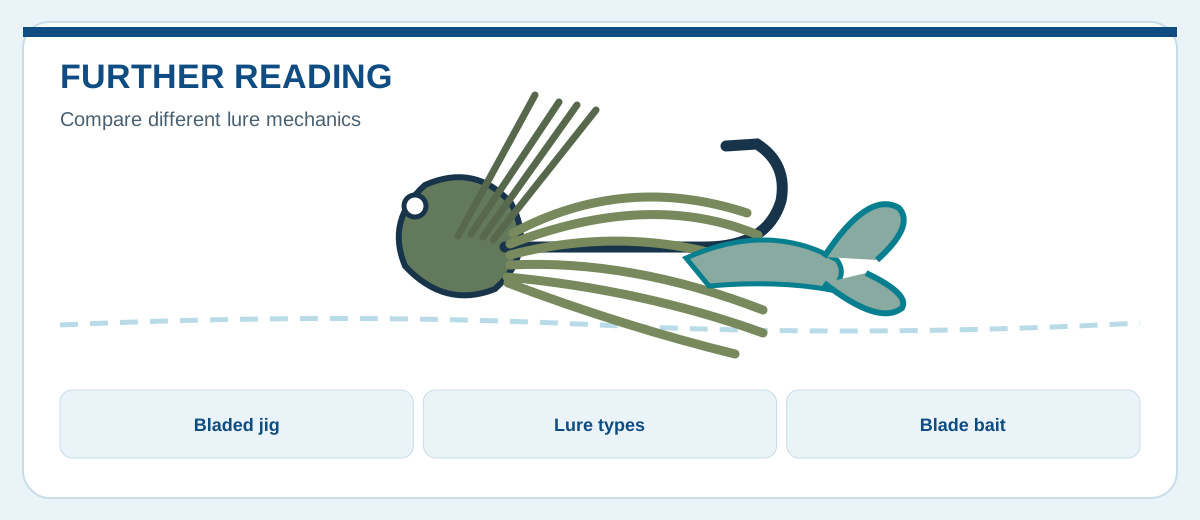
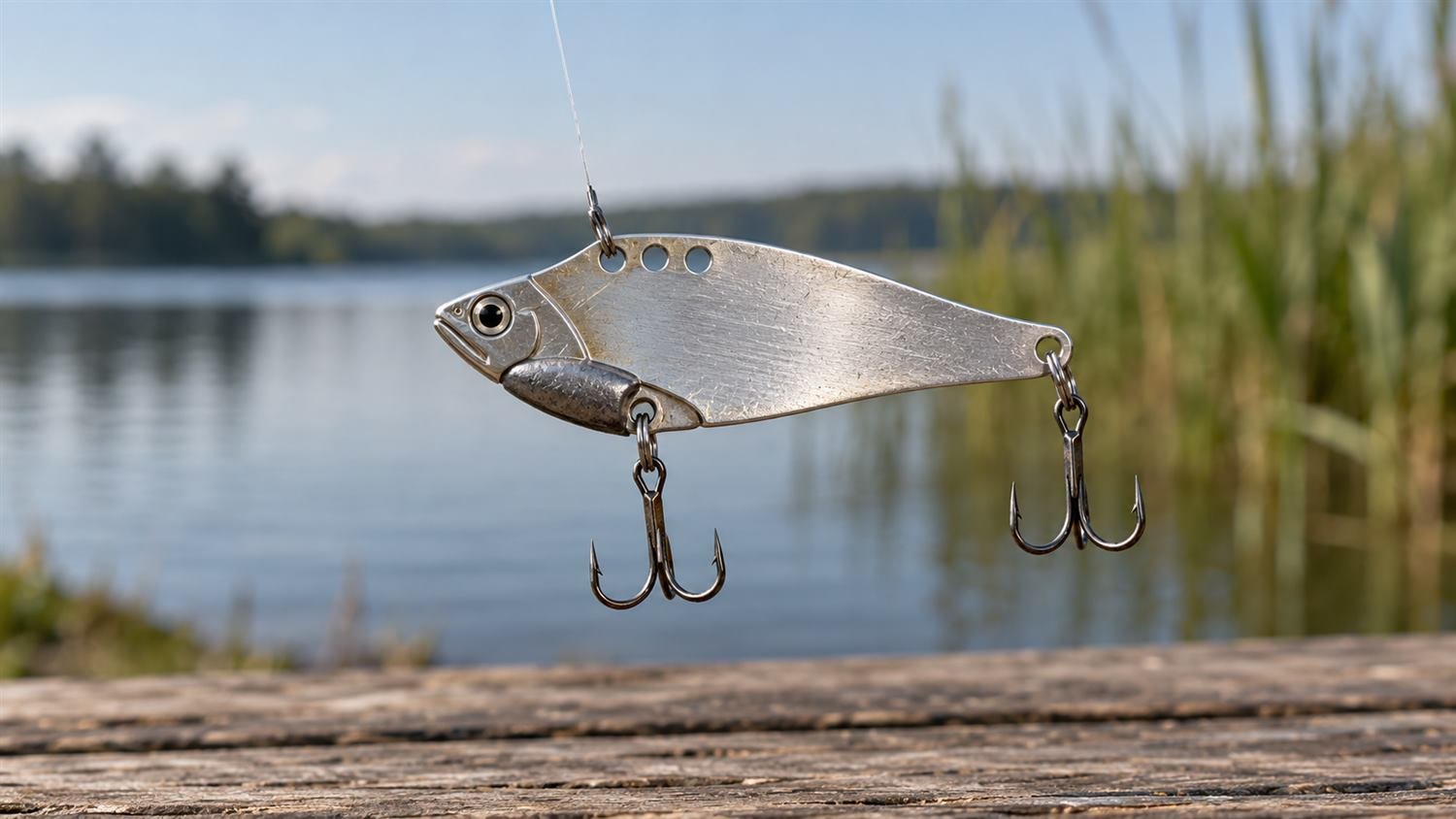
Finesse jig. Smaller profile, lighter weight or hook, and subtler skirt/trailer combinations can help in clear or pressured water. Some compact casting jigs overlap this role. A bladed jig such as a ChatterBait adds a moving metal blade, creating a different vibration source; a standard casting jig lacks that front blade.
| Jig type | Primary emphasis | Typical difference |
|---|---|---|
| Casting | Versatile casting | Mixed presentations |
| Flipping | Dense cover | Stouter build |
| Football | Open rock bottom | Broad head |
| Swim | Horizontal travel | Cover-clearing shape |
| Finesse | Compact subtle profile | Lighter tackle option |
| Bladed jig | Blade vibration | Metal front blade |
How Skirts and Trailers Change Action

Skirt strands expand the jig’s outline and can pulse when the head stops, falls, or changes direction. Silicone commonly offers durable colored patterns, while some round rubber strands flare strongly at rest. A longer or fuller skirt gives bulk; a trimmed skirt can make the trailer more visible. Keep strands clear of the hook point and replace a failed collar before the skirt slides down.
A craw-shaped trailer with modest claws suggests bottom-oriented prey and works well for dragging or hopping. A broad flapping craw or creature bait adds resistance and can slow the fall or increase movement. A compact chunk can keep the silhouette tight when fish are following without taking. These are tendencies, not fixed sink rates.
A paddle-tail trailer can make a casting jig more suitable for a slow horizontal swim and may suggest a small fish. It also adds drag and might alter tracking; rig it straight and test the jig in clear water. Keitech lists a Fat Swing Impact size as a trailer option for its Model I casting jig, illustrating one specific pairing rather than a universal standard.
| Trailer style | Common effect | Useful check |
|---|---|---|
| Compact craw | Controlled bottom profile | Straight fit |
| Flapping craw | More drag and motion | Fall rate |
| Creature bait | Broader silhouette | Snag risk |
| Paddle tail | Horizontal kick | Tracking |
| Flat chunk | Skip-friendly profile | Hook clearance |
Five Casting Jig Retrieves
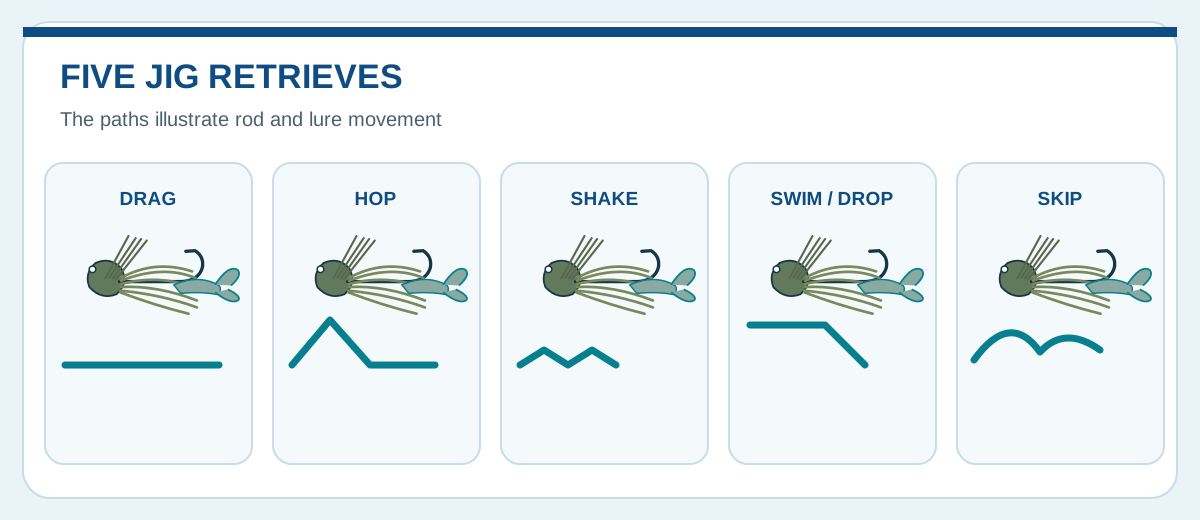
1. Slow drag. Make a cast beyond a point or bottom transition and let the jig reach bottom. Move the rod sideways in short strokes, then take up slack. The goal is to feel bottom while the head creeps forward, not plow continuously into crevices. Pause when it crosses a hard spot or isolated object.
2. Short hop. Lift the rod tip enough to raise the jig a short distance, then follow the fall with controlled line tension. A hop offers a fresh falling presentation without leaving the target area. On rock, large upward snaps can throw the head into a crack or prevent the angler from noticing a bite during the descent.
3. Shake and pause. Keep the jig mostly in place and make small rod-tip movements that shift the skirt and trailer. This can suit a dock post, rock edge, or small opening. Give the lure time to settle; constant shaking may pull it off a productive spot and make bite detection harder.
4. Swim and drop. Reel a casting jig slowly along sparse cover, then briefly let it fall beside a post, grass edge, or depth change. Select a trailer that swims cleanly and a head that tracks without rolling. If the lure repeatedly fouls, try a dedicated swim-jig shape.
5. Skip or target cast. With safe clearance, use a low trajectory and a compact, relatively flat trailer to skip under an accessible dock. Check for people and obstacles first. Skipping requires practice; a controlled sidearm cast to the dock edge is often the better starting move. After landing, watch the fall before moving the jig.
| Retrieve | Main motion | Good first target |
|---|---|---|
| Drag | Bottom crawl | Point or transition |
| Hop | Short lift and fall | Rock edge |
| Shake | Limited movement | Isolated cover |
| Swim and drop | Horizontal travel then fall | Sparse grass or post |
| Skip | Low cast into shade | Open dock gap |
Rocks, Docks, Wood, Grass, and Banks

Rocky banks and points let a casting jig cover several depths on one cast. Work the lure along a contour rather than dragging it blindly across every crack. If it starts wedging, lift slightly or change the angle. A football head may be worth comparing in open rock, while an all-purpose casting head can be useful where rock meets wood or brush.
Docks provide shade, vertical posts, and nearby bottom changes. Cast to the outside edge first, then work toward safe openings. Let the jig fall beside posts; a bite can occur before bottom contact. Under-dock skipping is an option only where the access and casting angle are clear. Avoid striking a person, boat, or dock hardware.
Wood can hold bass but also catches line, hook, and skirt. Approach a laydown from a direction that lets the head move over limbs instead of pulling it under them. A weed guard reduces some contact, not every snag. Sparse grass edges can be dragged or lightly swum; dense matted vegetation is usually a job for a more specialized presentation.
| Location | Initial path | Watch for |
|---|---|---|
| Rocky point | Across contour | Cracks |
| Dock | Post or shade edge | Falling bite |
| Wood | Over limb | Line abrasion |
| Sparse grass | Along edge | Trailer fouling |
| Bank break | Across bottom change | Depth shift |
Cast, Detect Bites, and Set the Hook

Step 1: choose a lane. Identify a point, stump, dock post, or bottom transition and cast a little past it. This gives the jig time to sink before entering the most likely holding area. Stop the spool or close the bail as needed and keep the line controlled enough to see an unexpected jump.
Step 2: follow the fall. A jig may fall on semi-slack line so it descends naturally, but total slack makes a bite easy to miss. Watch where the line enters water. If it stops too soon, moves sideways, or twitches, raise the rod carefully and check for weight. Not every change is a fish; a branch or rock can also interrupt the fall.
Step 3: learn bottom feel. Once the jig reaches bottom, lift slightly, feel the head, then start a drag, hop, or shake. A hard pebble gives a sharp contact; soft bottom feels dull. After a few casts, an unusual steady heaviness or movement becomes easier to recognize. Keep the line away from sharp rock and replace abraded sections.
Step 4: set and control. When the line moves with the jig or pressure feels alive, reel down until slack is removed and make a firm, controlled hookset suited to hook wire and line strength. Sweep or drive through the fish rather than snapping at loose line. Keep pressure during the fight, especially near posts or branches, and inspect the hook point before the next cast.
| Step | Action | Reason |
|---|---|---|
| Target | Cast past cover | Enter lane at depth |
| Fall | Watch controlled line | Notice early bite |
| Contact | Check bottom feel | Find changes |
| Hookset | Remove slack and drive hook | Penetrate guard and mouth |
| Follow-up | Inspect line and point | Keep rig reliable |
When to Use Casting Jigs
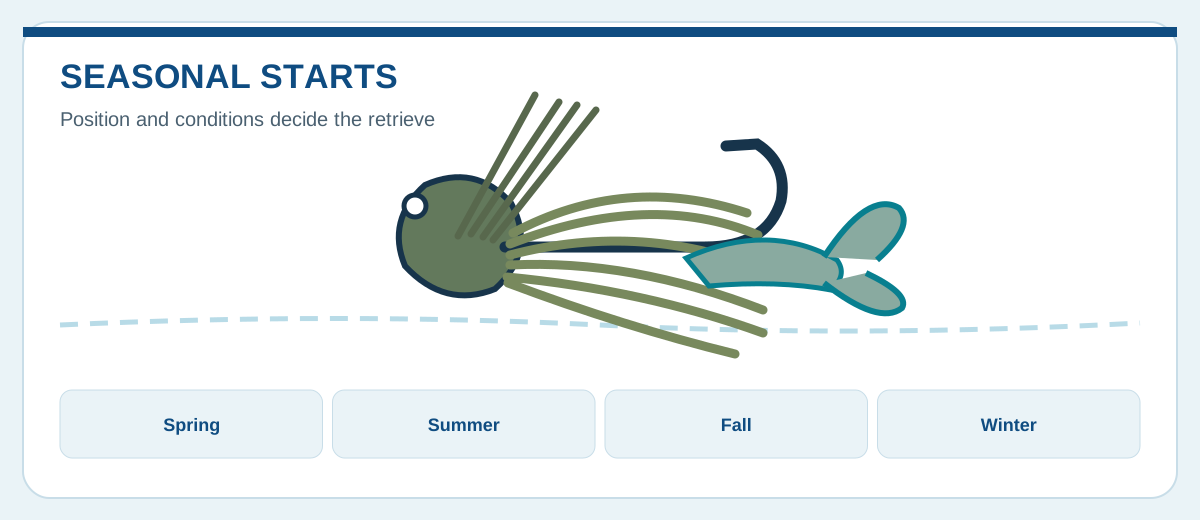
Spring. Cast along warming banks, secondary points, and cover transitions where local rules allow. A compact trailer can be easier for fish to take in cooler water; a longer pause keeps the jig near the target. Avoid disturbing protected spawning areas and follow local seasonal regulations.
Summer. Dock shade, deeper edges, and isolated wood can concentrate fish, while sparse grass offers lanes for a slow swim. If the bottom is deep or wind creates line bow, a somewhat heavier head may help maintain contact. Yet a faster fall is not always desirable; compare trailer drag and jig weight together.
Fall. Baitfish and moving fish may shift toward creek arms, points, or banks. A casting jig with a slimmer trailer can be swum or dropped beside cover. A craw profile still makes sense around bottom-oriented fish. Let actual forage and fish position guide the choice rather than assuming one seasonal color is mandatory.
Winter. Fish can remain near steep structure or hard bottom, depending on the lake. Short drags, small hops, and pauses can keep the lure in the strike zone. In cold, clear water, a smaller profile and longer observation period may be useful. There is no universal cadence: experiment with depth and speed before cycling through many colors.
| Condition | First adjustment | Reason |
|---|---|---|
| Clear water | Natural or compact profile | Subtle presentation |
| Stained water | Contrast and lane | Visibility |
| Wind or depth | Weight and line angle | Contact |
| Cold water | Short moves and pauses | Stay near fish |
| Sparse grass | Swim or drag edge | Cover clearance |
Choose Weight, Color, and Material

There is no universal best casting-jig weight. A 1/4-ounce head can give a slower fall in shallow or calm water. Three-eighths ounce is a convenient middle starting point for many moderate-depth casts; 1/2 ounce can improve bottom contact in deeper water or wind. Three-quarter ounce may suit some deeper or faster-water situations, but the exact choice depends on trailer size, line, current, and cover.
Consider the total package, not just the stamped head weight. A broad craw trailer adds water resistance and can slow descent. A narrow chunk may fall faster on the same head. If the jig blows away from a target, change cast angle or weight. If it plunges through the strike zone before fish can inspect it, try a lighter head or bulkier trailer.
Green pumpkin, brown, and black-and-blue are useful starting colors because they offer natural or contrasting outlines. Match trailer color roughly or deliberately add a small accent. A bright accent may help in some stained-water situations, but a jig need not exactly copy one prey species. Compare one variable at a time so a color change is meaningful.
Lead heads are common; tungsten-based compounds can be denser and more compact at comparable weight, depending on composition. Material cost and local lead rules may matter. Inspect paint durability, hook sharpness, skirt attachment, guard alignment, and keeper quality. An expensive head cannot compensate for a damaged hook or badly rigged trailer.
| Choice | Starting point | Check |
|---|---|---|
| 1/4 oz | Shallow and slower fall | Wind and casting |
| 3/8 oz | Moderate all-purpose use | Bottom feel |
| 1/2 oz | Deeper or windier water | Fall too fast? |
| 3/4 oz | Selected deeper targets | Cover and trailer |
| Color | Natural or contrasting | Clarity and forage |
| Material | Lead or denser compound | Local rules and cost |
Rod, Reel, Line, and Hook Setup

A medium-heavy casting rod with enough tip to load the chosen jig is a common starting point for many bass presentations. Lighter compact jigs may need a lighter rod; heavy cover and stout hooks can require more power. Match the rod to the lure’s total weight, hook wire, line, and the distance to the fish. A single fixed specification cannot cover every jig and cover type.
A baitcasting reel can manage longer casts and quick line pickup, while spinning tackle may suit a light finesse-style jig. Reel ratio alone does not determine speed; retrieve rate also depends on spool diameter and how full the spool is. Choose a setup you can work slowly without losing touch with the jig.
Fluorocarbon is often used for bottom contact; braid offers low stretch and can help around vegetation, sometimes with a leader. The correct line strength varies with cover and hook. Thicker line can create more drag and change the lure’s fall. Check knots, line abrasion, and local fish-handling needs. Do not use a delicate line with an oversized hook and forceful hookset.
| Setup element | Primary job | Check |
|---|---|---|
| Rod | Cast and move jig | Power vs hook |
| Reel | Control line and pickup | Manageable retrieve |
| Line | Transmit feel and withstand cover | Abrasion |
| Hook | Penetrate and hold | Sharpness |
| Trailer | Profile and fall | Straight alignment |
Mistakes, Snags, and Fixes

If the head keeps wedging in rock, change the retrieve angle, lift the jig slightly more, or compare another head shape. Pulling harder often jams it deeper. For a snag, try easing the line and changing direction before using more force, always keeping hooks and sinkers away from people.
If vegetation collects at the guard, clear the bristles and trailer after each cast. A misaligned guard can fail to protect the hook point; a guard that is too stiff may also hinder a hookset. Follow the maker’s advice before trimming. Remember that even a well-adjusted guard is not snag-proof.
Missed bites may come from slack line, a dull point, a trailer covering the gap, an unsuitable hook and rod match, or setting before the fish has the jig. Watch the fall, reel down to contact, and use a firm controlled sweep. If bass follow but do not take, reduce profile, slow the movement, or change depth before assuming the lure is wrong.
After rock or wood contact, inspect the head, hook, skirt collar, trailer keeper, knot, and line. A loose trailer or frayed knot can cost a fish. Replace damaged line and dispose of scraps responsibly.
| Symptom | First check |
|---|---|
| Rock snag | Angle and head shape |
| Grass fouling | Guard and trailer |
| Missed bite | Slack, point, gap, rod |
| Crooked swim | Trailer alignment |
| Trailer slips | Keeper and plastic fit |
Further reading and sources: Wired2Fish on skirted jig techniques, Wired2Fish on head styles, Realtree on casting and other bass jigs, Bassmaster on jig selection, and Keitech Model I specifications. Product examples illustrate variation; they are not independent performance tests.