
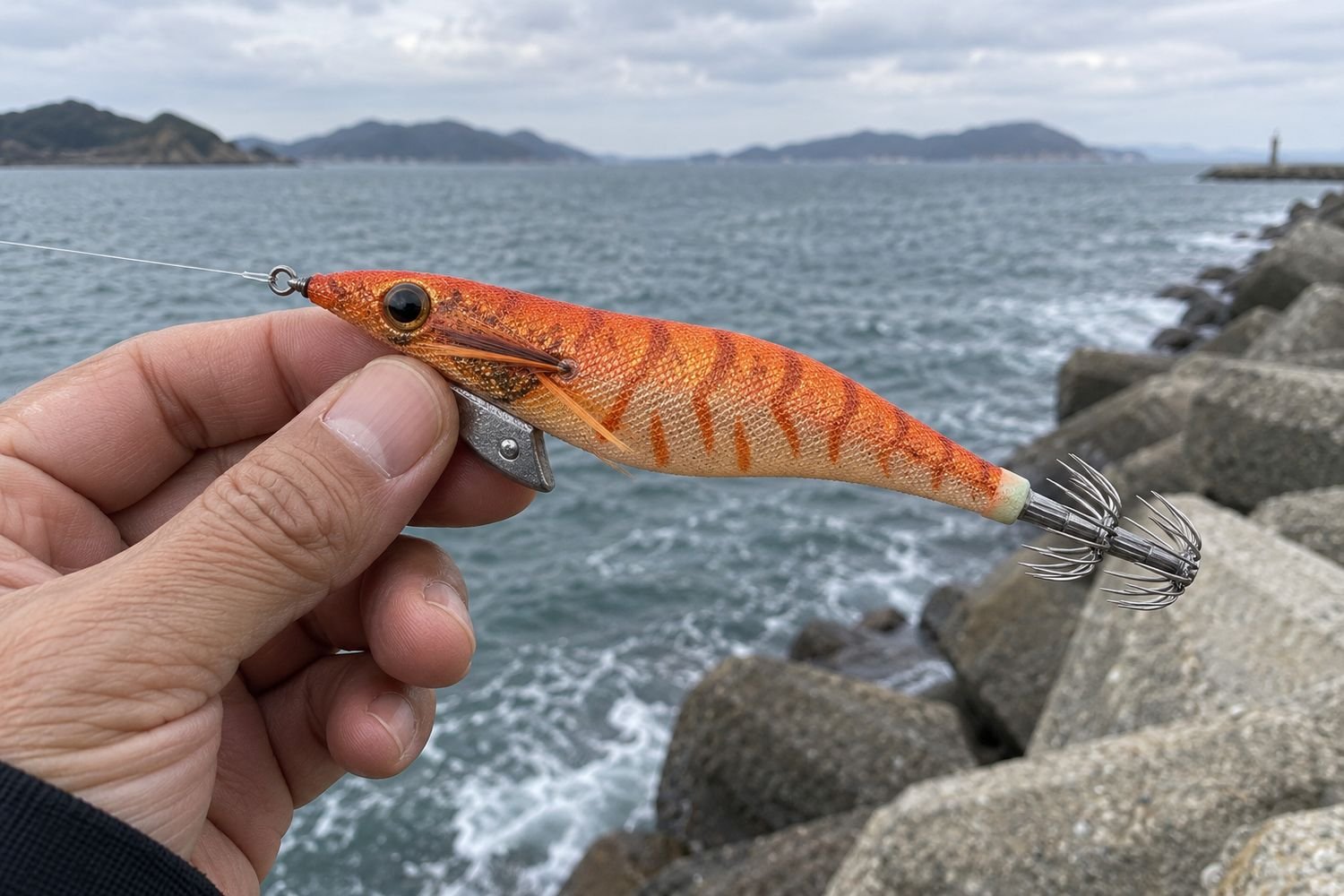
Squid Jig Anatomy

Body and line tie. A typical Egi has an elongated shrimp- or prawn-like shape. Molded plastic, wood, and other materials can form the body. The nose eyelet attaches the line and establishes the direction of pull. A misaligned or damaged connection can change how the lure tracks, so inspect it before casting.
Keel and exterior. The weight beneath the front or middle of the body affects the center of gravity, casting, darting, and fall posture. Some sinkers use lead, others tin or another metal. Cloth, a textured coating, paint, or foil-backed material changes appearance and sometimes how the lure feels when touched. None of these exterior treatments is mandatory for every squid jig.
Eyes, fins, and crown. Artificial eyes add a visual detail, but do not prove a strike on their own. Small side feathers or fins can contribute to silhouette or stability on some models. At the rear, a shaft holds one or two circular rows of fine, usually barbless prongs. These crown hooks are the catching component. Other optional features include rattles, internal reflectors, UV-reactive materials, or luminous sections.
| Component | Primary function | Practical effect |
|---|---|---|
| Body | Prey-like profile | Appearance and movement |
| Nose line tie | Line connection | Pull direction |
| Keel sinker | Low mass | Sink and balance |
| Exterior | Surface finish | Texture and appearance |
| Eye or side fin | Visual detail | Model-specific presentation |
| Crown prongs | Catch retention | Engage squid limbs |
| Reflector or light finish | Visual feature | Changes response to available light |
How a Squid Jig Works
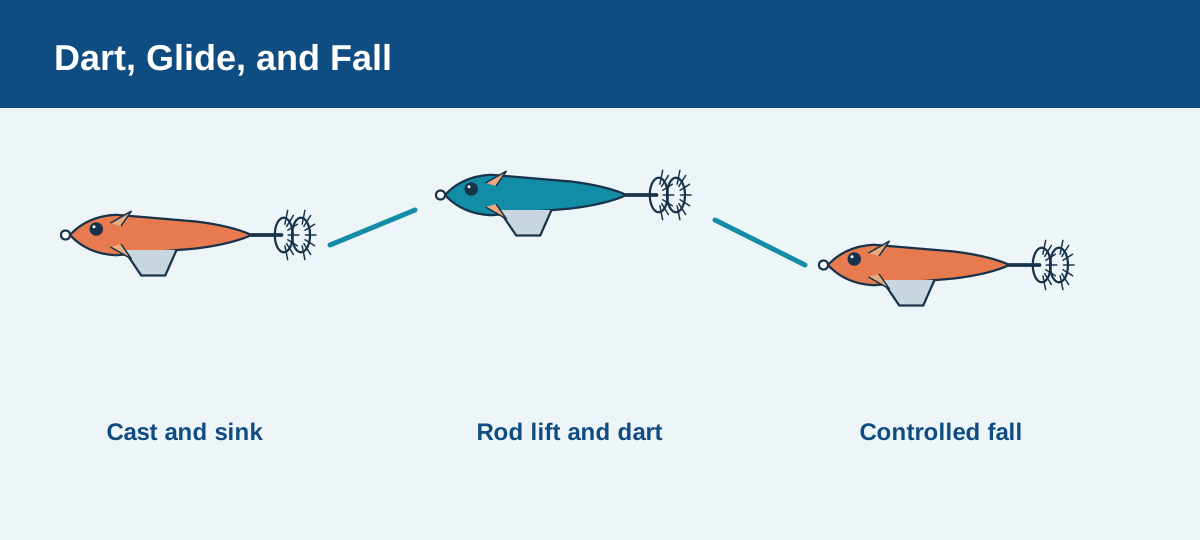
Cast or lower. After entry, a weighted Egi descends according to its body geometry, mass, water resistance, current, and line tension. The keel weight lowers the center of gravity and influences orientation. Some jigs fall near horizontal, some nose-down, and some glide. The manufacturer may publish an approximate fall time, but the water can change it.
Lift and dart. A measured rod-tip lift makes the lure rise; a sharper action can send an Egi to the side, depending on the model. Water pushing around the body, fins, and sinker helps determine its path. The movement can suggest a fleeing prawn, but not every squid jig has an identical dart. The angler should watch or feel a new model near the pier before assuming what it does farther out.
Pause and follow. After the lift, allow the lure to descend through the intended zone. Keep controlled contact so the line reveals a sudden stop, sideways movement, or added weight. Too much slack hides those changes. Keeping the line too tight can drag the jig toward you and change its designed fall. The goal is a watched, repeatable descent rather than a fixed number of seconds on every cast.
A squid can seize the jig at several points in the sequence, including the fall or a slow pause. It may grab with arms or specialized feeding tentacles. The rear crown can engage during that interaction. Maintain smooth pressure after contact; a violent hookset can pull fine prongs free. Check that the crown is clear of line and debris before casting again.
| Stage | What happens | What to watch |
|---|---|---|
| Entry | Jig begins descending | Line angle and fall count |
| Rod lift | Body rises or darts | Clean movement |
| Pause | Jig settles or glides | Subtle line changes |
| Take | Squid contacts lure | Unexpected weight or stop |
| Retrieve | Crown retains squid | Steady line tension |
Why Squid Jigs Have Crown Hooks
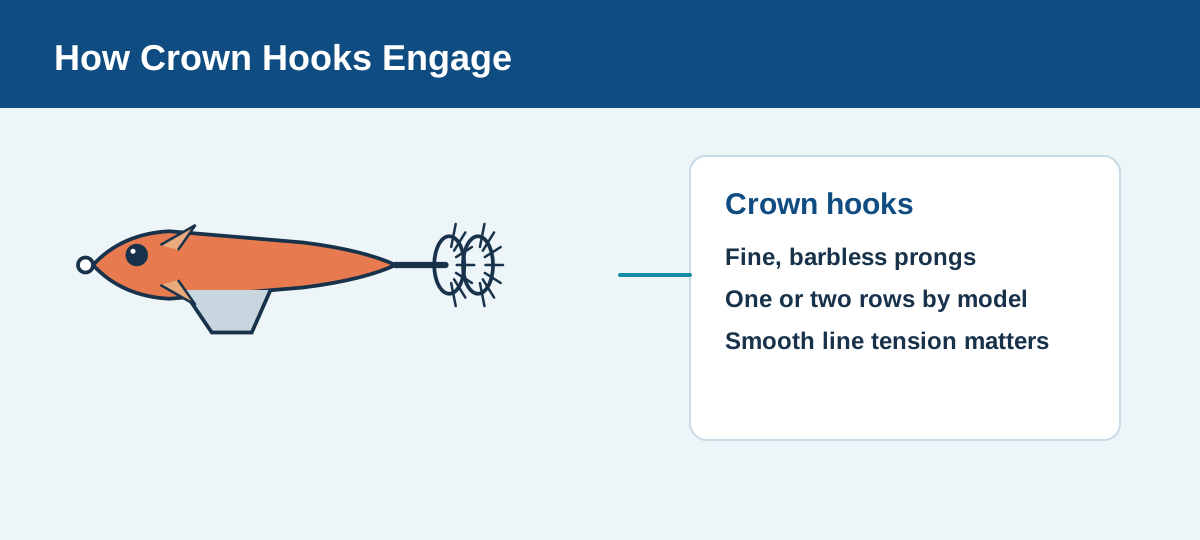
Most traditional squid jigs use a circular arrangement of fine metal prongs at the tail. The points commonly angle backward or upward relative to the lure. They are often barbless. One jig may have a single ring, another two, and a specialized design may have more. A crown is not a treble hook: its many fine points and radial arrangement address an animal that seizes the lure with limbs rather than taking a hook in a fish mouth.
Squid have eight arms and two specialized feeding tentacles. When one grabs the lure, the crown can catch or hold part of those limbs as the angler takes up pressure. A squid can also release or pull free, especially if the line goes slack. The prongs are delicate enough that crushing them, bending them out of shape, or snagging them on a rock can reduce their usefulness.
After feeling unexpected weight, raise the rod smoothly and reel at an even pace. Avoid a hard, sweeping strike intended for a fish with a barbed hook. Keep the squid in the water until it can be landed safely with a suitable net or lift method; large squid and elevated piers require particular care. Point the crown away from hands during removal, and expect possible ink discharge.
| Feature | Squid crown | Conventional fish hook |
|---|---|---|
| Arrangement | Many fine prongs in ring | One or a few hooks |
| Typical barb | Often absent | Often present |
| Main contact | Squid arms or tentacles | Fish mouth |
| Landing priority | Continuous pressure | Species- and hook-dependent |
Types of Squid Jigs

Shore Egi. This common Japanese-style prawn lure is cast from a jetty, pier, beach, or rocky coast. It has a nose line tie, keel weight, and tail crown. The term Eging describes fishing with these lures and associated dart-and-fall techniques. Egi is an important squid jig style, but squid jig is the broader category.
Shallow, standard, and deep versions. These labels mainly describe designed sinking behavior. A shallow model can remain longer above rocks or seagrass. A standard model gives a general-purpose fall, while a deep model can reach a lower layer or resist some current. The labels overlap with lure size; a 3.5 shallow Egi can descend more slowly than a smaller standard model.
Tip-run and vertical jigs. Tip-run fishing is a selected drifting-boat method using a suitable Egi, controlled line angle, and a rod tip that can show a subtle take. Vertical jigs and droppers may be elongated or cylindrical, sometimes fished in a multi-jig rig where permitted. Baited squid spikes are another specialized tool, not simply standard artificial Egi with a different color.
| Style | Typical use | Main distinction |
|---|---|---|
| Shore Egi | Cast and retrieve | Prawn-like dart-and-fall body |
| Shallow Egi | Shallow or snag-prone water | Slower designed fall |
| Deep Egi | Depth or current | Faster designed fall |
| Tip-run Egi | Drifting boat | Boat-specific balance and tip detection |
| Vertical dropper | Boat or pier | Lowered and worked in column |
| Baited spike | Specialty method | Carries natural bait |
Egi Sizes and Sinking Rates
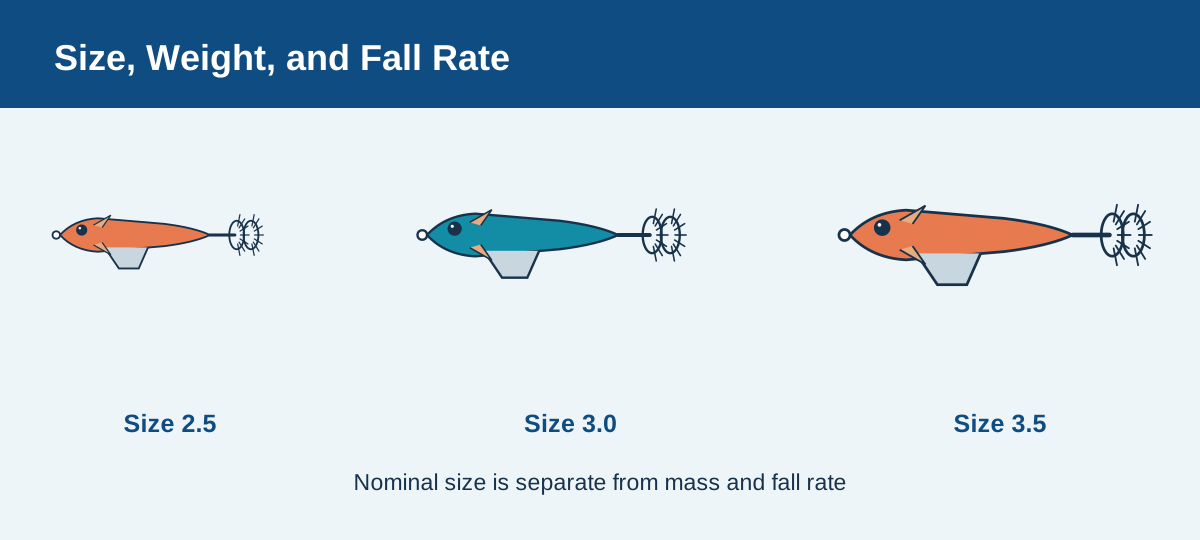
Numbers such as 2.5, 3.0, and 3.5 are nominal Egi size designations. They do not mean 2.5, 3, or 3.5 grams. Check the listed mass separately, along with body length and sinking specification. Larger models often have more mass, but size alone cannot tell you how fast a particular model will fall. Keel shape, body buoyancy, and a shallow or deep variant can change descent markedly.
A fall rate shown as seconds per meter estimates the time a specific jig takes to descend one meter under the manufacturer's test conditions. A higher number means a slower fall: six seconds per meter is slower than three. This is a useful comparison within a product range, not a promise for every cast. Current can sweep the lure sideways; a taut line can slow or redirect it; a loose line can hide bottom contact.
For a first shore setup, compare two models at the same nominal size but different fall profiles. A shallow Egi can provide more viewing time above a snaggy bottom, while a faster design can reach a deeper target before the line drifts far away. A 3.0 may be easy to cast from many piers, but conditions and the target species still decide whether it is suitable.
| Specification | What it means | Common mistake |
|---|---|---|
| Nominal size | Model size class, such as 3.0 | Treating it as grams |
| Weight | Mass of that lure model | Assuming size determines it |
| Seconds per meter | Approximate time to sink one meter | Assuming universal field performance |
| Shallow variant | Designed slower fall | Assuming all 3.5s sink alike |
| Deep variant | Designed quicker fall | Using it over very snaggy shallows |
Colors, UV, Glow, and Flash

An Egi's visible presentation combines outer cloth or paint, any underlying foil, body color, and available light. A reflective surface returns incoming light; it does not store energy. An internal moving reflector can change the angle of that flash while the lure moves or pauses. A textured fabric may alter the appearance in both daylight and artificial light, but its effect depends on the complete lure and the water.
UV-reactive or Keimura materials respond under ultraviolet illumination. They can fluoresce while exposed to suitable light; they are not the same as phosphorescent glow. Glow-in-the-dark material absorbs energy from light and emits visible light for a time after charging. Once it fades, recharge it if that feature matters to your presentation. Ordinary foil needs incoming light to reflect.
Water depth, clarity, time of day, and artificial lighting change what reaches the lure and what an angler can see. A brighter or highly reflective Egi can be easier to track in some conditions, while a muted color can make a different silhouette. Neither proves that squid will strike. Keep at least one natural-looking and one high-contrast option, then compare them at the same depth and cadence before crediting color alone.
| Feature | How it works | When to check it |
|---|---|---|
| Reflective foil | Returns available light | Daylight or pier light |
| Internal reflector | Moves reflected highlights | During movement and pause |
| UV-reactive finish | Fluoresces with suitable UV | Light reaching that depth |
| Glow material | Emits after charging | Dark or low-light tests |
| Cloth or texture | Changes surface appearance | Any visual presentation |
When and Where to Use a Squid Jig

From shore, look for reachable water where squid or their prey may move: jetties, piers, harbor edges, rocky points, seagrass margins, and sheltered bays. These are search areas, not guaranteed squid locations. Current seams and depth changes can help organize a search. A castable Egi lets the angler cover a horizontal path and several layers before bringing it back.
Do not assume every squid stays on the bottom. Begin with a measured fall toward a likely depth, then search above and below it. In clear water, watch for a shape following the jig. Where a pier has lighting, work both the illuminated water and its darker edge if access is safe. Light may concentrate prey or squid in some settings, but species and conditions matter; bright light is not a universal attraction.
Match the sink profile to the environment. Shallow, weeded, or rocky water can punish a fast-sinking crown. Deeper water or strong flow may require more weight, a faster design, or a boat method that keeps a better line angle. When the lure snags repeatedly, move the presentation higher or select a cleaner lane rather than pulling hard against the delicate crown.
| Water | Starting approach | Main risk |
|---|---|---|
| Pier or jetty | Cast across depth changes | Crowding and rail clearance |
| Seagrass edge | Slow fall over vegetation | Crown fouling |
| Rocky point | Work above hard bottom | Snags and footing |
| Sheltered bay | Search with varied sink counts | Fishing empty water too long |
| Drifting boat | Control vertical line angle | Excess current or drift |
How to Fish an Egi From Shore

1. Prepare the jig. Check the nose connection, keel, and every crown point. Remove weed, inspect the leader, and make sure the lure can clear the rail or rocks. Choose a sink profile that can reach the target layer without repeatedly contacting hazardous bottom.
2. Cast and count. Cast into a safe open lane, close the bail, and watch the line as the Egi falls. A manufacturer may list seconds per meter, but count your own fall with the prevailing current and line angle. Stop above the bottom if the crown would snag. Make a note of the count so the next cast explores the same layer rather than starting over blindly.
3. Lift, dart, and pause. Give one or two measured rod movements, recover loose line, and let the Egi sink again. Some models dart strongly; others glide or return more directly. Do not jerk continuously. A pause supplies time for squid to approach and also lets you see subtle line changes. Shorten the lift if the lure rises far above the feeding zone.
4. Detect and land. A take may feel like added weight, an early stop, or a line moving sideways. Sweep gently to remove slack and begin a smooth retrieve. Keep the rod loaded and avoid pumping with sudden slack. Use a landing net when appropriate and be ready for ink. If nothing happens after several consistent casts, change depth, retrieve cadence, position, or jig type one at a time.
| Step | Action | Observation |
|---|---|---|
| Check | Inspect line, keel, crown | No fouling or damage |
| Cast | Reach a clean lane | Safe clearance |
| Sink | Count and watch line | Target depth |
| Work | One or two lifts, then pause | Dart and controlled fall |
| Land | Smooth pressure and net | No sudden slack |
Vertical and Tip-Run Jigging

Vertical jigging lowers one or more squid jigs into a selected part of the water column instead of casting them far from the platform. A pier or boat angler may work a cylindrical jig or dropper gently up and down. The lure's crown and the rig must comply with local limits on gear and number of jigs. A multi-jig line is a separate presentation, not simply several shore Egi tied together without regard to tangles.
Tip-run is a specialized boat method. A suitable Egi is worked during a controlled drift, often near a chosen depth while the angler watches a responsive rod tip for a change in load. Boat movement and current influence line angle and lure posture. A lure designed for tip-run may have different balance and weight from a shore-casting Egi, so use the manufacturer's intended application as a starting point.
In either method, the basic question is where the jig is relative to squid. Lower it to a measured depth, lift it enough to move without leaving the zone, then pause and watch for a take. When multiple jigs are allowed, staggered depth can search more of the column, but line tangles, crowding, and safe handling become more important.
Commercial squid jigging may use powered machines and strings of cylindrical barbless lures. That illustrates the broader meaning of squid jig, but it is not a technique a beginner should copy from a public pier. Recreational rigging must follow the rules and practical constraints of the location.
| Method | Lure path | Key control |
|---|---|---|
| Shore Eging | Cast and retrieve | Sink count and cadence |
| Vertical pier jigging | Mostly up and down | Depth and crowding |
| Tip-run boat fishing | Drifting presentation | Rod-tip load and line angle |
| Commercial jigging | Machine-driven strings | Regulated industrial method |
Rod, Reel, Line, and Rigging

Choose a rod that casts the actual jig weight and lets you control its fall. A responsive spinning outfit is common for shore Eging. A tip that shows load changes helps detect a soft take; enough backbone is useful for moving the lure, but an extremely stiff rod can encourage excessive force. A smooth reel drag and line pickup help maintain tension during a careful retrieve.
Thin braided main line can improve feel at distance, while a suitable abrasion-resistant leader can tolerate contact with rocks and the crown area. Match line strength to the jig, target species, conditions, and local practice. Avoid attaching a bulky snap that interferes with the nose line tie. A small suitable clip or a secure direct knot may work, depending on the lure instructions.
Rig one Egi first. Learn its fall and action before adding droppers or sinker variations. On a pier, confirm that the cast clears other anglers. On a boat, manage drift angle so the lure does not trail too far behind the craft. Any connection that twists, fouls the crown, or makes the lure spin should be corrected before more casts.
Carry a safe storage case for exposed prongs, a landing net suited to the platform, a light when fishing in low light, and footwear that grips wet surfaces. A damaged jig and cut line belong in proper disposal, not in the water. Check local rules before using additional lures or lights.
| Item | Purpose | Check |
|---|---|---|
| Rod | Cast and animate Egi | Matches lure weight |
| Reel | Line pickup and drag | Runs smoothly |
| Main line | Contact and casting | No abrasion |
| Leader | Near-lure protection | Knot and clearance |
| Landing net | Secure catch | Reaches the water safely |
| Jig case and light | Safe storage and visibility | Prongs covered; light charged |
Light, Tides, and Squid Activity
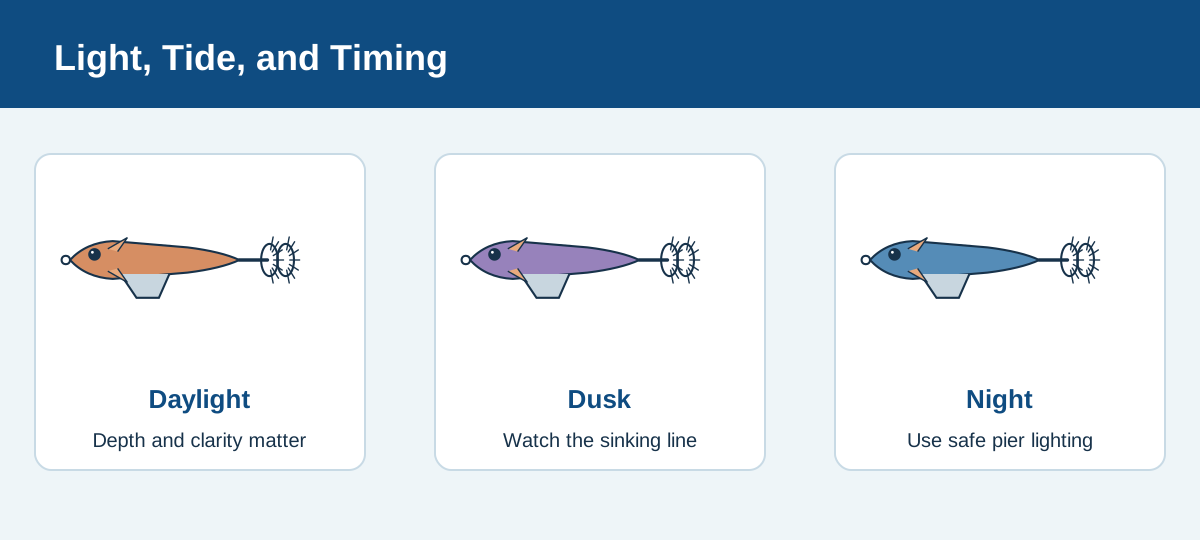
Squid can be targeted by day and by night. Their location and activity vary with species, prey, water clarity, tide, and local habitat. Do not assume all squid feed in the same way or that a lit pier will always outperform unlit water. During daylight, deeper or shaded areas may be worth searching; after dark, some fishable areas near lighting may become active. Observe the water rather than following a universal clock.
Moving tide can carry prey and change how an Egi sinks. Current can also bow the line, making a lure fall slower in practice or shifting it away from the intended track. If the line angle grows severe, shorten the cast, choose a suitable sink profile, or move to a protected position. A calm tide may allow a slower model to stay above structure longer.
Water clarity affects how far a visual cue travels. Reflection needs incoming light; UV-reactive surfaces need suitable ultraviolet illumination; phosphorescent glow must first be charged. The angler's ability to watch the line may matter more than the brightest lure. A colored or visible line section can help reveal a subtle stop, but keep the full rig balanced.
| Condition | First test | What to observe |
|---|---|---|
| Clear daylight | Natural or reflective Egi | Followers and depth |
| Dusk or night | Visible or glow option | Line and light edge |
| Strong current | Suitable faster sink | Line angle |
| Shallow rock | Slow-sinking model | Crown clearance |
| Deeper open water | Controlled vertical or deep Egi | Repeatable target depth |
Mistakes, Safety, and Fixes

Repeated crown snags. The jig may be falling too deep, too quickly, or through unsuitable cover. Shorten the sink count, choose a slower model, or move to a cleaner lane. Pulling violently can bend delicate prongs and leave gear on the bottom.
Unseen takes or dropped squid. Watch the line through each fall. A sudden stop or added weight may indicate contact; respond by lifting smoothly and maintaining pressure. Avoid a forceful fish-style hookset or letting the line go slack during landing. Check crown points for damage after a missed connection.
Unsafe location. Wet rock platforms and jetties can be slippery. Wear appropriate footwear, use sufficient light at night, keep a safe distance from waves, and plan how to land a catch before casting. Crown prongs can injure hands, and a squid may release ink. Handle retained or released animals responsibly and follow local access, permit, size, and bag rules.
Dispose of damaged jigs and fishing line properly. A lure that repeatedly snags, tangles, or spins may be the wrong tool for that water; selecting a safer presentation is a skill, not a failure.
| Problem | Likely cause | First adjustment |
|---|---|---|
| Crown catches bottom | Excess sink or hard cover | Shorten fall; change lane |
| Jig spins | Rigging or damage | Inspect line tie and keel |
| Take not noticed | Unwatched slack line | Track line on each fall |
| Squid comes free | Uneven tension | Retrieve smoothly |
| Unsafe landing | No plan or poor footing | Use safe access and net |