

Wakebait Anatomy
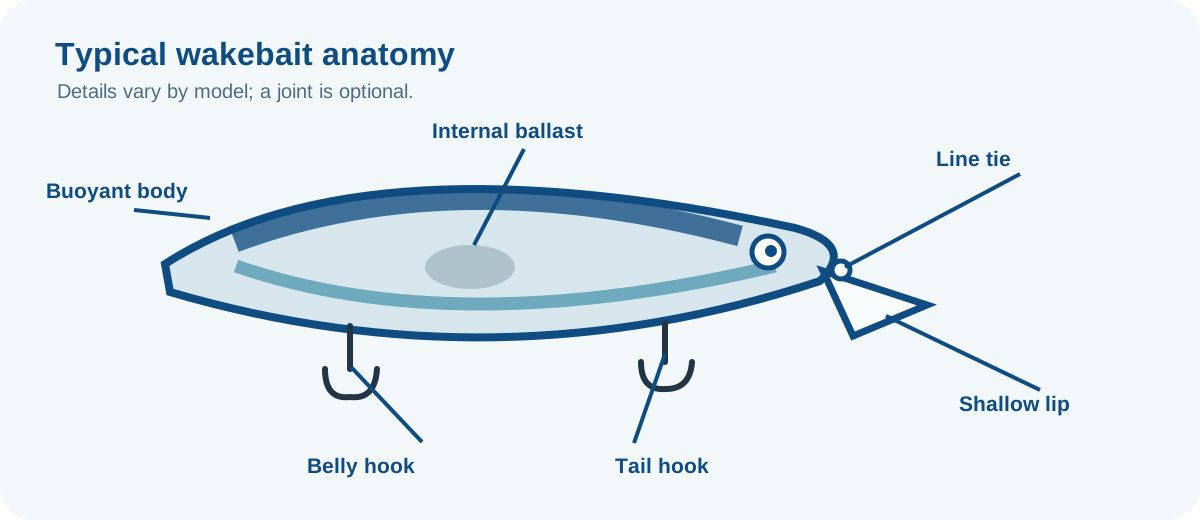
Buoyant body. A floating or highly buoyant body counters the downward pull produced by the line and, on some models, the lip. Material, internal air space, and ballast determine how high it sits at rest. A lure's advertised running depth is only a starting point; test it beside the bank before making long casts.
Shallow lip and line tie. Many wake cranks and minnows have a short, specially angled lip. Water pressure on it starts the wobble, while its geometry limits how deeply the lure dives at the intended retrieve. The line tie transfers pull to the nose or lip. A change in tie position, line angle, or clip can alter tracking.
Ballast and profile. Internal weight helps casting and balance. Broad sides tend to displace more water than a narrow profile, but actual movement depends on the complete design. A jointed section can add segmented swimming; it is optional, not a defining feature. Some bodies rattle, while others are silent.
Hangers and hooks. Check that hook hangers, split rings, and hooks are sound. Exposed trebles hook fish but also catch grass, wood, and line. Replacing hooks with heavier ones can lower the lure and spoil its wake. Match replacement hardware to the maker's size and test flotation afterward.
| Component | Function | Practical effect |
|---|---|---|
| Buoyant body | Supports flotation | Keeps the presentation high |
| Shallow lip | Redirects water | Starts swimming with limited dive |
| Line tie | Transfers pull | Changes tracking and line angle |
| Internal ballast | Balances lure | Changes casting and roll |
| Body profile | Shapes resistance | Changes silhouette and displacement |
| Hooks | Connect fish | Add weight and snagging risk |
| Joint, if present | Adds articulation | Creates segmented swimming |
How a Wakebait Makes a V Wake
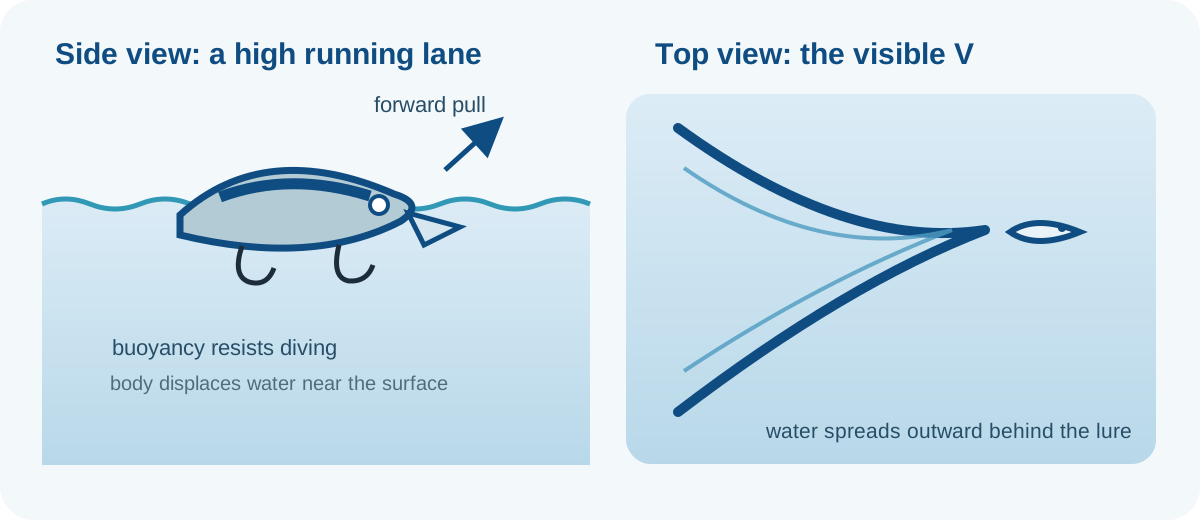
A wake starts with forward movement. As the lure travels, water flows around its lip and body. That pressure can make the body wobble, roll, or glide, depending on the design. Buoyancy resists the diving force. When the body remains close enough to the surface, it displaces water upward and outward. Two diverging surface waves form the visible V behind the lure.
The wake is not a separate motor-like action. It is evidence that a swimming object is disturbing the surface layer. A slightly submerged bait can produce it; the back need not always be exposed. If the lure runs too deep, the surface trace fades even though it may still wobble. A few models intentionally run faster and still wake, so speed limits are model-specific.
Bass may notice the movement, silhouette, vibration, or surface disturbance, particularly when they are already feeding high. None of those signals guarantees a strike. The useful check is visual: after each cast, can you follow a stable V along the intended path? If not, change one factor and watch again.
| Factor | Water or lure response | Fishing effect |
|---|---|---|
| Forward movement | Water meets the lure | Starts swimming |
| Lip and body | Pressure creates movement | Wobble or roll |
| Buoyancy | Opposes descent | Maintains shallow path |
| Surface displacement | Water spreads outward | Forms V-shaped wake |
| Retrieve speed | Changes flow and drag | Alters depth and wake |
| Rod and line angle | Changes pull direction | May raise or lower the path |
Types of Wakebaits
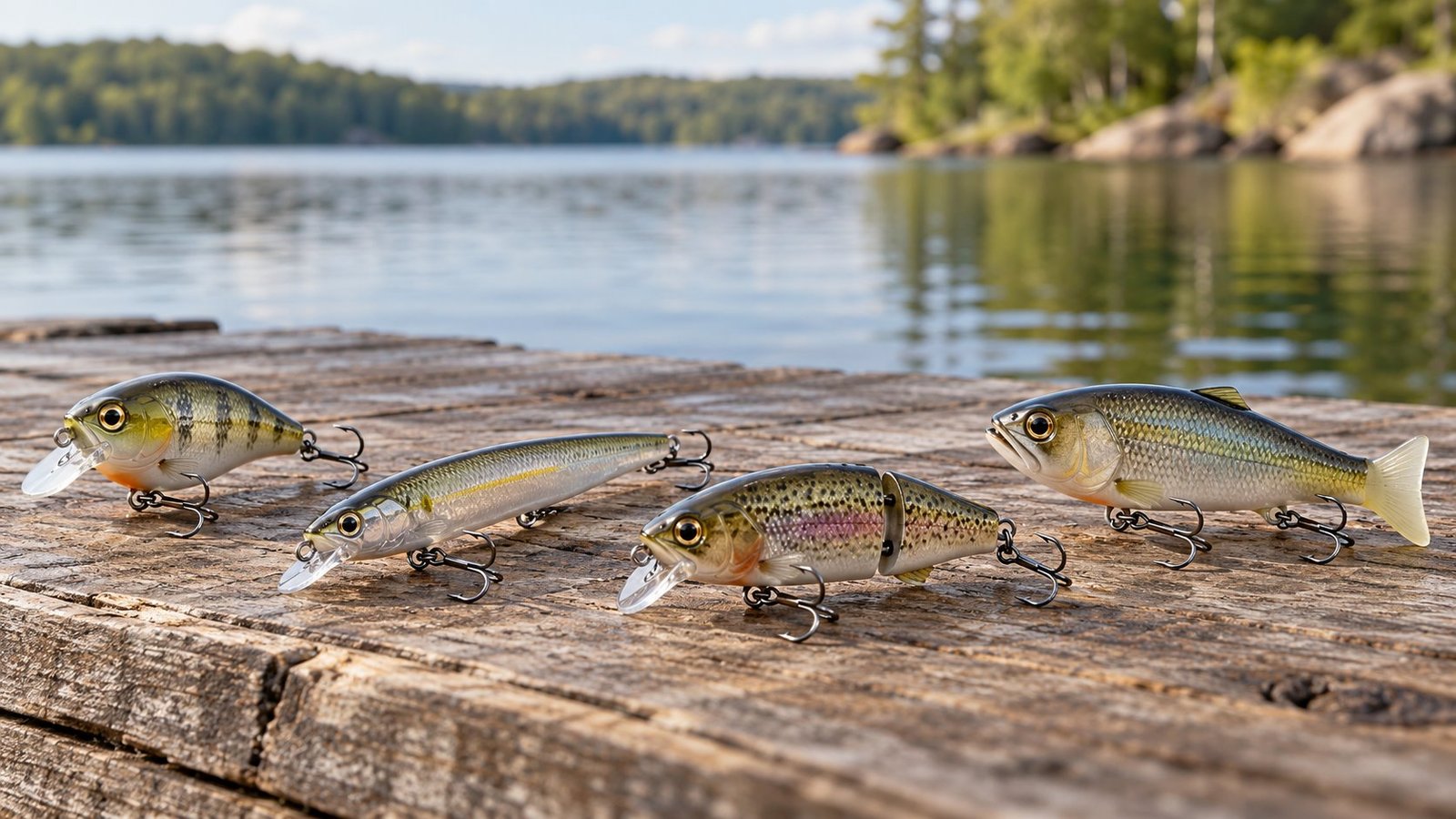
Wake crankbaits have a compact hard body and often a short lip. They can be a convenient first choice around shallow cover because their wobble is easy to feel and see. Minnow wakebaits are longer and slimmer, useful when bass are watching narrow baitfish. They may roll and flash more subtly than a wider crank shape.
Jointed wakebaits use a hinge or multiple body segments to create articulated movement. They can resemble a larger swimming forage fish, but not every jointed bait is designed to wake. Wake swimbaits generally offer a larger, slower profile. Their size, body material, and hook arrangement differ widely, so check the exact model's flotation and action before treating it like a compact wake crank.
There are also specialty designs with props, unusual lip arrangements, or hybrid bodies. Rather than buying by the label alone, inspect the lure's running depth at your normal retrieve. The right type is the one that stays in the desired surface lane and represents the local forage at an appropriate size.
| Type | Common body | Starting use |
|---|---|---|
| Wake crankbait | Compact, buoyant crank | Shallow cover |
| Minnow wakebait | Long, narrow profile | Small baitfish |
| Jointed wakebait | Segmented hard body | Articulated larger forage |
| Wake swimbait | Larger fishlike body | Slow, broad presentation |
| Specialty design | Model-specific | Specific sound or movement |
Wakebait vs Other Lures
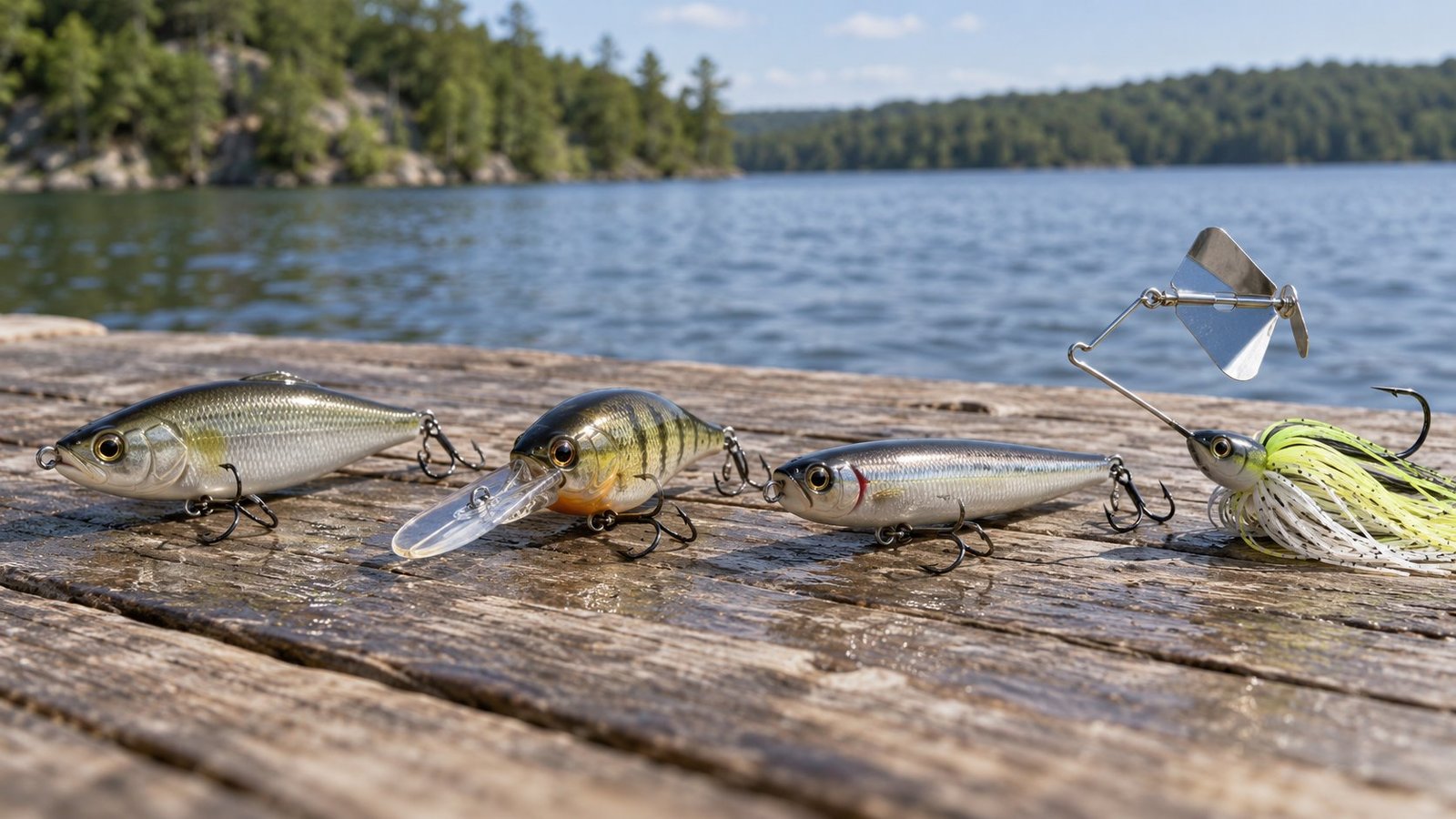
A conventional diving crankbait and a wakebait may share a hard body and diving lip. The difference is their intended running lane: a diving crankbait uses its bill to reach a chosen subsurface depth, while a wakebait is tuned to disturb the surface. Some very shallow crankbaits can be waked by changing speed and rod angle, but their best operating range may still differ.
A walking bait usually sits on the surface and moves side to side after rhythmic rod twitches and controlled slack. A wakebait commonly swims under a continuous retrieve. A buzzbait's turning metal blade provides lift, sound, and splashing; it is normally much noisier than a subtle wake minnow. A popper's cupped face throws water on short pulls, while a frog often has protected hooks for vegetation.
“Topwater lure” is a broad category, so a wakebait can be part of it. Calling it a topwater bait does not mean the entire body always rides above the waterline. Compare the actual action you want: steady swimming, deliberate walking, loud buzzing, or intermittent popping. That decision is more useful than arguing over a single category label.
| Lure | Main mechanism | Typical lane |
|---|---|---|
| Wakebait | Swimming body makes a wake | At or just below surface |
| Diving crankbait | Bill pulls it down | Model-specific subsurface depth |
| Walking bait | Rod twitches and slack | Surface |
| Buzzbait | Turning blade lifts and splashes | Surface |
| Popper | Cupped face pushes water | Surface |
| Hollow-body frog | Floating soft body | Surface vegetation |
When and Where to Use a Wakebait
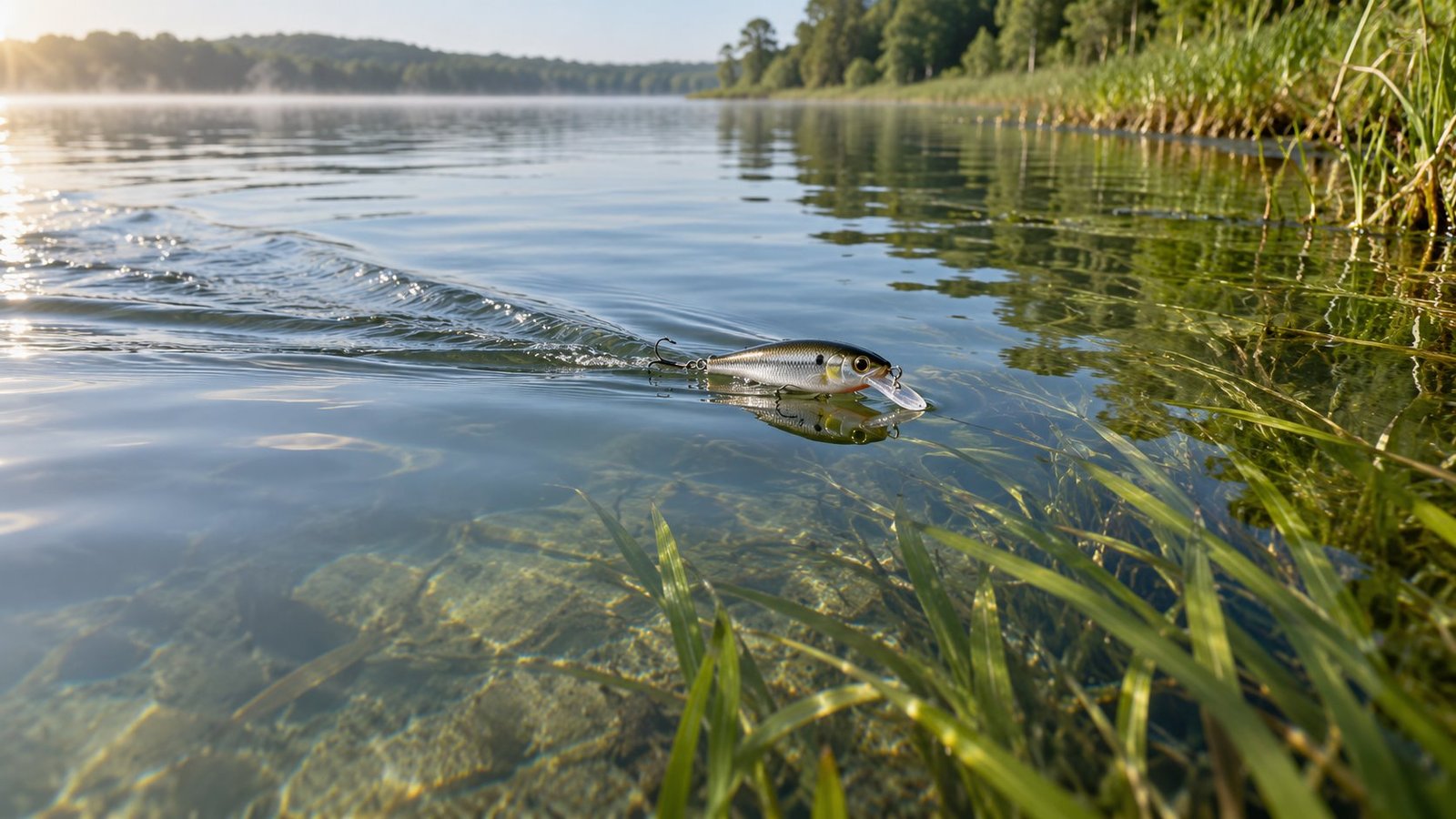
Start where fish can easily see or feel a near-surface target. Submerged grass is useful when there is enough clear water above it for the body and exposed hooks to pass. Run the lure along a weedline rather than straight into dense stems. A parallel cast keeps the bait in the productive lane longer than a cast that crosses the edge at a right angle.
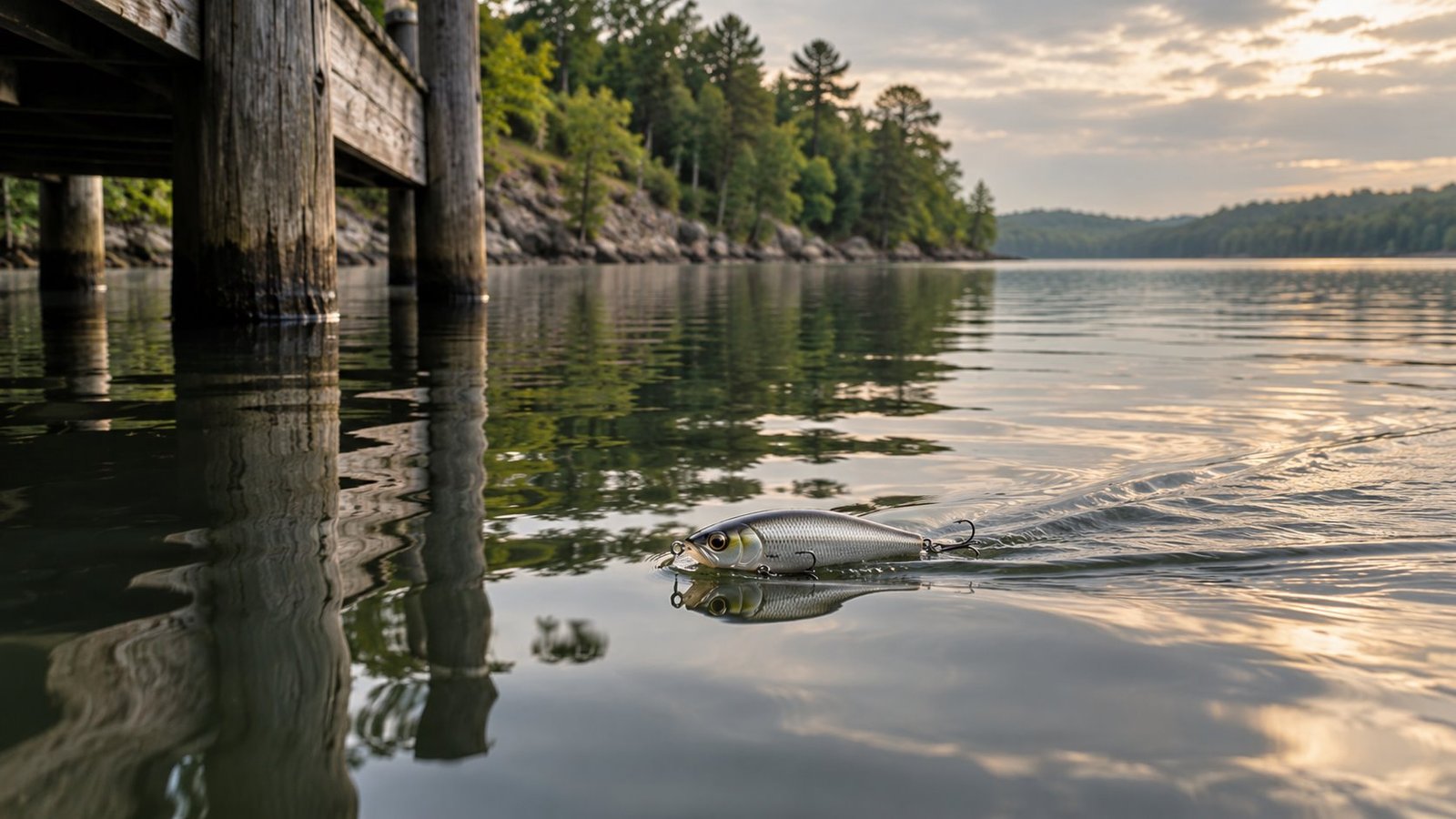
Docks, laydowns, and seawalls provide shade or ambush points. Bring the bait past the outside edge first, then work closer if the route is clear. Shallow flats and creek mouths can be worthwhile when baitfish are present, especially if you see surface activity. On clear-water points, a long cast and natural profile can keep the angler farther from fish that might spook.
Look for evidence, not just attractive cover. A flat with no forage or bass signs may be less useful than a short bank section with visible baitfish. If the lure repeatedly fouls in thick grass, choose a more protected-hook presentation. If fish hold well below the wake, test a lure that reaches them rather than forcing a surface pattern.
| Location | Why it can fit | First approach |
|---|---|---|
| Submerged grass | Open water above stems | Run over grass tops |
| Weed edge | Bass may hold at boundary | Cast along edge |
| Dock | Shade and ambush cover | Track beside posts |
| Shallow flat | Room to search | Make long steady casts |
| Creek mouth | Moving baitfish | Follow visible activity |
| Laydown | Shallow cover | Pass beside clear side |
Seasons and Water Conditions
Spring: Try warming shallow pockets and emerging vegetation when fish move high enough to notice a surface disturbance. A deliberate retrieve can keep the bait over cover without charging past it. Cold fronts may push fish lower, so be ready to change depth.
Summer: Weed edges, shade, docks, and low-light feeding windows can create good opportunities. Bright midday conditions do not automatically rule out a wakebait; the important question is whether bass are active near the top and whether the lure can run cleanly.
Fall: Follow baitfish on flats and around creek transitions. Match forage size before reaching for the largest lure in the box. A long cast across schooling activity can be more effective than dropping a bait directly into the center of the disturbance.
Winter: A wakebait is a situational choice when fish remain shallow or feed upward. Move slowly and test it only where the conditions support that lane. In most cold, deep-water situations, another lure may reach fish more reliably.
Calm or lightly rippled water makes the V easy to see. Wind can mask a small wake, so try a broader profile or a more obvious surface bait if necessary. Water clarity, light, current, and cover all change the picture; no season or weather rule works everywhere.
| Season | Possible opportunity | Starting approach |
|---|---|---|
| Spring | Warming shallows | Slow pass along cover |
| Summer | Shade and vegetation | Steady lane near surface |
| Fall | Moving baitfish | Long forage-matched casts |
| Winter | Selected shallow fish | Very deliberate test |
Five Wakebait Retrieves

1. Slow and steady. Cast beyond the target, let the splash rings settle if fish are cautious, and reel just fast enough for a regular V. This is the baseline presentation. Watch whether the bait tracks straight and stays high throughout the cast, not only near the rod tip.
2. Ultra-slow crawl. On calm water, reduce speed until the lure barely maintains action. Some models lose their wobble if moved too slowly, so find the lower end of that particular lure's working range. The goal is controlled displacement, not a motionless bait.
3. Twitch and pause. Add a short rod-tip movement near a stump, shade line, or open pocket in grass. Pause briefly so a floating lure rises, then restart the V. Keep the movement small; repeated hard jerks turn the presentation into something closer to a jerkbait.
4. Controlled speed change. If fish follow, increase or decrease pace for a few handle turns, then return to the baseline. Certain models wake at a faster clip, but others dive or roll over. Let the lure's behavior decide the maximum useful speed.
5. Parallel to cover. Make a long cast beside a weedline, dock row, or bank. Keep the lure close enough to be seen by fish using cover while leaving space for exposed hooks to pass safely.
Beginner check: Test the lure beside the bank, make a long cast, watch the V, keep the line under control, and change only one variable at a time.
| Retrieve | Good starting situation | Main cue |
|---|---|---|
| Slow steady | General search | Hold a stable V |
| Ultra-slow crawl | Calm, subtle conditions | Move just fast enough |
| Twitch and pause | Isolated target | Restart the wake |
| Speed variation | Following fish | Stay within lure range |
| Parallel cover | Weedline or docks | Keep bait beside cover |
How to Control Running Depth

Retrieve speed is the first variable to test. Many shallow-lipped baits dive farther when pulled faster because water pressure on the lip increases. But there are purpose-built high-speed wakers, so observe the lure rather than assuming all designs respond alike. Slow the reel until the back approaches the surface and a wake appears.
Rod position changes the line's pull angle. A higher tip can help some baits stay high, particularly on shorter casts. A low tip can pull some models deeper. Experiment with modest changes; an extreme high rod position reduces control and can make a hookset awkward. Line choice matters too. Floating monofilament or suitable braid often suits a surface lane; a dense sinking line may pull a small lure down.
The lure itself sets limits. Extra-heavy hooks, oversized split rings, or water inside a damaged body can lower its flotation. A larger lip or different ballast may simply make a particular lure run too deep for the intended technique. If a bait never forms a stable V, choose one built for waking instead of fighting its design.
| Factor | Possible effect | Practical test |
|---|---|---|
| Faster retrieve | Some models dive | Slow down |
| Higher rod tip | May lift running lane | Raise modestly |
| Lower rod tip | May deepen path | Change angle |
| Buoyancy | Resists diving | Check model and damage |
| Heavier hooks | Can reduce flotation | Use correct size |
| Line density | May alter pull | Compare suitable line |
| Lip geometry | Sets dive tendency | Choose true wake model |
Size, Color, Profile, and Sound

Match size to the forage you actually see. A compact bait can imitate small shad and be easier to keep in a quiet lane. A larger jointed or swimbait-style lure can present a bigger target, but it also demands suitable tackle and room to swim. Bigger does not automatically mean better bass.
In clear water with shad, a natural silver or translucent bait is a sensible first try. A bluegill profile may fit waters where sunfish are common. Dark silhouettes can remain easy to see against a bright surface from below, especially in low light, but local results vary. Consider the bait's underside as well as its side finish.
Body width and action matter alongside color. A broad bait may push more water; a slender minnow can be quieter and more restrained. Rattles are an option, not a rule. Try silent or subtle models around pressured fish, and compare sound only after the lure is running in the correct zone. A lure that dives out of sight is the wrong test of color.
| Situation | Starting choice |
|---|---|
| Small shad present | Compact silver minnow |
| Bluegill forage | Sunfish-shaped profile |
| Larger baitfish | Larger jointed or swimbait style |
| Calm clear water | Subtle wake and natural finish |
| Low visibility | More noticeable profile or sound |
| Heavy vegetation | Consider protected-hook alternative |
Rod, Reel, Line, and Hooks

A medium or medium-heavy rod that matches lure weight is a practical starting point. With treble hooks, a moderate or moderate-fast action can help absorb sudden lunges. Very large wake swimbaits may need heavier dedicated tackle. Use a reel that lets you hold a consistent slow pace without repeatedly starting and stopping by accident.
Monofilament floats and offers some stretch, making it a common choice for trebled surface baits. Braid also floats and can help around vegetation, but its low stretch asks for a more forgiving rod and restrained hookset. Some anglers use other lines successfully; test whether the chosen line changes the lure's running lane. Leader and knot strength still matter.
Inspect hooks after wood, rock, or a fish. Sharp points and appropriate size help, but heavier replacements may make the bait sink or roll. If you change hardware, test the lure beside the bank before fishing it again. There is no one rod length, reel ratio, or line strength that fits every wakebait size and cover type.
| Equipment | Starting consideration | Purpose |
|---|---|---|
| Lure | Floating compact or medium model | Learn a stable wake |
| Rod | Medium or medium-heavy | Cast and control |
| Action | Moderate or moderate-fast | Protect treble hookups |
| Reel | Controlled steady cadence | Maintain running lane |
| Line | Floating mono or suitable braid | Match cover and depth |
| Hooks | Model-appropriate size | Keep balance and sharpness |
Why Bass Strike and Miss Wakebaits

A near-surface fish may track the lure's silhouette, its swimming rhythm, and the pressure wave it pushes through the top layer. A bass holding beside grass or dock shade can move upward to inspect a bait crossing its lane. That is a possibility, not a promise: fish that are deep, inactive, or focused on different forage may ignore it.
Surface strikes are dramatic but can be poorly aimed. A swirl behind the bait may mean the fish missed the hooks. If you immediately jerk at the splash, you can pull the lure away before it takes weight. Keep reeling until you feel a solid load, then sweep rather than striking violently. Maintain a bent rod and steady pressure during the fight.
When bass repeatedly follow without committing, change one factor. Try a slower wake, a brief pause near cover, a smaller profile, or a different line of travel. If they strike short, a controlled second cast through the same path can help. If they consistently ignore the surface, switch to a lure that reaches their actual holding depth.
| Observation | Possible reason | What to try |
|---|---|---|
| Follows only | Wrong size or cadence | Change one factor |
| Swirl without load | Missed hooks | Keep control and recast |
| Strike behind bait | Short strike | Vary cadence or profile |
| Fish comes unhooked | Poor contact or slack | Keep steady pressure |
| No surface response | Fish may be deeper | Change depth or lure |
Common Mistakes and When to Switch
The most common mistake is assuming that a shallow lure is automatically waking. If you cannot see the V in suitable light, slow down, raise the rod slightly, or test a more buoyant model. A second mistake is reeling so hard that the lure rolls sideways or blows out. Check whether the line tie and hooks are straight before blaming speed alone.
Do not force exposed trebles through a dense grass mat. Fish the open side, a lane between clumps, or the water above submerged stems. Similarly, a wakebait beside a laydown is not snag-proof. Plan a path past branches rather than through them. Save a pause for a clear pocket where the lure can rise without fouling.
Switch presentations when your observations point elsewhere. If bass feed aggressively on the surface, a buzzbait or walking bait may provide more commotion. If they follow but refuse a loud lure, a smaller silent wakebait may fit. If sonar, catches, or visible fish show a deeper zone, use a diving crankbait, swimbait, or another depth-appropriate lure. Treat the wakebait as one tool, not the default answer to every shallow-water problem.
| Problem | Likely cause | Response |
|---|---|---|
| No visible V | Running too deep | Slow down or lift rod |
| Sideways roll | Speed or tracking | Check tie and reduce speed |
| Grass on hooks | Path too close | Use open lane or switch |
| Follows without strike | Size or cadence | Change one variable |
| Fish far below | Surface lane misses fish | Reach deeper |
| Repeated misses | Timing or pressure | Wait for load |
- Keep waking when the bait tracks near the top and fish respond.
- Change the presentation when the wake is right but fish only follow.
- Change the lure class when cover or fish depth makes the surface lane unsuitable.


