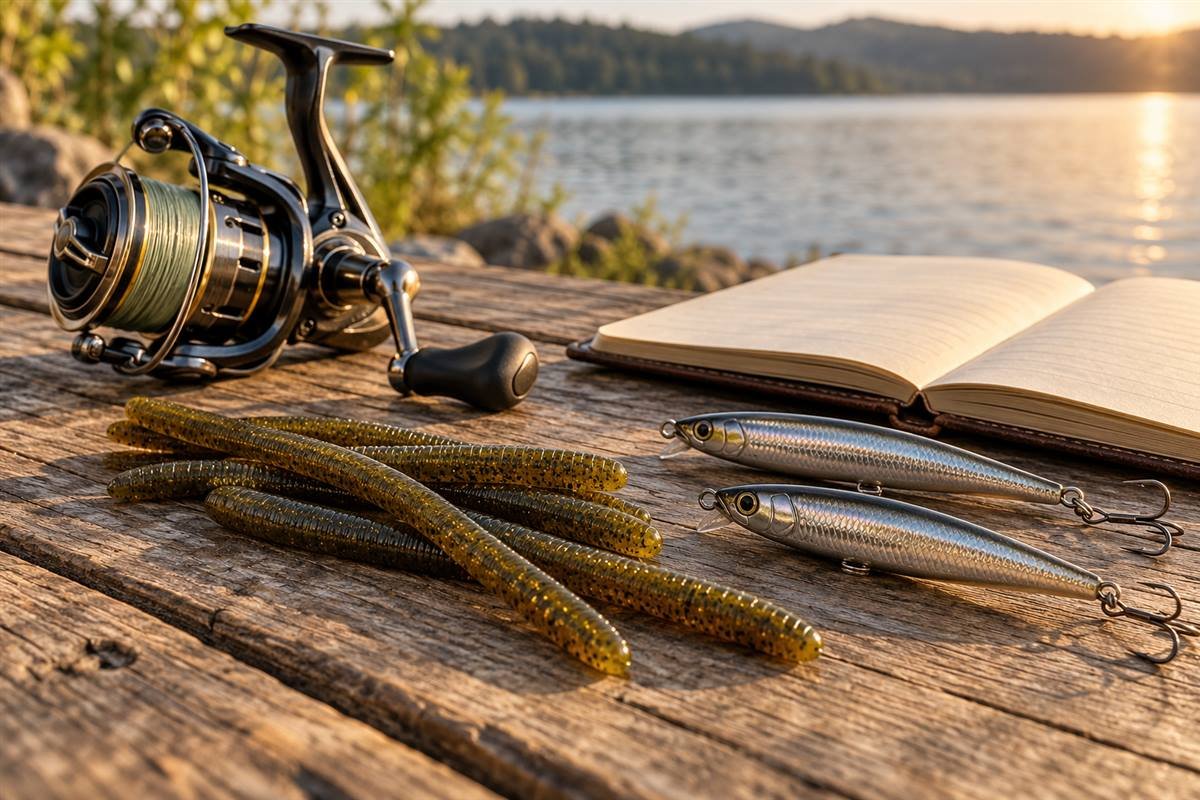

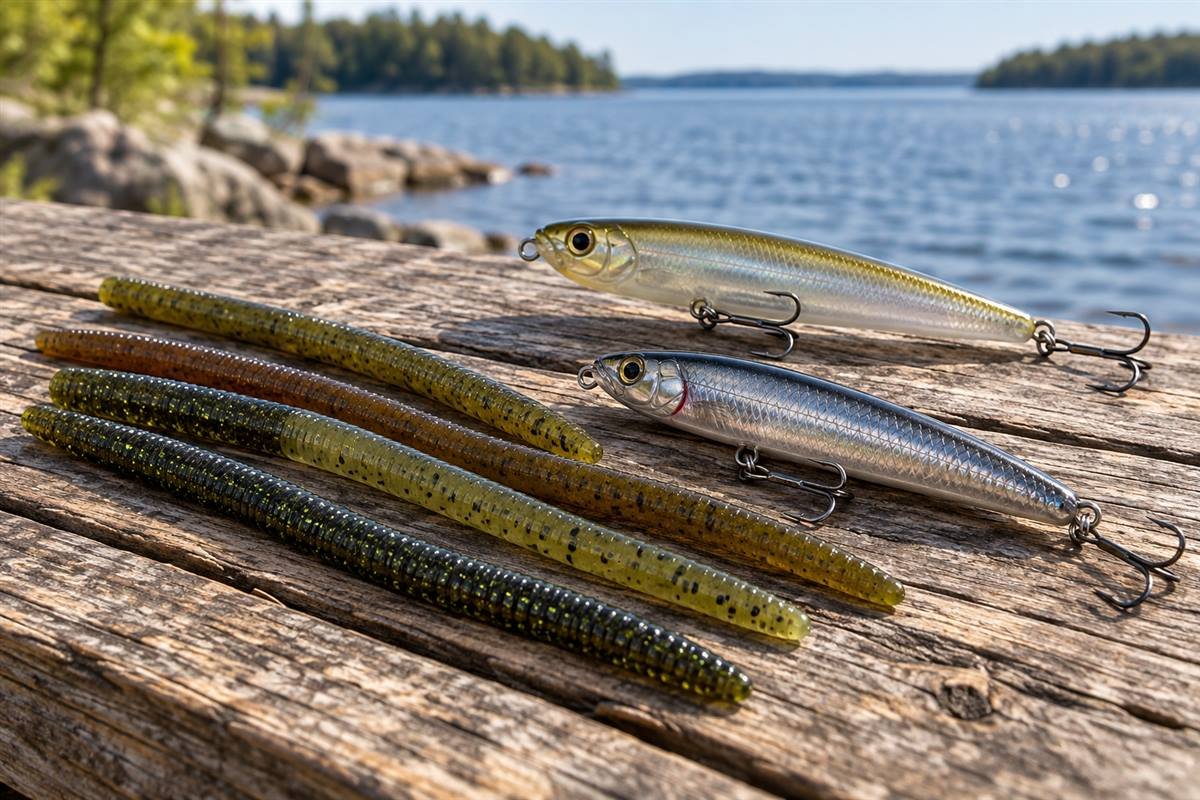
Types of Stickbaits: Soft, Floating, and Sinking

The word groups lures that share a lean profile but differ in construction and fishing depth. Check the actual packaging or test the lure at the water's edge: a hard bait that looks identical to another may be built to float, suspend, or sink.
Soft-Plastic Stickbaits
These flexible, straight-bodied worms are threaded or hooked on a separate rig. Many bass anglers cast them beside docks, grass edges, or isolated cover and let the bait fall. Some formulations shimmy as both ends move; others have a quieter glide. Hook placement and added weight matter as much as the shape.
Floating Hard Stickbaits
A buoyant pencil or walking bait remains at the surface. Short, rhythmic rod-tip movements with a little controlled slack can make its nose alternate left and right, a retrieve called walk-the-dog. These hard lures often use exposed treble hooks and fit open surface lanes better than dense vegetation.
Sinking Hard Stickbaits
Added ballast gives these rigid baits access to fish feeding below the surface. Depending on design, they may sink level, nose-first, or with a flutter, then dart or glide when worked. Saltwater anglers cast some models toward moving baitfish schools, but smaller versions can also work in freshwater.
| Type | Material | Main action | Typical application |
|---|---|---|---|
| Soft-plastic stickbait | Flexible soft plastic | Fall, shimmy, glide | Freshwater bass |
| Floating hard stickbait | Hard plastic or wood | Surface walk or glide | Surface-feeding predators |
| Sinking hard stickbait | Weighted hard body | Dart, glide, sink, flutter | Subsurface feeding |
Anatomy of a Soft-Plastic Stickbait
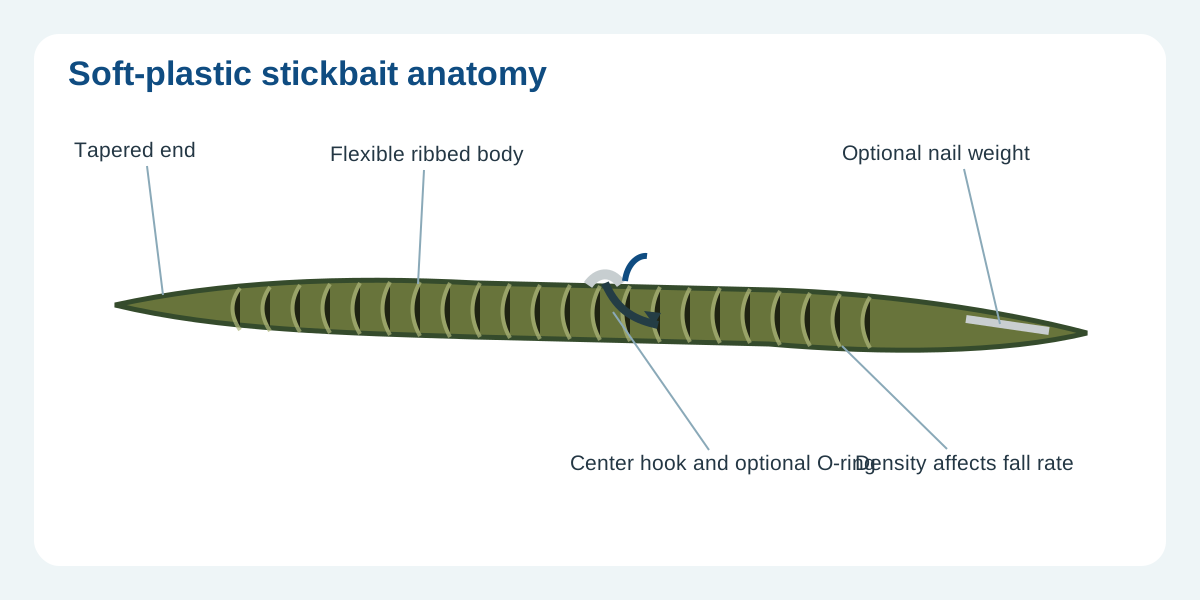
A soft stick worm is often nearly straight, with gently tapered ends rather than a large tail. Its length and thickness determine how much profile it shows and how much water it resists. The flexible material bends under gravity, current, and small rod movements. Smooth, ribbed, and lightly textured surfaces are all common; texture is a design detail, not proof of one particular action.
Material formulation can change density. Salt and other additives may make a worm sink faster or flex differently, but not all soft stickbaits contain the same blend and they do not share one buoyancy. A hook through the center gives a wacky rig two free ends. A hook laid lengthwise creates a more streamlined Texas-rigged profile. A small nail weight in one end makes a Neko-style bait fall nose-down. An O-ring can hold a center hook while reducing wear on soft plastic.
Keep the lure distinct from its rig. The worm itself is the body; the hook, O-ring, nail weight, line, and optional sinker are separate tackle choices. Change one at a time to learn whether a slower fall or different angle draws more attention. Replace a torn bait when it no longer hangs straight or stays on the hook.
| Property or component | Function | Fishing effect |
|---|---|---|
| Soft body | Flexes during movement | Subtle action |
| Tapered ends | Shape the profile | Can influence fall |
| Body thickness | Sets volume and resistance | Changes profile and sink |
| Material density | Sets weight and buoyancy | Changes fall rate |
| Hook position | Orients the rig | Changes presentation |
| Nail weight | Adds localized mass | Nose-down fall |
| O-ring | Retains center hook | Can reduce tearing |
Anatomy of a Hard Stickbait: Body, Weight, and Hooks
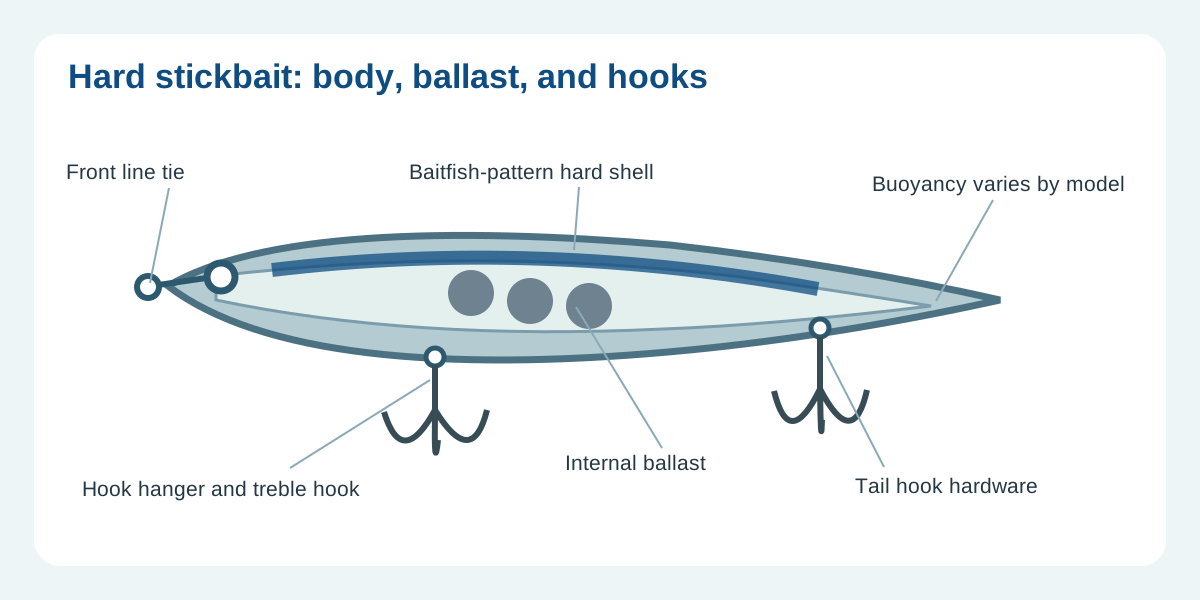
A hard stickbait has a rigid, elongated shell that resembles a small baitfish. Makers use plastic, wood, or other materials, and the body's shape determines how water presses against it. A line tie near the nose connects leader or line; its position and tension can alter how freely the lure turns. The internal ballast may favor long casts, a level rest, a head-down descent, or a particular swimming response.
Hook hangers hold trebles or replacement single hooks. Their size and weight affect balance, so changing hooks can change buoyancy and action as well as hookup characteristics. Finishes range from translucent to reflective silver or dark natural baitfish colors. They affect what fish can see, not the basic buoyancy of the lure.
Some hard models float, some suspend, and some sink. A floating pencil is intended to work on or close to the surface; a sinking model descends during pauses. Do not infer buoyancy from shape alone. Also do not confuse this construction with a soft stick worm: a hard bait carries its own body, line tie, ballast, and usually external hooks, whereas a worm relies on the chosen rig for its hardware.
| Component | Function | Effect on action |
|---|---|---|
| Hard body | Provides shape | Baitfish profile |
| Line tie | Connects line | Movement and control |
| Internal weight | Balances lure | Casting and swimming |
| Hook hangers | Attach hooks | Maintain placement |
| Hooks | Secure fish | Affect balance |
| Body finish | Reflects or absorbs light | Visual presentation |
| Buoyancy | Floats, suspends, or sinks | Available depth |
How Does a Soft-Plastic Stickbait Work Underwater?

The soft worm's signature presentation is often its fall. After the cast, gravity pulls the bait down while water resists its flexible body. The two ends may bend or quiver; the exact movement depends on plastic density, body thickness, hook position, line tension, and current. Some formulations barely shimmy at all, so watch the actual bait rather than assuming a package name guarantees motion.
Natural and Wacky-Rigged Falls
With a wacky hook near the middle, each end is free to move around the center. Leave enough slack for the bait to fall naturally while still watching the line. A sudden sideways line jump, faster movement, or early stop can signal a bite. Do not allow so much uncontrolled slack that you cannot respond.
Texas-Rigged and Weighted Falls
A weightless Texas rig holds the body lengthwise on the hook and often falls with a slimmer outline, useful near cover. A nail weight or bullet sinker changes the sink rate and orientation. A weighted version reaches lower targets faster but may lose some of the long, slow falling window that makes an unweighted worm useful.
- Cast beyond a likely target and let the bait enter quietly.
- Allow it to sink according to its buoyancy and chosen rig.
- Watch both the line and the body as water resistance bends it.
- Note any quiver, glide, or unexpected line movement.
- Lift gently after the fall, then let it descend again.
How Do Floating and Sinking Hard Stickbaits Work?

Hard stickbaits use a rigid shell and designed weight balance, so rod movement and water resistance matter differently than they do for a soft worm. A floating model rests at the surface and can slide in short alternating directions when pulled and released. A sinking model descends when the angler pauses and may reach fish holding beneath visible baitfish.
Floating Stickbait Action
For a walk-the-dog retrieve, twitch the rod tip while leaving a little slack between movements. Each twitch nudges the floating pencil to one side; the next can send it the other way. Reel only enough to recover excess line. Too much constant tension often pulls the lure straight toward you instead of letting it pivot.
Sinking Stickbait Action
Internal weight and body shape set the fall rate and angle. Some sinking models glide or roll on a pause; others simply sink with little display. A short twitch can make a bait dart, while a longer sweep can produce a wider path. Count down after the cast to reach a target lane, but monitor the line so the lure does not drop into snagging cover.
Rod Movement, Balance, and Water Resistance
Twitch length, pause time, retrieve speed, line tension, and current all alter the action. A broader or flat-sided body may resist water differently from a cylindrical one. Hook replacements can upset the balance. Test the precise model in clear water before relying on a technique, because not every hard stickbait can walk, flutter, and glide equally well.
| Action | How it happens | Typical lure |
|---|---|---|
| Walk-the-dog | Rhythmic twitches with controlled slack | Floating pencil |
| Subsurface dart | Twitch changes direction | Sinking hard bait |
| Glide | Momentum and balance move bait sideways | Selected hard models |
| Fluttering fall | Body and ballast shape descent | Selected sinking models |
| Pause | Lure floats, suspends, or sinks | Model-dependent |
How to Rig a Soft-Plastic Stickbait for Bass
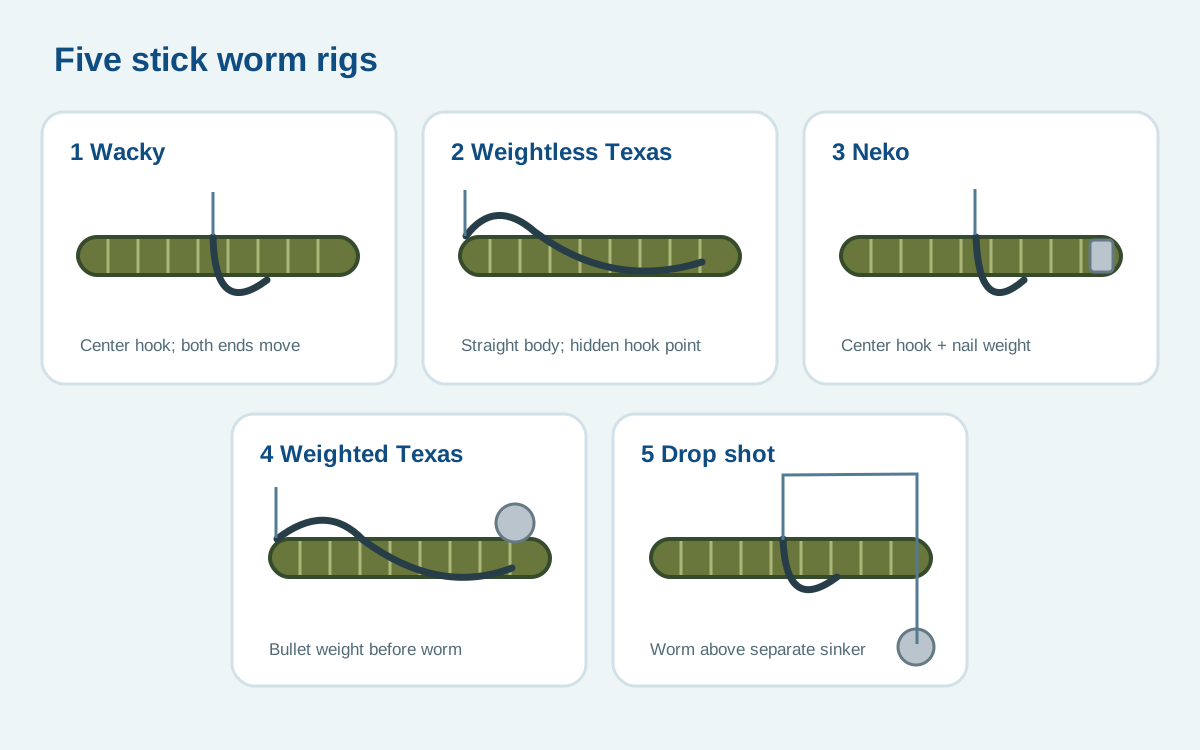
Choose a rig by the fall you want and the cover you must pass. Match hook gap, hook size, weight, and line to the worm's diameter; an oversized hook can overpower a small bait, while a tiny hook may not clear a thick body.
1. Wacky Rig
Place a hook through or under an O-ring near the center. Both ends remain free and often bend on the descent. Let it fall beside docks, sparse grass edges, or open pockets, then lift and repeat. Its exposed hook is vulnerable in heavy cover.
2. Weightless Texas Rig
Insert an offset hook through the head, turn it, and re-enter the body so the worm hangs straight. The point may be lightly concealed to reduce snagging. This is useful near vegetation or shallow wood where a center hook would catch.
3. Neko Rig
Add a small nail weight at one end and place a hook near the middle. The weighted end descends first, giving a nose-down, bottom-oriented presentation. Protect soft plastic with an O-ring if needed and confirm the hook point remains clear.
4. Weighted Texas Rig
Add a bullet weight ahead of a Texas-rigged worm when you need a quicker fall or deeper access. Keep the body straight and select weight for the cover; too much mass can make a subtle bait rush past a fish.
5. Drop Shot Rig
Tie a hook above a separate sinker and nose-hook or lightly rig a stick worm. The weight holds a reference point while the bait moves above it. This can keep a small profile near suspended or bottom-related bass without relying on a free fall.
| Rig | Main presentation | Starting situation |
|---|---|---|
| Wacky | Center-hooked fall | Open targets and docks |
| Weightless Texas | Streamlined subtle fall | Grass and shallow cover |
| Neko | Weighted nose-down movement | Bottom finesse |
| Weighted Texas | Faster fall and bottom contact | Deeper or thicker cover |
| Drop shot | Bait above separate weight | Suspended or bottom fish |
How to Fish Hard Stickbaits

First identify the hard bait's buoyancy. A floating pencil needs a surface lane; a sinking model can be counted down to a deeper target. After each cast, change one part of the retrieve at a time and watch how the lure actually responds.
Walk-the-Dog
Cast beyond surface activity, point the rod tip low, and give short rhythmic twitches with controlled slack. Recover line between twitches without pulling the bait continuously. Its nose should alternate left and right. Pause briefly beside a likely ambush point.
Twitch-and-Pause
Short rod movements can make floating or sinking models dart. Let the bait settle afterward: a floater returns to the surface, while a sinker loses depth. The pause is part of the presentation, so keep enough line awareness to detect a strike.
Sweep-and-Glide
A longer, controlled rod sweep can move some hard stickbaits in a wider path. Reel back slack, then repeat. This works only if the body and ballast support a glide; test it beside the boat or bank rather than assuming every stickbait responds the same way.
Sink-and-Work and Speed Changes
Count a sinking bait down to fish holding below the surface, then twitch, sweep, or reel it without contacting hazardous bottom cover. For actively chasing predators, a faster retrieve may be useful, but keep the lure stable and vary speed deliberately. Long casts are valuable only if you can control and feel the lure at that distance.
| Retrieve | Best-suited lure | Technique cue |
|---|---|---|
| Walk-the-dog | Floating hard bait | Rhythmic short twitches |
| Twitch-and-pause | Floating or sinking | Short movements and pauses |
| Sweep-and-glide | Suitable hard bait | Longer controlled sweeps |
| Sink-and-work | Sinking hard bait | Count down before retrieve |
| Variable speed | Model-dependent | Adjust to fish response |
Beginner checklist: Cast beyond the target, confirm the lure's buoyancy, give only the slack needed for its action, pause where fish may follow, and watch for line movement or sudden weight before setting the hook.
When and Where Should You Use a Stickbait?

The best location depends on which stickbait you mean. A soft worm can fall beside shallow bass cover, docks, overhanging trees, or grass edges. In clear water or under pressure, its low-action descent may be less intrusive than a fast moving lure. Texas rigging helps when vegetation makes an exposed center hook impractical.
When baitfish or predators disturb the surface, a floating pencil can cover open lanes across a lake, bay, or shoreline. Leave enough room for side-to-side movement and exposed hooks. If fish track baitfish below the surface, a sinking hard stickbait reaches them without asking them to rise. Suitable saltwater models may be cast toward inshore schools, reef edges, or offshore feeding activity; choose hardware and tackle for the species and local conditions.
Season, light, clarity, current, and fish position refine these choices. Neither a “clear water” label nor a calendar month substitutes for observing depth. Make several controlled casts through the likely lane, then change buoyancy or retrieve if fish show interest without striking.
| Fishing situation | Stickbait type | Why it may work |
|---|---|---|
| Shallow bass near docks | Soft stick worm | Subtle fall |
| Pressured bass | Soft stick worm | Low-action approach |
| Surface-feeding fish | Floating hard bait | Side-to-side surface action |
| Fish below surface | Sinking hard bait | Subsurface reach |
| Saltwater baitfish schools | Suitable hard bait | Baitfish imitation |
| Thick vegetation | Texas-rigged soft worm | Reduced hook exposure |
Choosing the Right Stickbait Size, Color, and Buoyancy

Begin with target species, forage size, and depth. For bass, a four- or five-inch soft stick worm is a practical starting size; smaller worms fit finesse presentations, while larger ones serve selected bigger profiles. A hard stickbait's length and casting weight should match the rod, leader, hook strength, and the distance needed to reach fish.
Choose buoyancy before finish. A floating bait serves a surface lane; a sinking model reaches lower fish. Green pumpkin and watermelon are common natural soft-plastic colors, while black-blue or other dark profiles may create contrast. Silver or baitfish finishes suit many hard-bait tests; bright patterns can be visible in selected conditions. These are experiments, not guaranteed choices. Actual fall speed and action may change when hooks, weights, or line are altered.
| Fishing need | Practical starting choice |
|---|---|
| General bass finesse | 4–5-inch soft stick worm |
| Shallow cover | Weightless Texas-rigged worm |
| Open-water finesse | Wacky-rigged worm |
| Surface feeding | Floating hard stickbait |
| Fish below surface | Sinking hard stickbait |
| Natural baitfish look | Forage-matching hard finish |
Rod, Reel, and Line Setups for Stickbait Fishing

Because the three lure groups differ in weight, hooks, and action, there is no universal stickbait outfit. Match the rod's casting range to the actual lure and the line to cover and target fish. Balance sensitivity with enough control to work the presentation.
Soft-Plastic Stick Worm Equipment
A medium-light or medium spinning rod around 6 feet 8 inches to 7 feet 3 inches often handles finesse worms well. A spinning reel, light braid with an appropriate fluorocarbon leader, or suitable fluorocarbon line can help detect a bite during a fall. Select hook size and wire strength for the worm's diameter and cover. A heavy hook can change the sink and action of a small bait.
Floating Hard Stickbait Equipment
Pick a rod that can cast the plug and deliver repeated short twitches without fatigue. Line and leader should allow the intended topwater action and suit the exposed hooks; too much line drag or tension can inhibit walking. After changing treble or single hooks, test whether the bait still floats and sits at the intended angle.
Sinking Hard Stickbait Equipment
Small freshwater models and heavy saltwater casting baits demand very different tackle. Consider casting distance, bait weight, current, drag, and the target species. Where saltwater is involved, use appropriate corrosion-resistant hardware and maintain it after the trip. A setup that controls a five-inch bass worm may not cast a dense offshore stickbait safely.
| Stickbait type | Equipment focus | Main consideration |
|---|---|---|
| Soft-plastic worm | Sensitive finesse setup | Detect falling bites |
| Floating hard bait | Balanced rod and line | Control walking action |
| Sinking hard bait | Matched casting and retrieve setup | Depth, distance, target species |
Stickbait vs Jerkbait, Worm, and Pencil Bait
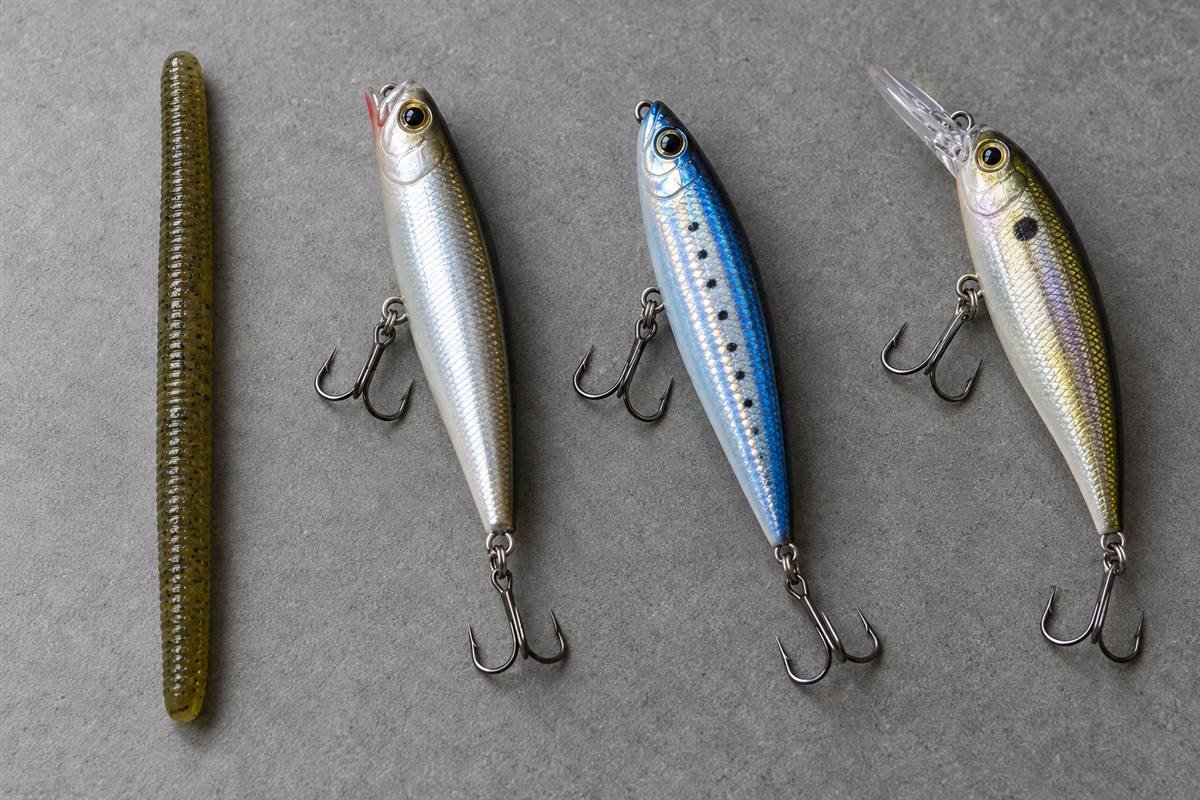
These names overlap, so identify construction before technique. A soft stickbait is a straight-bodied member of the broader plastic-worm family. A ribbon-tail worm is still a plastic worm but does not share the same profile or fall. A floating topwater pencil is often called a hard stickbait because its elongated body can walk side to side. A weighted hard stickbait may look similar but sinks and fishes below the surface.
“Jerkbait” usually describes a hard or soft lure worked with rod jerks. Many familiar hard minnow jerkbaits have a diving lip and a built-in swimming action; some regional usage calls minnow-style hard lures stickbaits too. Neither term alone proves that the lure is lipless, floating, or a walking bait. Look for a bill, confirm buoyancy, and read the model's design notes before choosing a retrieve.
| Lure term | Common meaning | Important distinction |
|---|---|---|
| Soft stickbait | Straight-bodied soft worm | Rig and fall shape its action |
| Topwater pencil | Floating elongated hard lure | Walk-the-dog presentation |
| Sinking stickbait | Weighted hard lure | Subsurface dart or glide |
| Jerkbait | Lure worked with jerks | Often more specific, may have lip |
| Traditional plastic worm | Broad soft-worm category | May include ribbon tails |
Common Stickbait Mistakes and How to Fix Them

A hard pencil does not fish like a soft worm. Letting a fall-focused worm descend under heavy line tension can prevent its natural movement; reeling it quickly may miss the useful falling window. Conversely, a walking bait often tracks straight if you pull with constant tension instead of leaving controlled slack between twitches.
Check buoyancy before casting to a chosen depth. A sinking hard bait may drop past fish during long pauses, while a floating one cannot reach the same lane. Use hooks and tackle sized for the actual lure. If a worm bunches on the hook or a replacement treble changes hard-bait balance, correct the rig before changing locations.
| Problem | What to check |
|---|---|
| Soft bait has little falling action | Material, hook position, added weight |
| Walking bait moves straight | Rod cadence and line slack |
| Sinking bait runs too deep | Countdown and retrieve speed |
| Frequent snagging | Hook exposure and cover path |
| Poor casting distance | Lure weight and tackle compatibility |