

How Artificial Lures Produce a Fishing Opportunity

From cast to encounter
First choose a zone where the target species could be feeding or resting. Cast beyond the intended lane and bring the lure to the right depth. A surface popper passing above bottom-holding fish or a jig beneath surface-feeding fish can miss the encounter even if its color is ideal.
Next, water flow and the angler’s movements make the lure act. A diving lip pushes a crankbait into a wobble, a spoon may flutter as it falls, and a soft tail bends as water flows past it. The lure’s shape, mass, buoyancy, line tie, and rigging all determine the action; the angler supplies the cast, retrieve, twitch, or pause.
Detection is not a strike
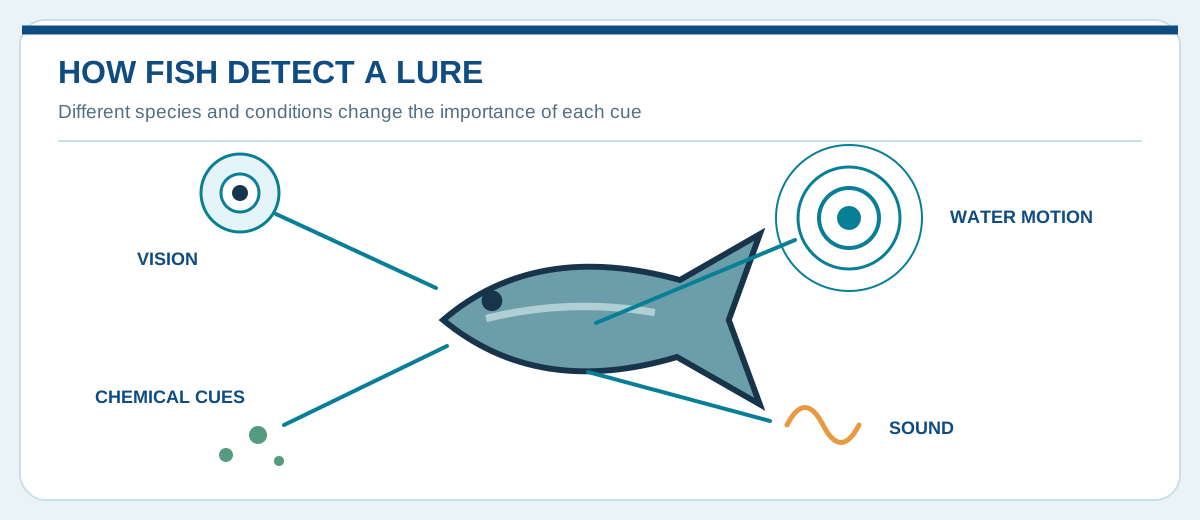
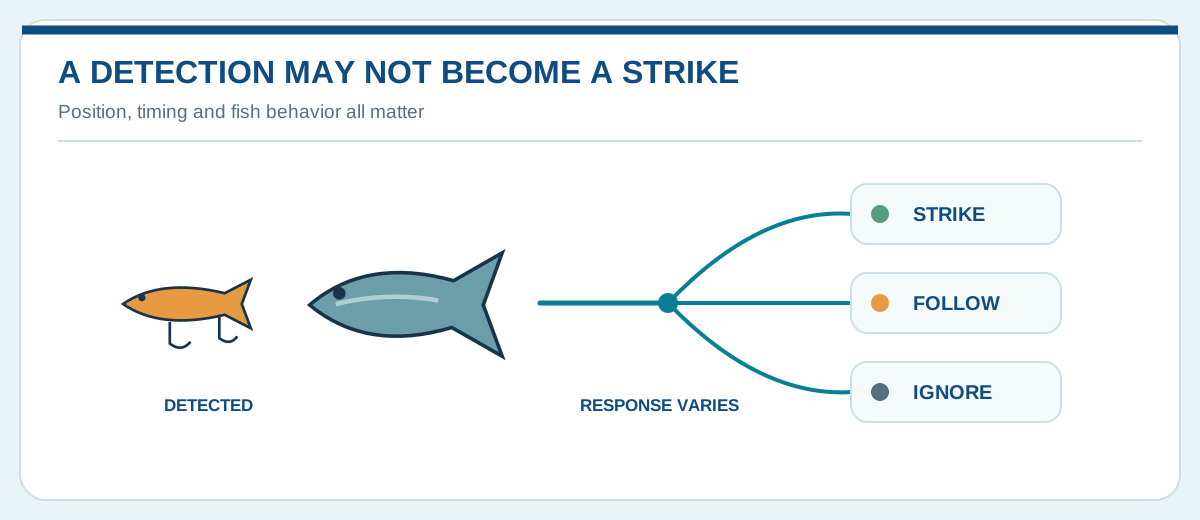
A fish may notice the lure through vision, nearby water movement, sound, or a chemical cue. It can ignore it, follow it, test it, or strike. That response depends on species, position, hunger, competition, prior experience, and local conditions. A strike can resemble feeding behavior or a reaction to a sudden change, but an angler cannot know its exact motivation from one catch.
After a bite, tackle and hook placement determine whether the fish stays connected. This final step matters in practice, yet it should not be confused with the reasons the fish approached the lure.
| Step | Angler or lure action | Why it matters |
|---|---|---|
| Choose zone | Target likely fish position | Encounter chance |
| Reach depth | Place lure at fish level | Detectability |
| Create action | Retrieve or let fall | Visual and mechanical cues |
| Fish detects | Uses available senses | May investigate |
| Fish responds | Ignores, follows, or strikes | No guarantee |
How Fish Detect Lures
Vision and species differences
Many predatory fish use vision to detect motion, silhouette, contrast, and in some cases color. The colors they distinguish are not necessarily the same as those a person sees. Species differ in retinal cells, habitat, and light exposure. Research summarized by the University of Illinois shows that largemouth bass color perception differs from human color perception; do not generalize that result to every fish.
Lateral line and hearing
The lateral line is a sensory system along the fish’s body that detects nearby water movement and pressure changes. It can help a fish sense a moving lure at close range, particularly when visibility is limited. Hearing is a separate system that can respond to suitable underwater acoustic signals. A rattling lure may produce sound, but not every rod vibration is the same as a sound detectable by a fish.
Smell and taste can also matter, especially for soft baits or scented materials. They do not replace location, action, or a fish’s willingness to feed. The relative weight of these senses changes with water clarity, light, distance, species, and the presentation.
| Sense | Potential cue | Important limit |
|---|---|---|
| Vision | Shape, motion, some colors | Needs useful light |
| Lateral line | Nearby water motion | Not precise long-range sight |
| Hearing | Underwater sound | Species vary |
| Smell and taste | Chemical cue | Depends on lure and contact |
How Lure Colors Change Underwater

Light changes with water and depth
Water absorbs and scatters light. In clear ocean water, longer red wavelengths generally weaken with depth sooner than shorter blue-green wavelengths. NOAA uses this principle to explain why a red object may appear dark in deep water when little red light reaches it. That is a physical example, not a universal depth chart for every lake.
Freshwater may contain algae, tannins, sediment, or other material that changes which wavelengths pass through and how far light travels. A shallow muddy pond and a clear lake can make the same lure look very different. Cloud cover, shade, time of day, and the background behind a lure matter as well.
Do not use a fixed color-depth rule
Red does not disappear at one universal number of feet. Its apparent brightness depends on the amount and spectrum of light available, the lure’s finish, and the route light travels to the observer. A metallic lure may flash when it briefly reflects available light, while a matte dark bait can still make a strong outline against a bright surface.
For a practical test, lower a lure beside the boat or shore at several depths and look at it against the actual bottom or sky. Your view is not identical to a fish’s, but it is more useful than relying on a universal color ranking.
| Factor | Typical influence | Practical question |
|---|---|---|
| Depth | Less available light | Can the lure still stand out? |
| Water clarity | Scattering or absorption | How far is visibility? |
| Red wavelength | Can weaken with depth | What light remains? |
| Background | Changes silhouette | Dark or bright behind it? |
| Surface light | Changes reflection | Sun, cloud, or shade? |
Does Lure Color Matter? Contrast and Flash
Hue, brightness, and silhouette
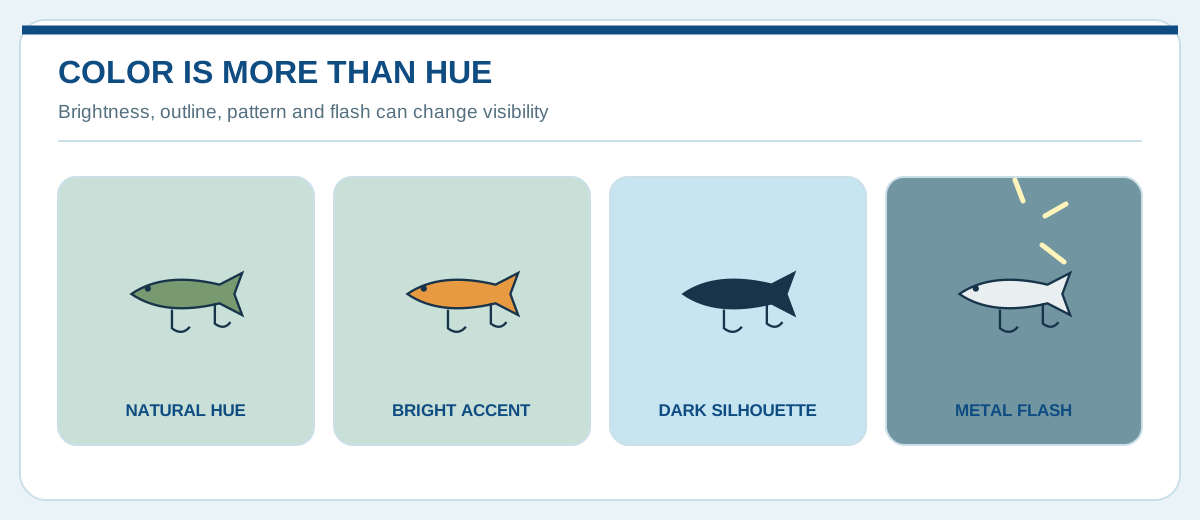
Hue is the color name—green, red, yellow, or blue. Brightness is how light or dark the lure appears. Contrast describes how well it separates from the surrounding water, bottom, vegetation, or sky. A dark lure may form a clear outline against a bright surface even when a fluorescent lure seems brighter in a tackle box.
Natural patterns can suggest local forage in relatively clear water. High-contrast or bright patterns may be easier to notice in some stained water. Neither choice works everywhere. Pattern details that look convincing in a hand can become invisible at distance or depth, while a simple outline remains detectable.
Flash depends on light
Silver, gold, and other reflective finishes produce changing highlights as a lure rolls, wobbles, or spins. This is flash, not light made by the lure. A spoon or spinner blade can momentarily stand out without imitating a prey fish precisely. In heavy shade or muddy water, that visual effect may be reduced.
Start with a color that offers useful contrast and then watch how fish react at the correct depth. If a lure has the right action but receives follows without bites, color or size may be worth changing. If the lure never reaches fish, color is unlikely to be the first fix.
| Visual property | Meaning | Starting test |
|---|---|---|
| Hue | Color category | Natural or accent |
| Brightness | Light versus dark | Available light |
| Contrast | Difference from background | View from fish level |
| Silhouette | Visible outline | Against sky or bottom |
| Flash | Changing reflection | Light and movement |
How Lure Action Works

Shape meets water flow
A lure’s action is a physical response to its design and movement through water. A crankbait lip redirects flow and can make its body wobble. A minnow lure may roll or dart when twitched. A spoon can flutter as its curved metal body falls. A paddle-tail swimbait bends at its thin tail section under flow.
Floating, sinking, and suspending designs behave differently during a pause. A floating lure rises, a dense jig or blade bait falls, and a suspending hard bait may remain near its working level for a time. Real behavior varies with water temperature, line, hardware, and the lure’s actual balance.
Different actions create different opportunities
A steady retrieve can make repeated movement that fish can track. A brief pause lets a bait fall or hover near cover. A sudden dart can change the apparent direction of prey; a slower fall can keep a soft plastic in a strike zone. A topwater popper adds splash and surface disturbance rather than a deep swimming path.
The best movement is not always the largest. Small, controlled changes can be easier for fish to intercept. Test the lure at the speed and depth you plan to fish, and check that the hook or trailer is not distorting its intended action.
| Action | Typical design or input | What it changes |
|---|---|---|
| Wobble | Crankbait body and lip | Repeated side motion |
| Dart | Rod twitch on minnow bait | Direction change |
| Flutter | Curved falling spoon | Falling flash |
| Tail kick | Flexible soft-plastic tail | Trailing motion |
| Surface pop | Cupped face and pull | Splash at surface |
Vibration, Water Movement, and Sound
Mechanical motion and nearby water
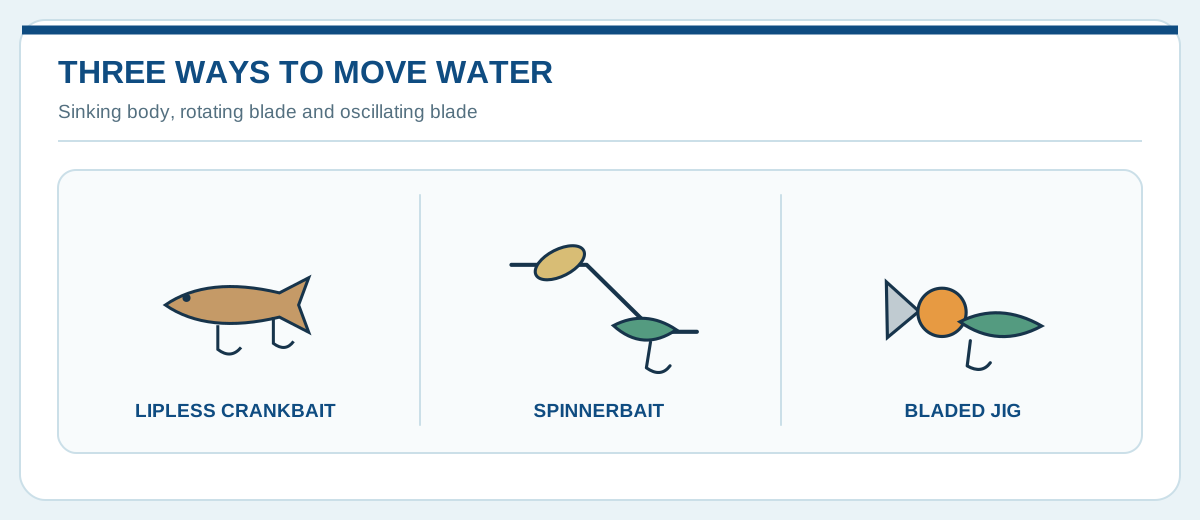
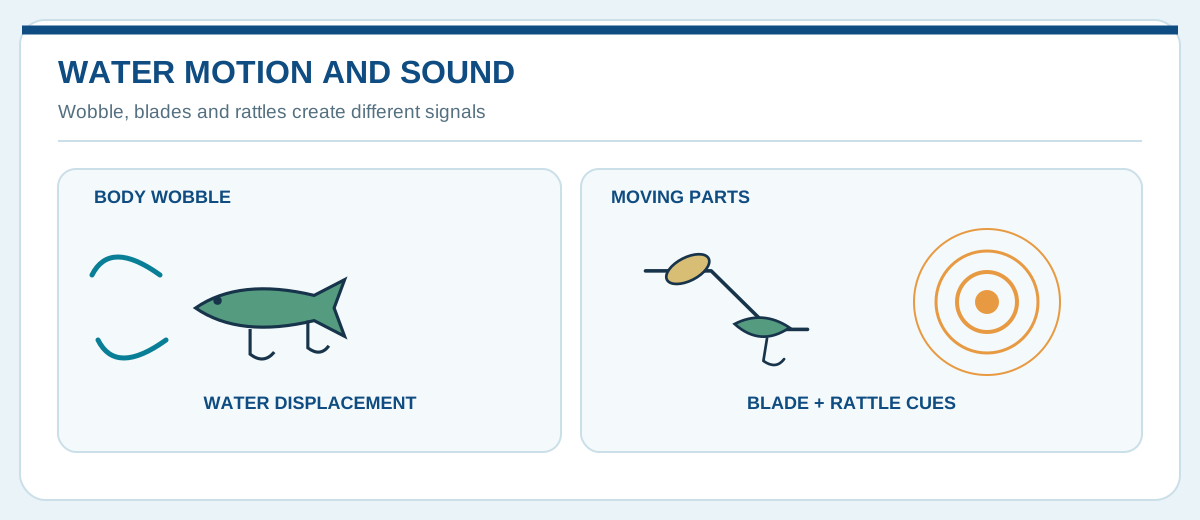
A wobbling hard bait, rotating spinner blade, or oscillating bladed jig moves water. Their motions differ: a conventional spinnerbait blade revolves on a mount, while a ChatterBait-style front blade swings rapidly relative to its jighead. These actions can create recurring forces felt through the line, but a rod’s sensation is not a direct measurement of what every fish detects.
Water displacement is the local movement around a lure. The lateral line can sense suitable nearby disturbances. Sound is an acoustic signal that may travel beyond the immediate flow field. An internal rattle or clicking hardware can add sound; a silent soft plastic can still move water. Vibration and sound overlap in some cases but are not synonyms.
More is not always better
A loud rattle or hard thump may help a presentation get noticed in one situation and be less useful in another. Fish species, distance, visibility, cover, and prior exposure all affect response. There is no reliable rule that stronger vibration or a louder lure catches more fish everywhere.
If a noisy lure gets no response, compare a subtler version at the same depth and speed. If a silent lure is hard to track in stained water, try a moving bait that produces more feedback. Change one variable at a time.
| Signal | Source | Keep distinct from |
|---|---|---|
| Body vibration | Wobble or tail motion | Internal rattle |
| Blade rotation | Spinner hardware | Blade oscillation |
| Blade oscillation | Front blade on bladed jig | Continuous rotation |
| Water movement | Lure displaces nearby water | Sound at distance |
| Rattle sound | Internal moving parts | Visible flash |
How Different Lure Types Combine Cues

Moving hard baits and blades
A crankbait’s body shape and lip can create wobble; some models rattle while others do not. A lipless crankbait usually lacks a diving bill and can create tight body movement on the retrieve. A minnow lure or jerkbait may dart or pause. Spinnerbaits and inline spinners turn metal blades, but the first uses an offset wire arm and the second a straight shaft.
A ChatterBait-style bladed jig oscillates a metal plate at its front. A metal blade bait vibrates as its body is pulled. A spoon uses curved metal to wobble, flash, or flutter. These are distinct mechanisms even if anglers describe all of them as vibrating lures.
Soft plastics, jigs, and topwater
Soft swimbaits may kick a tail; worms and creature baits often depend on slower fall, shape, and rigging. A skirted casting jig adds a weighted head, hook, skirt, and sometimes a trailer to a deliberate bottom presentation. Topwater lures work at the air-water boundary through wake, pop, splash, or glide.
The useful comparison is not which family is universally best. It is which action and depth suit the fish in front of you. Explore the existing lure types guide for category definitions and the spinnerbait mechanics guide for a closer look at blade rotation.
| Family | Defining movement | Possible cue |
|---|---|---|
| Crankbait | Body wobble | Motion and flash |
| Spinnerbait | Rotating blade | Flash and water motion |
| Bladed jig | Oscillating front blade | Strong body response |
| Spoon | Wobble or flutter | Changing reflection |
| Soft plastic | Tail or falling action | Profile and motion |
| Topwater | Surface disturbance | Outline and splash |
How Retrieve and Depth Change a Lure

Speed and pauses change the signal
A steady retrieve can keep a crankbait wobbling or a spinnerbait blade turning. Reeling faster often increases water flow and may raise some lures; slowing down can reduce action or let a sinking lure run deeper. Each model has an operating range. A lure that rolls sideways, stalls, or fouls at the chosen speed is not delivering the intended presentation.
Rod twitches make minnow baits dart. A stop-and-go retrieve alternates movement with a pause. Lift-and-fall makes a jig or spoon rise and drop, creating a second chance on descent. A countdown after splashdown can help repeat a sinking lure’s starting depth, though current and line tension change its actual path.
Depth before fine color changes
A fish holding near bottom may never inspect a surface retrieve; a suspended fish may ignore a jig dragging too far below it. Begin with a depth range based on fish location, water temperature, structure, or observed activity. Then choose a lure whose buoyancy, weight, and retrieve can stay in that range.
For a beginner, cast beyond a likely target, let the lure reach its lane, make one controlled retrieve, and note its action. On the next cast, change only speed or pause length. That comparison teaches more than swapping color after every cast.
| Retrieve | Movement | Suitable first test |
|---|---|---|
| Steady | Continuous swim | Search lane |
| Twitch and pause | Dart then hold | Minnow bait near cover |
| Lift and fall | Rise then descent | Jig or spoon |
| Countdown | Repeat sink time | Open-water target |
| Stop-and-go | Restart after pause | Isolated structure |
How Water and Species Change Lure Choice

Water and light
Clear water can give fish more time to inspect a lure, so size, natural profile, and controlled speed are useful starting tests. Stained water shortens visual range; a stronger outline or more water movement may make a lure easier to locate. In muddy water, accurate placement near cover and fish position becomes especially important. No color is universally visible in every kind of muddy water.
Bright sun, clouds, shade, and waves alter reflections and background contrast. A lure under a bright surface can look like a dark silhouette to a fish below. Near bottom, the same lure may blend with rock or vegetation. These are reasons to view a lure against its real background instead of relying only on packaging colors.
Fish species differ
Bass, trout, walleye, pike, and other predators occupy different habitats and have different sensory capabilities. Even within one species, fish behavior changes with season, time of day, pressure, and available forage. A lure selected for one species is not automatically wrong for another, but hook size, presentation speed, target depth, and local regulations should fit.
Use conditions as hypotheses. Observe fish or forage when possible, make a controlled presentation, and update the choice from actual response. A clear-water color rule cannot substitute for locating fish.
| Condition | Starting emphasis | Check |
|---|---|---|
| Clear water | Profile and controlled action | Fish inspection time |
| Stained water | Outline and movement | Visibility range |
| Muddy water | Close placement | Actual fish location |
| Low light | Silhouette | Background |
| Deep water | Depth and remaining light | Running lane |
How to Choose a Lure Step by Step
Start with the fish, not the paint
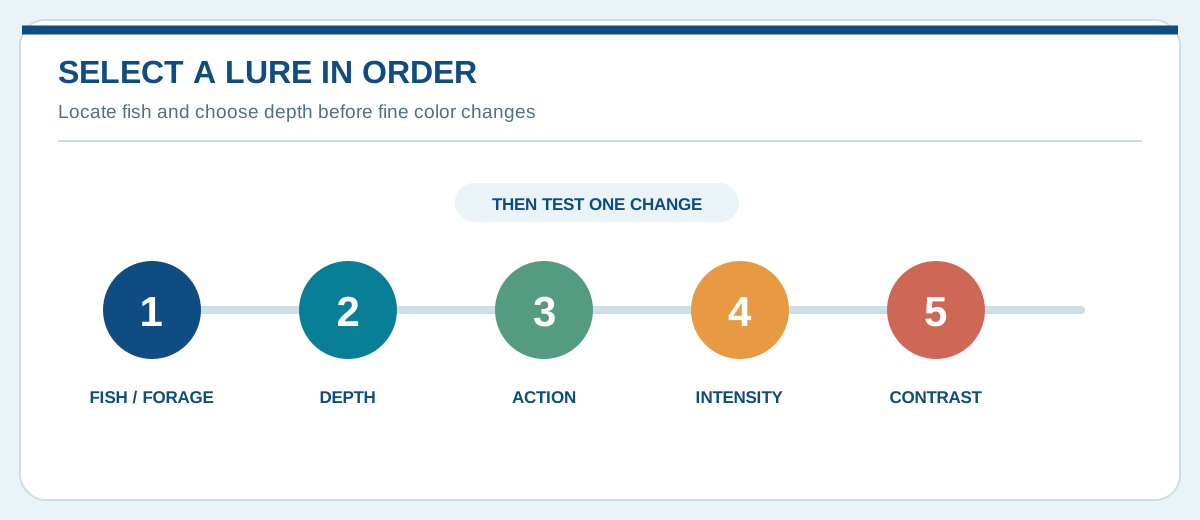
Identify your target fish and plausible forage. Look for baitfish, insects, crawfish, or cover that could hold prey. Choose a lure size the fish can encounter and that your tackle can cast and control. Then select the water layer: surface, midwater, bottom, or a specific edge between them.
Pick a movement that works in that layer. A topwater popper cannot search a deep rock point; a dense jig may be inefficient above shallow grass. Decide whether subtle tail motion, broad wobble, rotating blade flash, or a falling presentation fits the cover and fish activity.
Adjust signal and color last
Choose an appropriate intensity of water movement or sound, then a color and contrast against the actual background. A natural shade, bright accent, dark silhouette, or reflective finish can each be useful for different reasons. Do not assume a single “best” hue independent of light and water.
Test the lure close enough to see whether it tracks, spins, dives, or falls as expected. Make several comparable casts. If fish follow without striking, change one variable such as speed, size, or color. If there is no encounter, move the lure to a better lane before buying another color.
| Decision | Question | First action |
|---|---|---|
| Fish and forage | What might be present? | Match useful size |
| Depth | Where are fish holding? | Choose running layer |
| Action | How should it move? | Match lure design |
| Intensity | How much water motion? | Subtle or stronger |
| Contrast | Will it stand out? | Check background |
| Test | Does it behave correctly? | Observe and adjust |
Why Fish Strike or Ignore Lures
Several explanations are possible
A moving lure may look like accessible prey, or it may pass so close to a fish that the movement prompts an immediate response. A wobble, dart, or flutter can suggest a vulnerable target. A fish positioned behind wood or grass may encounter the lure only when it crosses a narrow lane.
Fish also follow without striking. They may detect an inconsistency, lack feeding motivation, lose interest when the lure leaves their area, or simply choose not to attack. It is usually impossible to isolate one exact cause while fishing. Treat follows as useful observations rather than proof of a particular color preference.
What to do after a follow
Try bringing the lure through the same lane at a different speed, adding a short pause, changing size, or using a quieter presentation. If the lure was above or below the fish, correct depth first. Avoid changing action, color, size, and location simultaneously; otherwise the result teaches little.
A successful strike does not show that a fish believed an artificial object was a perfect replica of prey. Fish may respond to a practical combination of visibility, movement, disturbance, timing, and opportunity.
| Observed response | Possible reason | Controlled adjustment |
|---|---|---|
| Strike | Several cues aligned | Repeat lane |
| Follow | Interested but no take | Pause or resize |
| No visible response | Fish absent or lure missed | Change location or depth |
| Short strike | Missed hook or timing | Check rigging |
| Repeated refusal | Presentation mismatch | Change one variable |
Common Lure Mistakes and Fixes
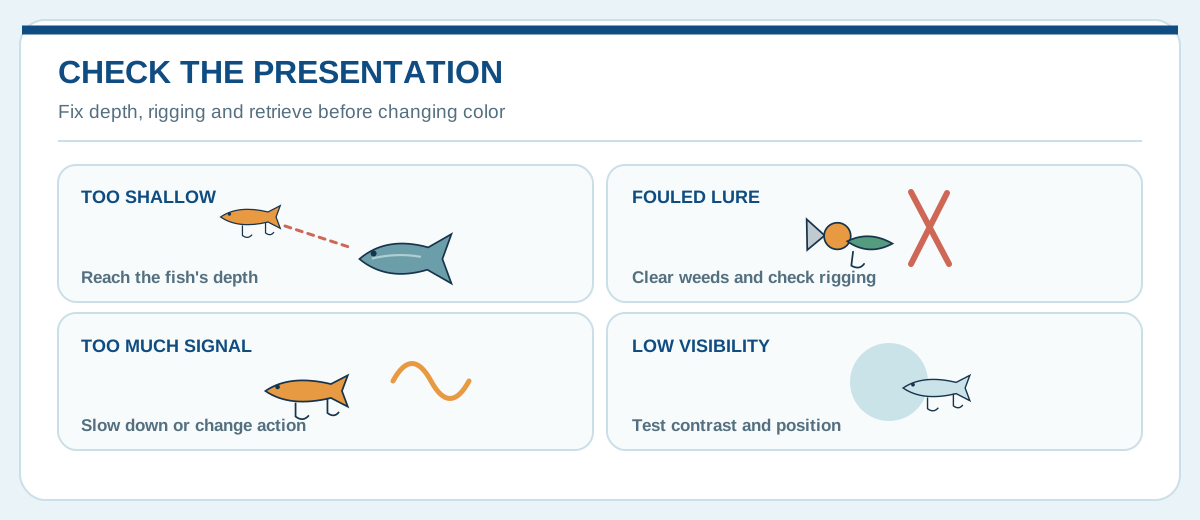
Check the basics first
The most common mistake is fishing the wrong place or depth. A lure can be technically sound and still miss fish. Another is assuming that color controls every result. Check where fish are holding, then watch whether the lure reaches them at a useful speed.
A fouled hook, bent wire, crooked soft-plastic trailer, or damaged diving lip can change action. Clear grass and line tangles after each suspicious cast. If the lure rolls or stops vibrating, test it in clear view before fishing more water. A lost action is a mechanical issue, not a color problem.
Beware universal rules
More noise, stronger vibration, brighter paint, or greater realism are not automatically better. Red does not become invisible at one fixed depth in all waters. Silent lures still move water. A fish can detect a lure without striking it.
Use a short checklist: target, depth, movement, visibility, rigging, then response. Repair a faulty presentation before changing lure category. If an area produces no sign of fish after a fair test, relocate instead of cycling endlessly through tackle.
| Problem | First check | Useful fix |
|---|---|---|
| No contact | Fish position | Change lane or depth |
| Poor action | Rigging and fouling | Straighten or clear |
| Too shallow | Speed or buoyancy | Adjust retrieve or weight |
| Weak visibility | Background and light | Change contrast |
| Excess noise | Sound and pressure | Try quieter lure |
Further reading and sources: NOAA on red light underwater, NOAA on water filtering light, University of Illinois on bass vision, In-Fisherman on hearing and lateral-line sensing, Wired2Fish on lure types, and Bassmaster on color choice. Ocean-light examples do not set fixed color-depth rules for freshwater.