
Creature Bait Anatomy

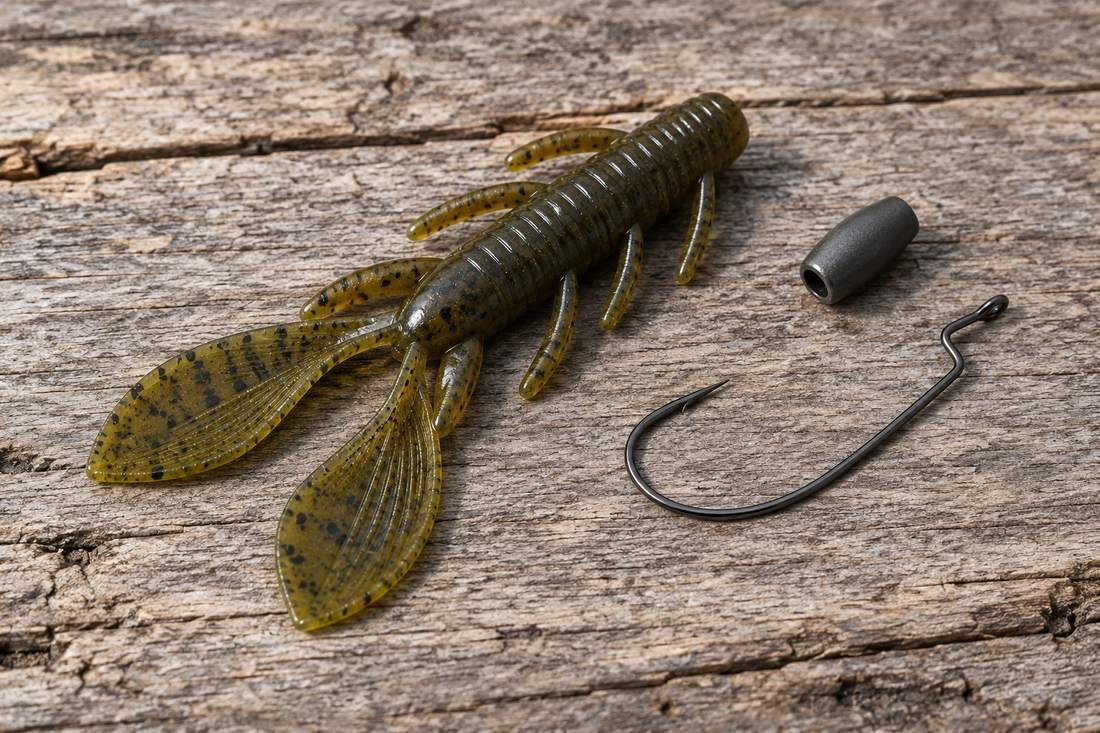
The central soft-plastic body holds the hook and establishes the silhouette. A thick head can grip a hook keeper, while a thinner area near the hook point may let the plastic compress during a hookset. These features vary by model, so look at the actual bait before choosing a hook.
Body, Ribs, and Appendages
Ribs add texture and surface area; they can also change how readily the body bends. Side legs and fine feelers may sway with slight water flow. Claws and wide flappers meet more resistance and may kick or open as the bait moves. Trailing tails extend the outline beyond the main body. Each part matters only within the complete design: material softness, thickness, and the rig affect whether it moves at all.
Some baits include a shallow hook slot or molded rigging channel. This can help the hook sit straight, but it does not make every hook size suitable. Optional salt, scent, and different plastic densities may alter feel, durability, or descent; none is a defining feature of all creature baits.
| Part | Practical role | Check |
|---|---|---|
| Central body | Holds hook and sets profile | Is it straight? |
| Ribs | Texture and bending | Does plastic tear? |
| Side legs | Subtle movement | Are they free? |
| Claws or flappers | Model-specific action | Do they move at your speed? |
| Trailing tails | Extended silhouette | Do they foul the hook? |
| Hook slot | Rigging guide | Does point align? |
How a Creature Bait Works Underwater
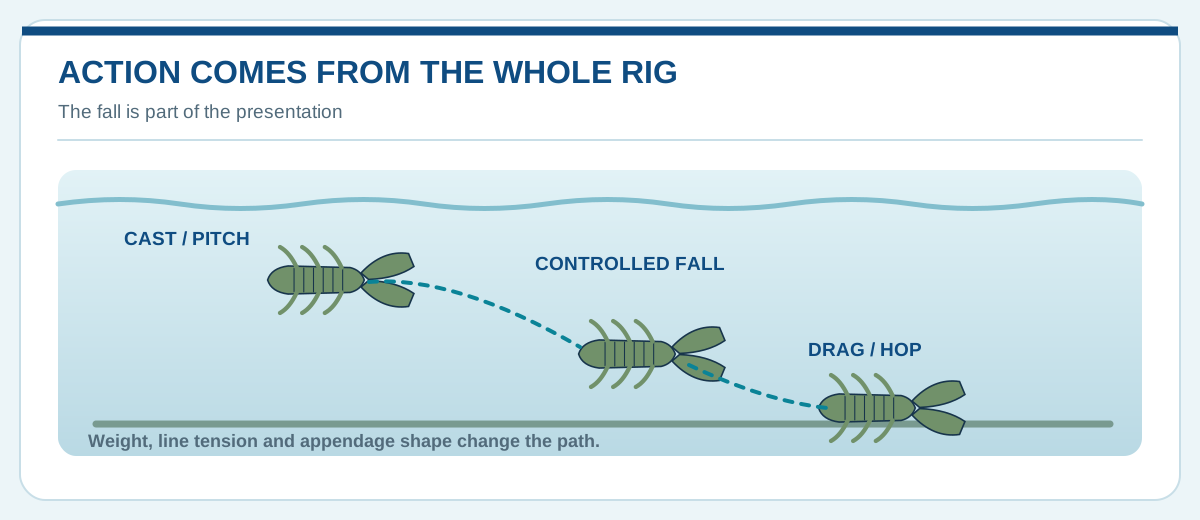
An unrigged creature bait normally has no hard lip or rotating blade that forces one fixed swim. Action emerges when the angler, weight, line, and soft body move through water. On a pitch, the sinker and bait descend while legs trail, claws resist flow, and the body may glide or settle. A rod lift changes direction; a pause lets the rig fall again.
Why the Fall Matters
Bass often hold beside grass, wood, or dock pilings. A controlled drop puts the lure close to that cover. An active flapper may move visibly on descent; a compact bait may fall with less motion. Neither is universally better. Weight, line tension, current, body density, hook placement, and appendage size can all change the path. A crooked bait may rotate instead of falling cleanly.
Watch the line after the lure enters a target. A sudden stop, sideways movement, or unexpected slack can indicate contact or a bite. After settling, drag or hop it just far enough to test the next piece of cover. Avoid claiming a universal sink rate: even the same bait behaves differently on another rig.
| Input | Potential effect | What to observe |
|---|---|---|
| More sinker weight | Faster descent in many setups | Can it enter cover? |
| Large flappers | More drag or kicking | Does fall change? |
| Taut line | More directional control | Does lure pendulum? |
| Rod lift | Rise and change of angle | Do appendages reset? |
| Pause | Return to fall or rest | Does line jump? |
Main Creature Bait Profiles

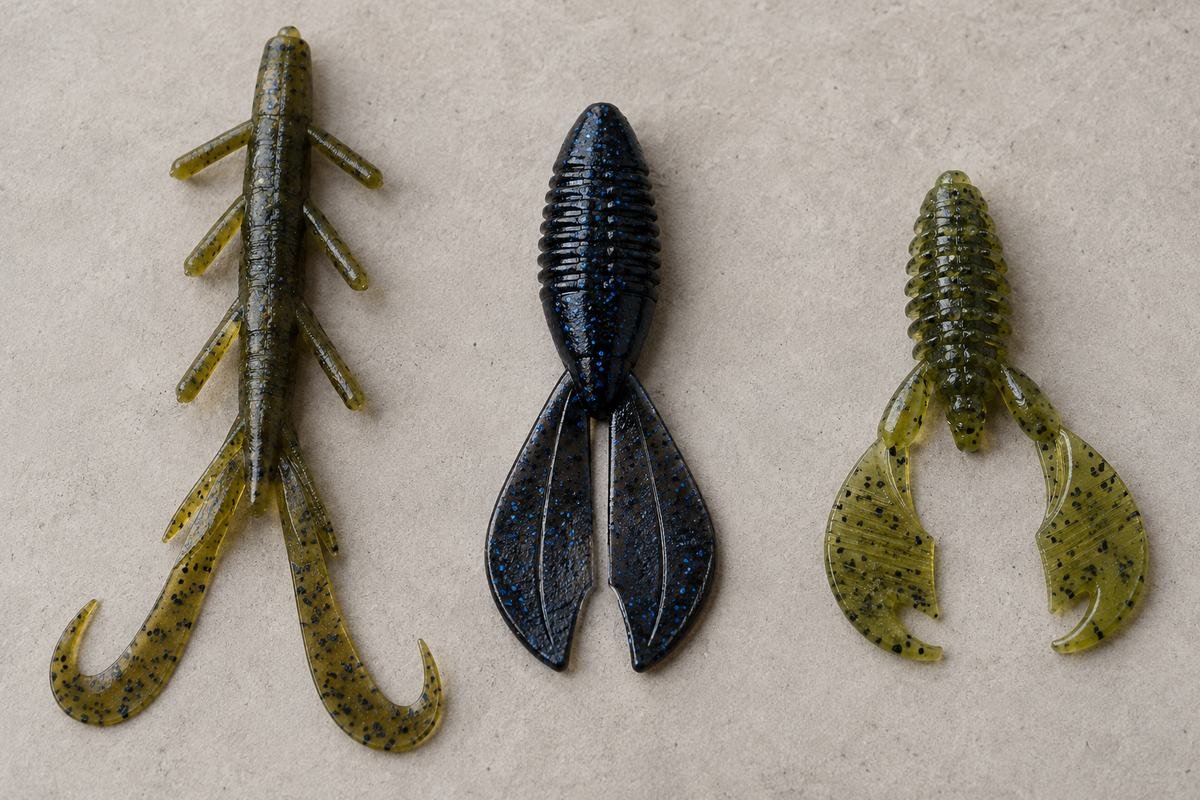
A Brush Hog-style bait is long, with side legs and trailing tails. It can be useful on a Texas or Carolina rig where the larger silhouette has room to move. Beaver-style baits concentrate bulk in a shorter body and usually have paired tail sections. Their streamlined outline can help with selected flipping and grass-mat punching presentations.
Flapping, Craw, and Compact Shapes
Flapping bugs use broad flexible appendages for more visible movement on a fall or retrieve. Craw-creature hybrids combine claws with extra legs, ribs, or unusual tails; they may fit both the craw and creature descriptions. A small compact creature offers less bulk and can be a useful test when fish are cautious or the hook and tackle are lighter.
These names are descriptive, not strict manufacturing standards. The fishing lure types guide places creature baits in the broader soft-plastic family. Compare the physical bait, not just the package label. In thick vegetation, wide loose appendages can snag or slow entry. In open cover, the same movement may be an advantage. A long bait is not automatically better for a large fish, and a compact bait is not only for small fish.
| Profile | Typical shape | Starting use |
|---|---|---|
| Brush Hog style | Long body with legs and tails | Texas or Carolina rig |
| Beaver style | Compact body and paired tails | Flipping or selected punching |
| Flapping bug | Wide active appendages | Fall or swimming test |
| Craw hybrid | Claws plus added features | Bottom cover |
| Compact creature | Smaller restrained profile | Subtle presentation |
Common Creature Bait Rigs
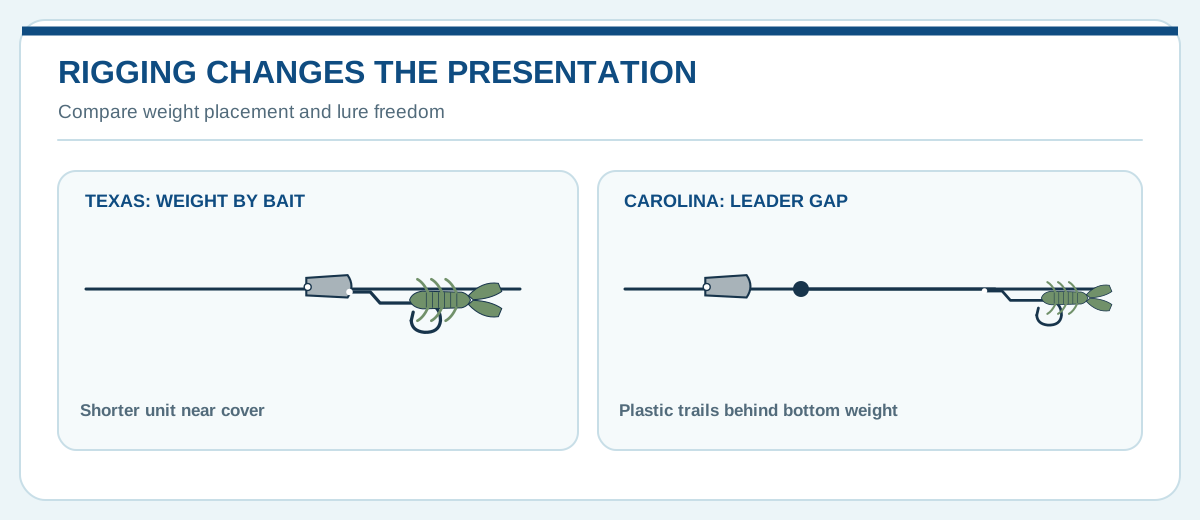
A Texas rig places the soft plastic on a hook in a relatively weed-resistant orientation, usually behind a bullet sinker. It is a practical first choice beside grass, wood, and docks. A Carolina rig separates a bottom weight from the bait with a swivel and leader. The weight searches structure while the soft plastic trails behind it.
Jig Trailers and Swing Heads
A creature bait can also ride on a casting or flipping jig as a trailer. In that role, its body adds profile to the jig, while appendages may move behind the skirt. A swing-head or wobble-head presents the bait behind a weighted head on a movable hook connection. A small creature may also work on a drop shot or unweighted hook in selected situations.
Do not confuse a lure category with a rig: the same piece of plastic can be a Texas-rigged lure one day and a jig trailer the next. Match body width and hook gap so plastic can move out of the way on a hookset. Confirm that the combined rig travels straight before making a long cast.
| Rig | Weight placement | Useful starting situation |
|---|---|---|
| Texas | Bullet sinker near bait | Targeted cover |
| Carolina | Weight ahead of leader | Points or flats |
| Jig trailer | Weighted jighead | Bottom cover |
| Swing head | Movable hook behind head | Hard-bottom dragging |
| Unweighted | No separate sinker | Shallow slow descent |
How to Texas Rig a Creature Bait
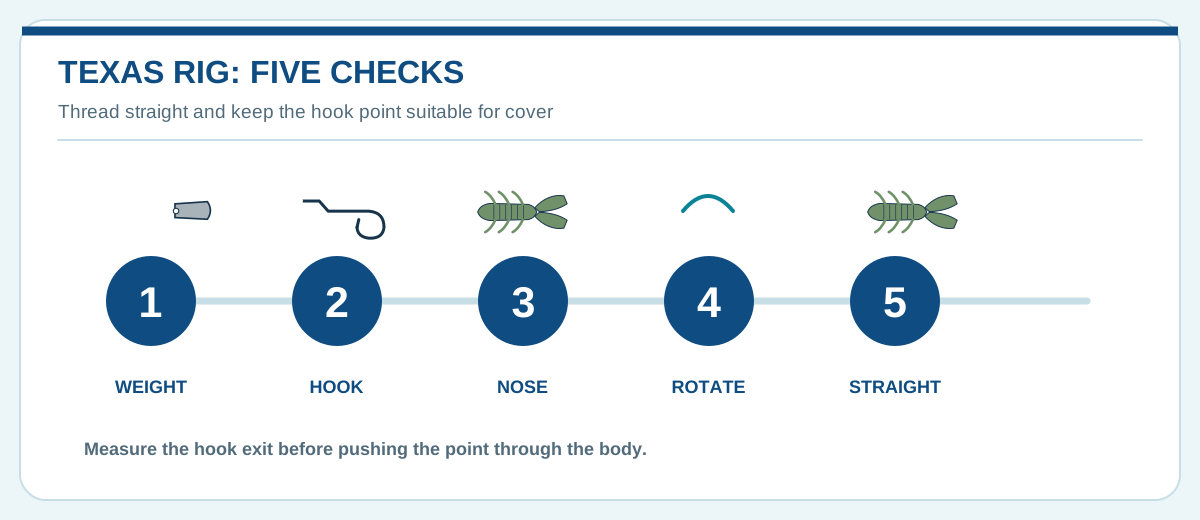
Texas rigging is straightforward once the hook and bait are matched. The hook gap must leave room for the soft body to compress; an oversized hook can crowd a compact bait, while an undersized one may not clear a bulky body. Extra-wide-gap, offset round-bend, and straight-shank flipping hooks each have useful applications. There is no single hook size for every creature bait.
A Beginner-Friendly Sequence
- Thread a bullet sinker on the line, narrow end facing the rod. Add a bobber stop first only if you want the weight pegged near the bait.
- Tie on a sharp hook suited to the bait's body thickness and the cover.
- Insert the point into the lure's nose and bring it out a short distance down the body.
- Slide the plastic up the shank, over the offset or keeper, and rotate it so the body hangs straight.
- Lay the hook alongside the bait to mark where the point should re-enter.
- Push the point through at that mark, keeping the lure centered and untwisted.
- Set the point flush with the surface or lightly skin-hook it where appropriate. Pull gently to confirm the bait sits straight.
Pegging keeps sinker and bait together for entry through thicker grass. An unpegged weight can separate on a fall, allowing a different glide or delay. Neither choice is universal. Test the assembled rig near shore and replace torn plastic that no longer stays in place.
| Hook | General advantage | Check |
|---|---|---|
| Extra-wide-gap | Room for thicker bodies | Enough gap after compression |
| Offset round-bend | Versatile soft-plastic option | Point alignment |
| Straight-shank flipping | Cover-oriented rigging | Keeper and hook strength |
| Finesse hook | Smaller bait compatibility | Avoid underpowered heavy cover |
Flipping, Pitching, and Punching Around Cover
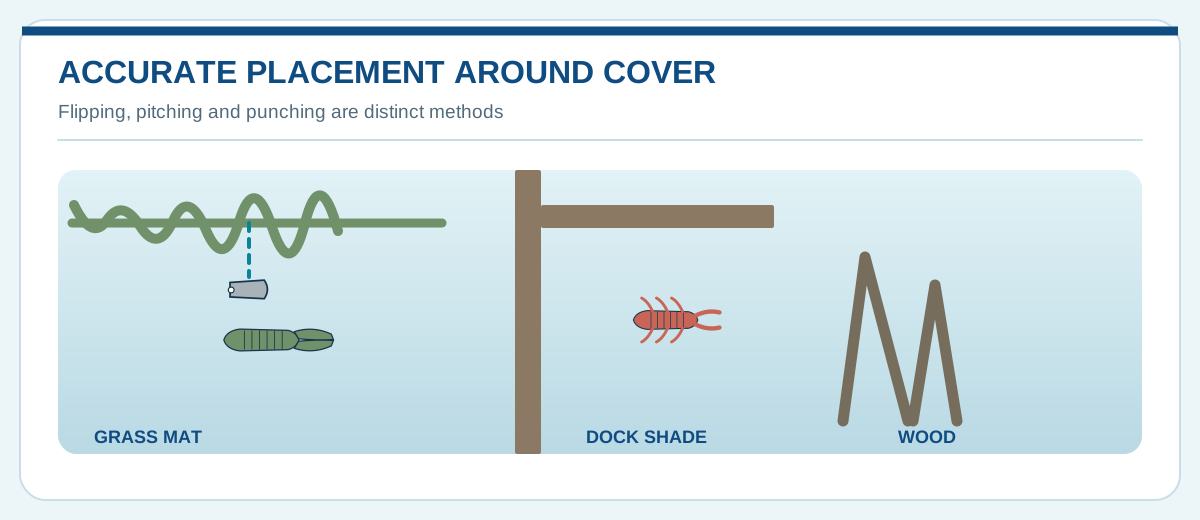
Flipping is a controlled short-range placement technique with limited line out. Pitching is a low, accurate cast that can reach targets farther away. Punching uses a sufficiently heavy, usually pegged presentation to penetrate selected dense vegetation mats. Anglers may pitch a punching rig, but the terms describe different parts of the method.
Choose a Shape That Reaches the Fish
Beside a dock post or fallen tree, a moderate creature bait with moving legs may have room to fall. Under matted grass, that same bait can hang at the surface. A shorter, streamlined Beaver-style shape with restrained appendages often enters more cleanly. Start with only enough weight to reach the water beneath the canopy; extremely heavy tackle is not a substitute for selecting a usable opening.
Present the bait quietly near the edge or pocket, let it descend on controlled slack, and watch the line. If it stops early, check whether the bait rests on vegetation or a fish has taken it. Keep line, hook, and rod strength appropriate for the cover, and plan a safe path to land a hooked fish. Do not force the bait through habitat where local rules prohibit fishing.
| Method | Presentation | Profile to test |
|---|---|---|
| Flipping | Very short controlled placement | Compact to medium |
| Pitching | Low accurate cast | Compact or moderate action |
| Punching | Weight penetrates dense mat | Streamlined, restrained appendages |
| Dock pitch | Target shade or pilings | Texas rig kept straight |
Carolina Rigs, Jigs, and Swing Heads

A Carolina rig uses a sinker above a swivel and a leader between swivel and bait. Drag the weight along suitable bottom while the creature bait follows behind it. A long-bodied profile can move freely across points, flats, or ledges, but leader length and weight should match the water, casting room, and snag risk.
Trailers Change a Jig's Profile
On a casting jig, a creature bait becomes a trailer rather than a separate rig. Thread the body centered on the jig hook; leave enough appendage beyond the skirt to move without overwhelming the hook gap. A flipping jig may call for a compact trailer that passes through cover. A football jig on rock can carry a craw-creature hybrid for a broad bottom profile.
A swing-head places a hook on a movable connection behind a weighted head. That articulation can let the soft bait follow changes in direction while dragged over hard bottom. Finesse presentations, including small creature baits on drop-shot setups, are possible but require a proportionate hook and weight. Check each rig in shallow water: if the bait spins, rolls, or blocks the hook, change its alignment or size before changing color.
| Setup | Bait role | First check |
|---|---|---|
| Carolina rig | Trails behind weight | Leader and bottom contact |
| Casting jig | Adds body and movement | Trailer alignment |
| Flipping jig | Compact cover trailer | Hook clearance |
| Swing head | Moves behind pivot | Straight tracking |
| Small finesse rig | Localized soft-plastic option | Scale of hook and body |
How to Fish a Creature Bait
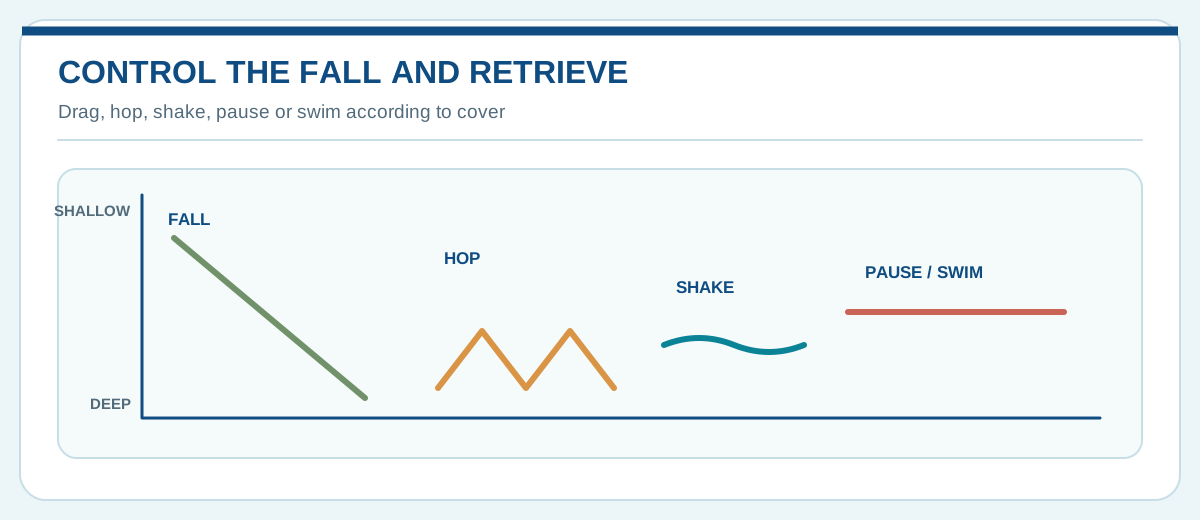
Begin with the fall. Cast or pitch past the target, let the bait enter its lane, and allow it to descend without dragging it away immediately. Watch the line and keep enough control to recognize an unusual stop. Then select a retrieve that fits the bait's appendages and the fish's position.
Six Practical Movements
- Controlled fall: Present the rig beside cover and let appendages respond on descent.
- Slow drag: Pull it steadily along bottom structure, pausing at changes in texture.
- Short hop: Lift a little, then allow another watched fall.
- Shake and pause: Move the rod tip lightly without hauling the bait far from a dock or stump.
- Slow swim: Retrieve an active flapping model along an open edge at a speed where it tracks straight.
- Deadstick: Leave the bait nearly motionless for a short period, then resume carefully.
The lure's geometry limits which retrieve works well. A compact bait may offer little swimming action; a broad flapper may move strongly at a modest speed. If a fall receives no response, change location or depth before assuming color is wrong. Repeating one controlled presentation teaches more than changing every variable at once.
| Movement | Primary cue | Useful starting area |
|---|---|---|
| Fall | Appendage motion on descent | Targeted cover |
| Drag | Bottom contact | Rocks or points |
| Hop | Rise and second fall | Open bottom |
| Shake | Subtle local motion | Dock post |
| Swim | Trailing or flapping action | Open grass edge |
| Pause | Minimal motion | Isolated cover |
Where to Fish Creature Baits
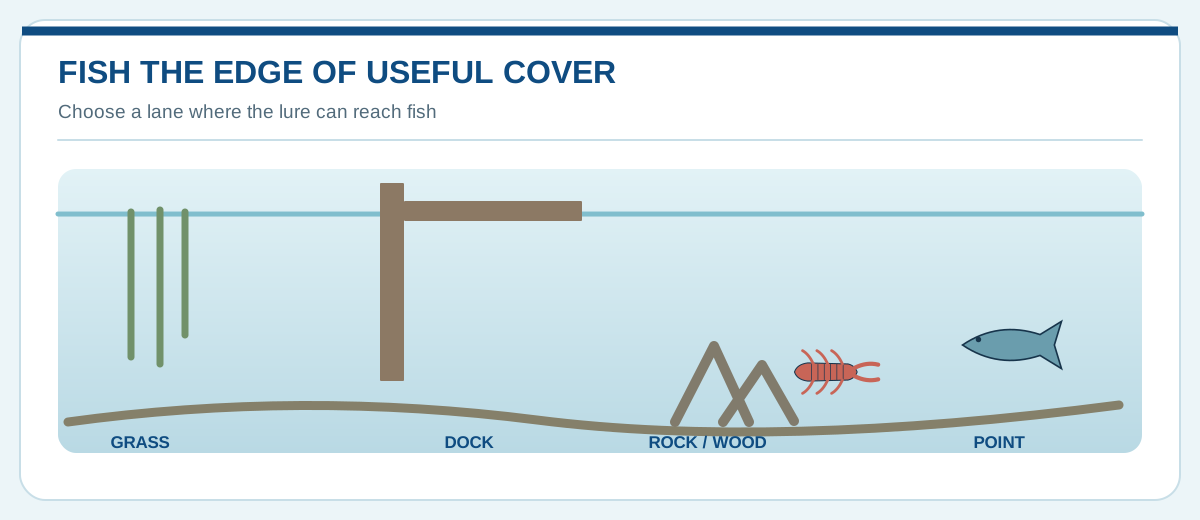
Look for an encounter lane, not just an attractive object. Submerged vegetation has edges, gaps, and changes in density. A Texas-rigged creature bait can fall beside those transitions. Thick mats need a rig that reaches openings below them. Pitching under a dock places the bait near shade, pilings, and other isolated cover.
Wood, Rock, and Offshore Structure
A laydown or flooded bush offers several narrow target lanes; start at the outer limbs and work toward the thicker center while managing snags. On a rocky bank or point, a Carolina rig or suitable Texas rig can be dragged slowly so its soft body follows bottom contours. Offshore humps and ledges can also be useful when fish are holding there and the weight reaches them.
Fish position changes with water level, forage, season, and local pressure. A creature bait is versatile because it can be rigged for multiple zones, not because every zone always holds bass. If casts through a lane show no sign of fish, test a different depth or place.
| Location | Presentation to test |
|---|---|
| Grass edge | Texas rigged controlled fall |
| Dense mat | Compact pegged punching setup |
| Dock shade | Low accurate pitch |
| Fallen wood | Cast beside branches |
| Rocky point | Slow bottom drag |
| Open pocket | Drop through the gap |
When to Use a Creature Bait

Creature baits are not reserved for one season. In spring, fish may occupy shallow cover or staging areas that suit a targeted Texas rig. Summer can offer grass, dock shade, and deeper structure. In fall, remaining vegetation and forage routes can guide where to pitch. In winter, slower presentations near stable cover or deeper structure may be worth testing.
Water Clarity and Temperature
Clear water may favor a smaller or more restrained profile when fish can inspect the bait. Stained water may justify testing a stronger outline or more movement. These are hypotheses, not universal color rules. A bait that falls into the correct strike zone often matters more than choosing a particular shade.
Cold water does not automatically make all appendages motionless. Material stiffness, retrieve speed, and current still matter. Test a compact or subtle lure against an active one at the same depth. In warm water, do not assume every fish wants a high-action bait. Let actual bites, follows, and missed strikes guide changes.
| Context | Starting presentation |
|---|---|
| Spring cover | Targeted Texas rig |
| Summer shade | Pitch under docks or near grass |
| Fall remaining grass | Work edges and pockets |
| Winter stable cover | Slow drag or compact bait |
| Clear water | Test natural profile and control |
| Stained water | Test contrast and movement |
Choose Size, Shape, Color, and Action

Begin with the cover and target depth. For a dense grass mat, prioritize a profile that passes through it. For sparse wood or an open rock point, a longer multi-appendage bait has room to work. A compact creature may be easier to handle on a smaller hook or when a subtler presentation is needed.
Test Action Before Paint
Wide flexible flappers can produce more visible movement on a fall or steady swim, while slender legs may respond gently. In clear water, green pumpkin or watermelon can be practical natural starting colors. In stained water, black-blue, junebug, or another high-contrast option is a test, not a guarantee. Check how the lure appears against the real bottom and light.
Match hook gap to body thickness, sinker to the cover and desired fall, and line to abrasion and vegetation. Consider material durability: a very soft bait may move readily but tear after a fish or a few hard pitches. The best-looking lure in its package is unhelpful if it rolls, fouls, or never reaches fish.
| Situation | First profile to test |
|---|---|
| Thick vegetation | Compact and streamlined |
| Sparse wood | Moderate appendages |
| Open bottom structure | Longer or craw hybrid |
| Small forage | Smaller body |
| Active fall wanted | Broad flappers |
| Subtle movement wanted | Thin legs or compact tails |
| Jig trailer | Match jig hook and skirt |
Tackle, Bite Detection, and Fixes
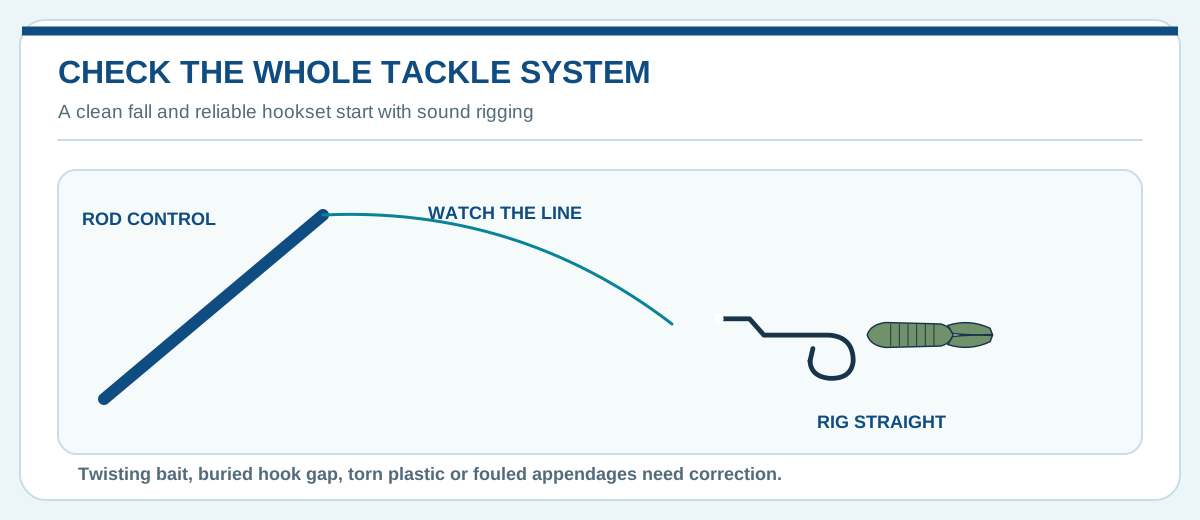
Use a rod and reel that can cast or pitch the chosen weight and control fish around the cover. The exact power depends on the rig and habitat: a light Carolina presentation on open bottom does not need the same equipment as punching a dense mat. Line should handle abrasion and offer sufficient control without making the bait too difficult to present.
Recognize the Bite
Watch the line closely on every fall. A line that jumps, moves sideways, or stops before the expected bottom depth deserves attention. Reel down, feel for weight, and set the hook with the tackle and hook style you selected. Do not swing blindly at every contact with rock or vegetation.
If the bait twists, rethread it in a straight line. If a trailer rolls, use a smaller size or mount it centrally. If a mat stops the rig at the surface, consider a more compact body and sufficient weight rather than simply adding more legs. If appendages are torn or stuck around the hook, replace the bait. Check local fishing rules and handle hooks safely.
| Problem | Likely check | Try |
|---|---|---|
| Twists on fall | Crooked body | Rerigg straight |
| Will not enter grass | Bulk or weight | Streamline and match sinker |
| Frequent snags | Exposed point or lane | Check hook and route |
| Missed fall bites | Excess slack | Watch and manage line |
| Plastic slides down | Torn head | Replace or use suitable keeper |
| Jig trailer rolls | Misaligned trailer | Center or resize |
Research and further reading: Outdoor Life on Texas rigging, Wired2Fish on creature bait applications, Bassmaster on hook styles, Bassmaster on compact baits in mats, Missile Baits on ribbed and flapping designs, and Reaction Innovations on the Beaver profile. Manufacturer descriptions explain particular products; they are not universal performance evidence.