
Soft Plastic Lure Anatomy
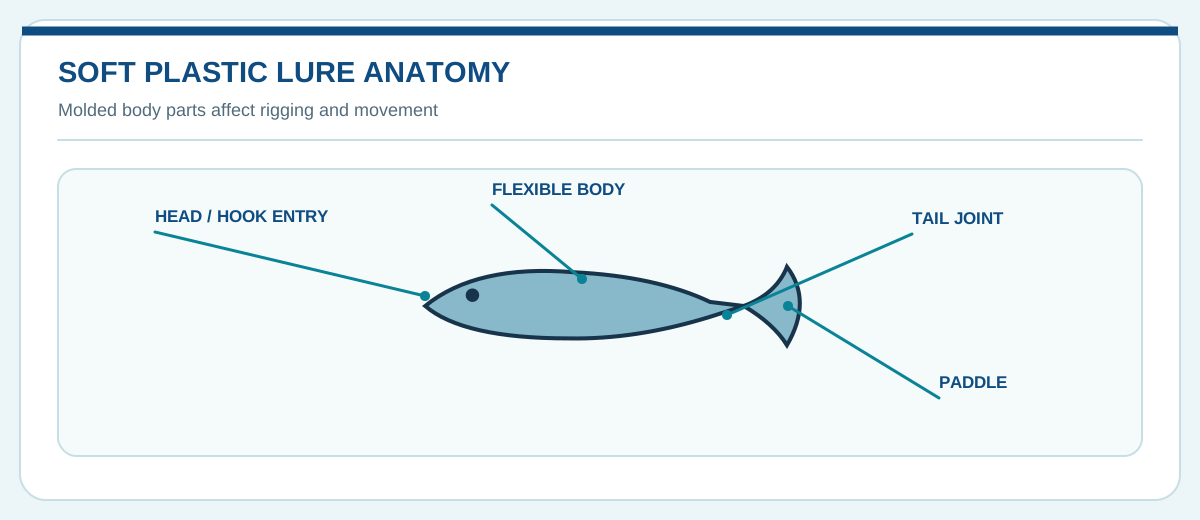
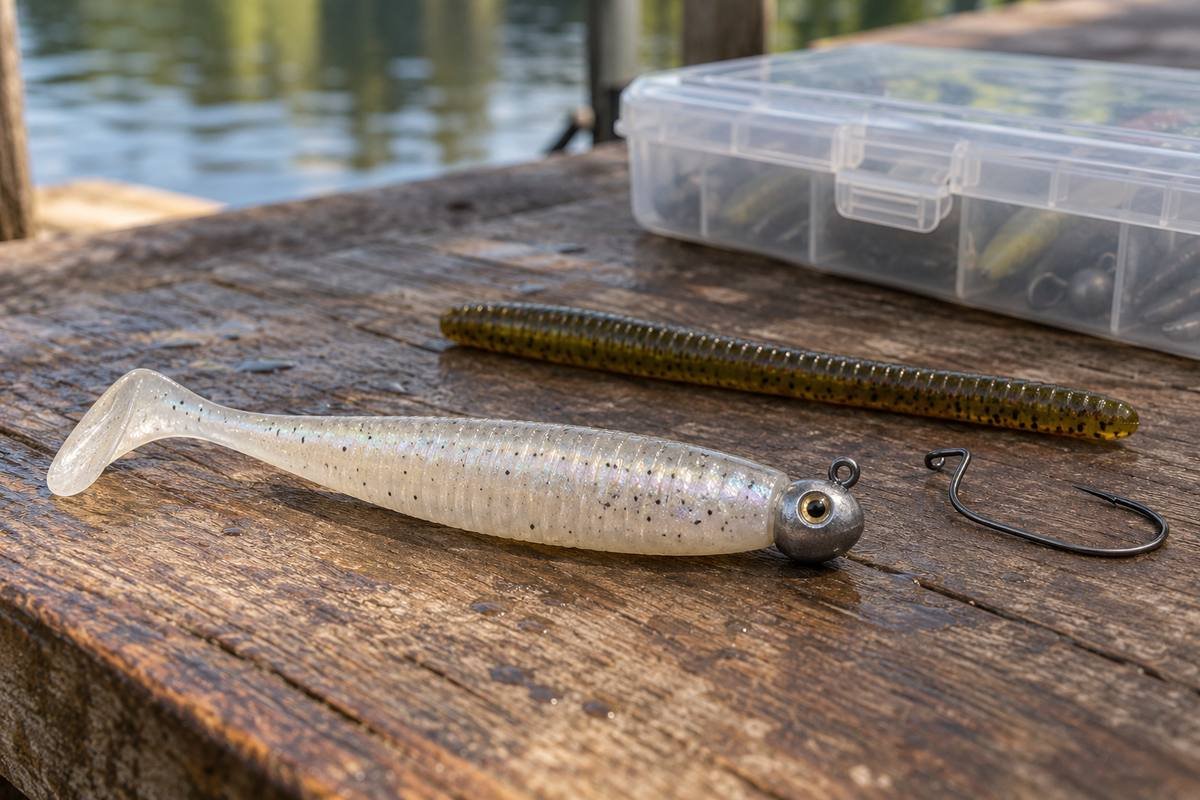
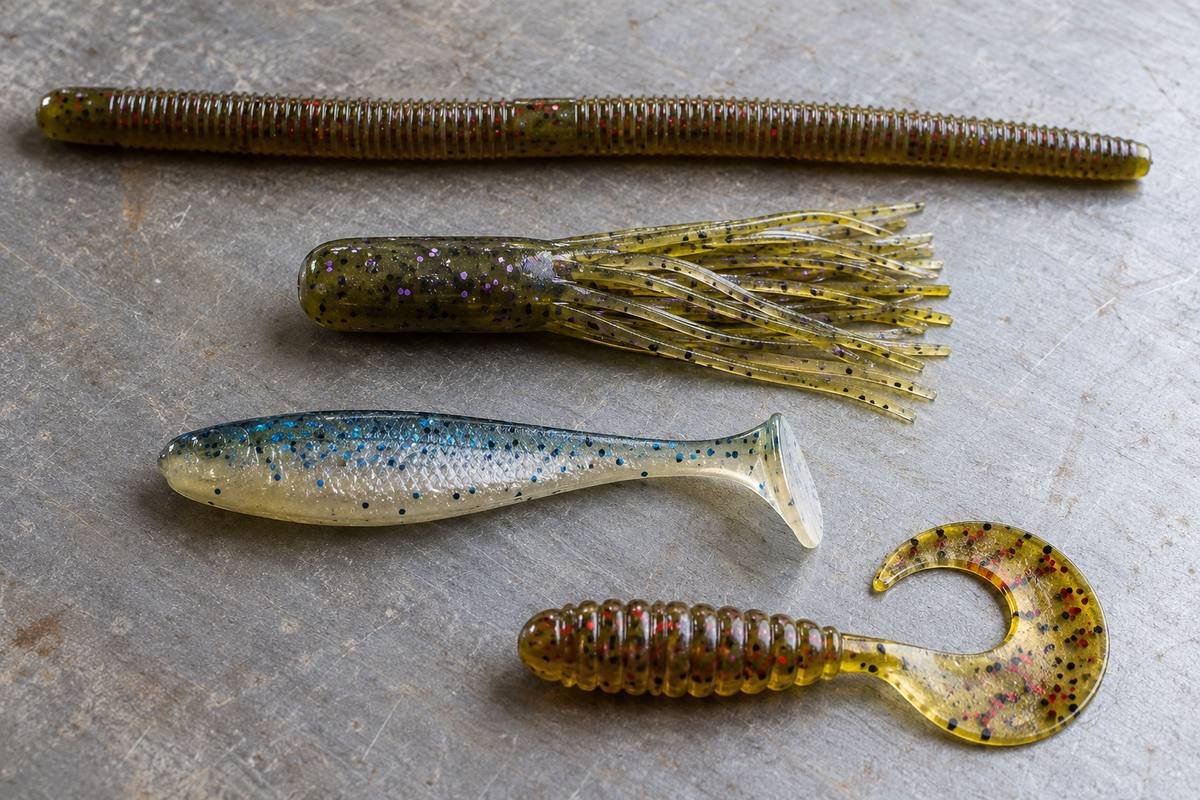
Soft plastic lure design starts with the body. A straight cylinder slips through cover and bends gradually. A flattened body glides and flutters differently. Ribs increase surface area and can change water resistance, while a narrow neck lets a tail swing more freely. An oversized paddle pushes more water at a given retrieve speed than a small one. These are design tendencies, not guarantees about a finished bait.
Parts That Change the Presentation
A curly tail may twist behind a grub; broad claws may flap on a falling craw; a split minnow tail may give only a restrained kick. The hook slot, belly thickness, and nose shape affect how straight the lure sits and how much room remains for hook penetration. Molded eyes or printed scales can help a profile resemble forage, but they do not substitute for the right depth and movement.
Compare two baits outside the package before fishing. Bend the thinnest joint gently, inspect the symmetry, then rig one and pull it through shallow water. A lure that looks active in your hand may barely move on a slow fall. Conversely, a slim worm may show subtle movement even when the angler pauses. The assembled hook, sinker, line, and body matter more than an isolated feature.
| Part | What to inspect | Possible effect |
|---|---|---|
| Body | Length and thickness | Profile and hook fit |
| Tail joint | Thickness and flexibility | Ease of tail movement |
| Appendages | Size and spacing | Water resistance and silhouette |
| Ribs | Depth and direction | Texture and flow around body |
| Hook channel | Position and depth | Alignment and hook clearance |
What Are Soft Plastic Lures Made Of?
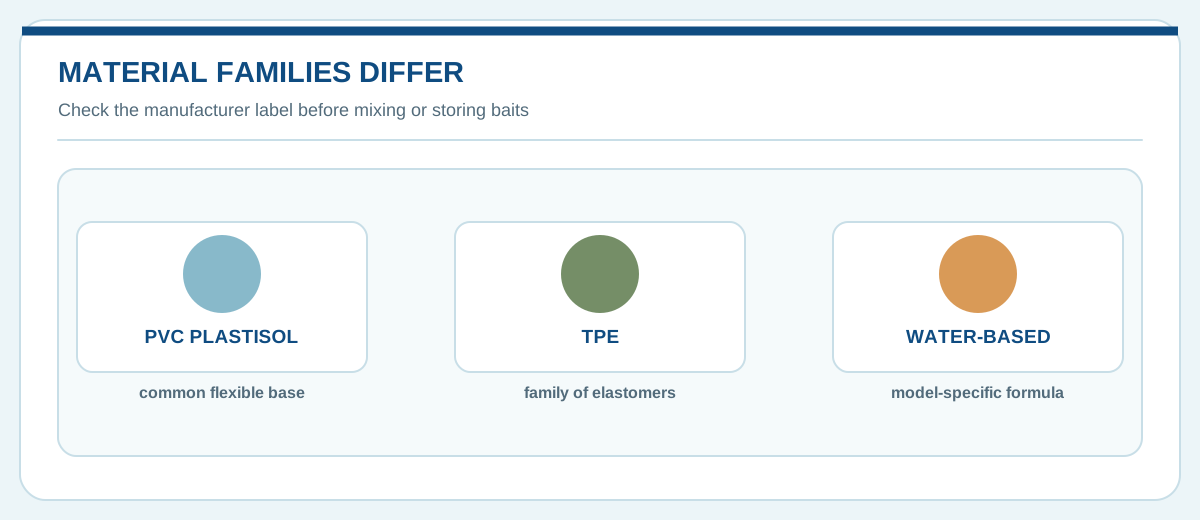
Many traditional soft baits are molded from PVC plastisol: PVC resin dispersed in liquid plasticizer and heated until it forms a flexible solid. Makers can adjust the recipe, so two plastisol worms can have noticeably different softness and tear resistance. Colorants, glitter, salt, scent, and other ingredients may also be included. The finished body's performance depends on the whole formulation and shape.
Alternatives Need Specific Labels
Thermoplastic elastomer, or TPE, is a family of materials, not one recipe. Some branded TPE baits stretch far and resist tearing; others behave differently. Certain products use other proprietary or water-based formulations. A manufacturer may describe a particular model as buoyant, scented, or biodegradable, but that claim cannot be extended to all soft plastics in its material family. Read the product label for the model in your hand.
Density and buoyancy are especially easy to oversimplify. Added salt can affect mass and fall, but the hook and sinker may dominate the complete rig. An unweighted buoyant body might still sink with a heavy hook. Likewise, a soft bait's color or strong smell does not identify its chemistry. For practical fishing, test the assembled lure in water rather than inferring its behavior from a single ingredient.
| Description | What it means | Check before use |
|---|---|---|
| PVC plastisol | Traditional flexible PVC-based formulation | Softness and additives vary |
| TPE | Broad thermoplastic elastomer family | Follow brand storage instructions |
| Other or water-based | Model-specific alternative formulation | Verify claims on that model |
| Salt or scent added | Additional ingredient or treatment | Check package and rig behavior |
Worms, Stickbaits, and Lizards
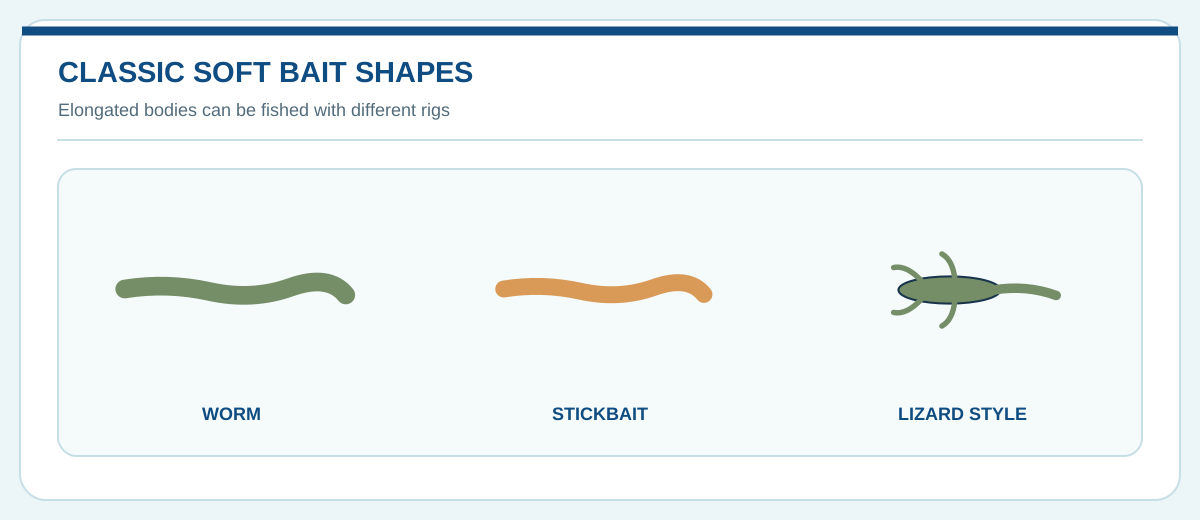
The straight-tail plastic worm is a slender, relatively restrained profile. It can be moved along bottom, suspended on a drop shot, or presented weightless where a slow fall is useful. A ribbon-tail worm has a long, thin trailing section that can undulate as water passes it. Neither style has a fixed action: a short pull, current, or sinker choice can change what the tail actually does.
Subtle and Broad Profiles
A soft plastic stickbait has a thicker, usually plain body. It often shines when allowed to fall or twitch with little added motion. The center-hooked Wacky rig and weightless offset hook are common ways to present it, though hook placement and local conditions control the result. Some stickbaits contain salt, but not all do; the same shape can be made in different materials and densities.
A lizard bait has an elongated body plus molded legs and a tail. Its silhouette is more complex than a worm's, but it need not imitate a real lizard perfectly to draw a response. Texas and Carolina rigs can carry one around cover or across bottom. Choose hook length and gap for its body, and check that legs are free rather than wrapped around the hook. The useful comparison is how each shape travels at the depth you need, not a claim that one universally catches more fish.
| Type | Defining shape | Starting presentation |
|---|---|---|
| Straight-tail worm | Slim, simple tail | Slow drag or drop shot |
| Ribbon-tail worm | Long flexible tail | Texas rig near bottom |
| Stickbait | Thick, plain body | Weightless or Wacky fall |
| Lizard | Body with legs and tail | Texas or Carolina rig |
Craws, Creatures, Tubes, and Grubs
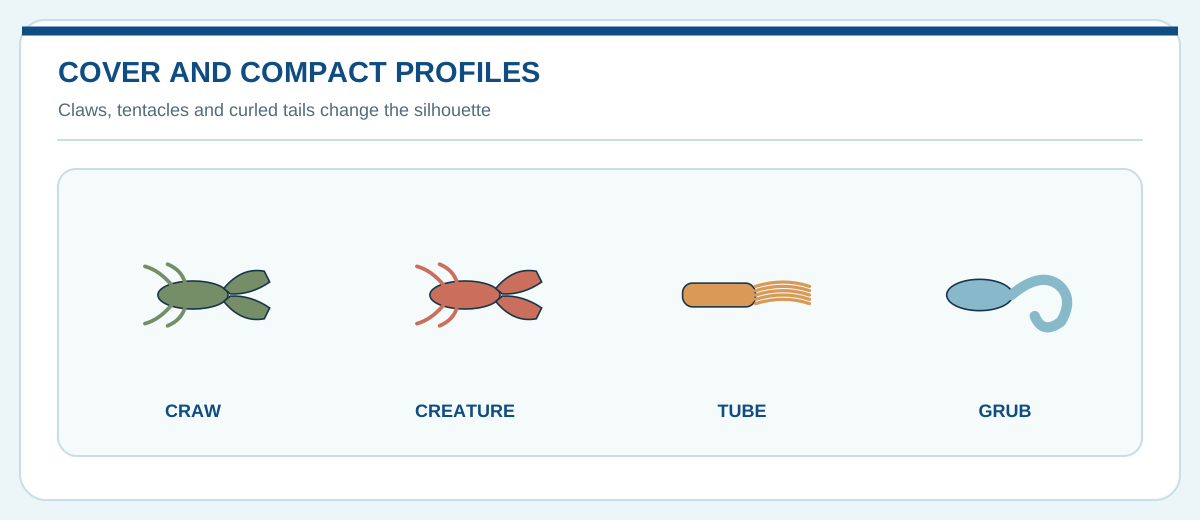
A craw bait emphasizes a crawfish-like body and claws. A creature bait is broader: it may combine claws, legs, paddles, and ribs without copying one animal. Both can be pitched near grass, wood, docks, or rock, or used as trailers behind a jig. Wide flappers often create visible action during a fall, while compact claws can pass through cover more easily. Our creature bait guide explains these profiles in more detail.
Hollow Bodies and Small Tails
A tube has a hollow or partly hollow body with a skirt of thin tentacles at the rear. A tube jig can be inserted inside it, leaving a streamlined shape that can spiral or glide depending on head placement and line tension. Tubes also work on exposed or concealed hooks. Inspect the skirt before casting: trapped strands may change the fall.
A grub generally has a compact body and one curly tail. Small grubs can be practical for panfish or trout; larger ones can cover water on a jighead for other species. The tail may start turning at a lower speed than a stiff paddle tail, but this varies with design and material. Select head weight for the depth and pace, then watch the bait beside the boat or bank. These categories overlap. A clawed grub can be sold as a creature, and a tube may act like a compact baitfish profile. Shape and rig are more informative than package category.
| Type | Main visual cue | Common role |
|---|---|---|
| Craw | Claw-like appendages | Bottom or jig trailer |
| Creature | Mixed legs, claws, or flappers | Cover or trailer |
| Tube | Hollow body and skirt | Glide, hop, or drag |
| Grub | Compact body and curled tail | Small swimming presentation |
Soft Minnows, Swimbaits, and Toads
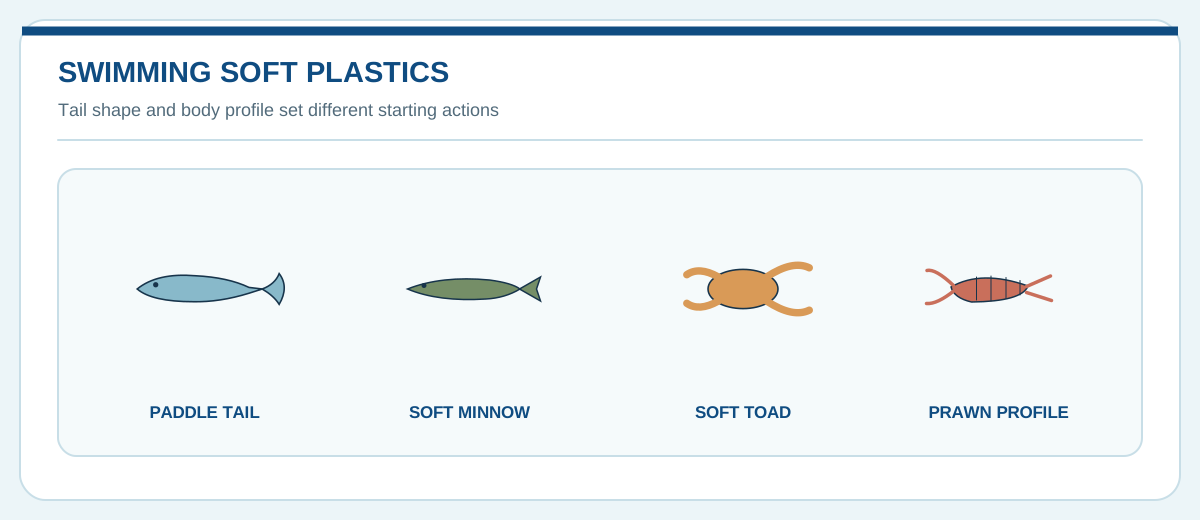
A paddle-tail swimbait carries a flat rear paddle on a narrow tail stem. When retrieved at a suitable speed, water pressure makes the paddle oscillate and often causes the body to roll. A soft minnow or soft jerkbait, sometimes called a fluke-style lure, tends to have a slimmer, straight or forked tail. It may dart on rod twitches or glide on slack line rather than making a strong steady kick.
Surface and Saltwater Profiles
A soft-plastic toad often has a broad body and two kicking legs. Many are retrieved at or near the surface; an offset hook may keep the point close to the body where cover is present. The toad should ride level and the legs should work at the intended speed. It differs from a hollow-body frog, which typically has a separate hollow shell and its own hook arrangement.
Soft shrimp and prawn lures add another useful silhouette for inshore saltwater fishing. Some are worked near bottom on jigheads, while others are suspended below floats or on other local rigs. Saltwater swimbaits may target redfish, sea trout, or other predators where those species occur. Choose corrosion-resistant terminal tackle as appropriate and rinse gear after use. Whether the lure is called a minnow, jerkbait, shad, or prawn, inspect its actual profile. A split tail that sits still on steady retrieve may be intended for twitch-and-pause fishing rather than a continuous swim.
| Profile | Typical movement | Check |
|---|---|---|
| Paddle-tail swimbait | Repeated tail kick | Minimum working speed |
| Soft minnow or jerkbait | Twitch and glide | Straight rigging |
| Soft toad | Surface leg kick | Level ride and hook clearance |
| Shrimp or prawn | Hop, drift, or slow swim | Depth and local species |
How Soft Plastic Lures Work Underwater
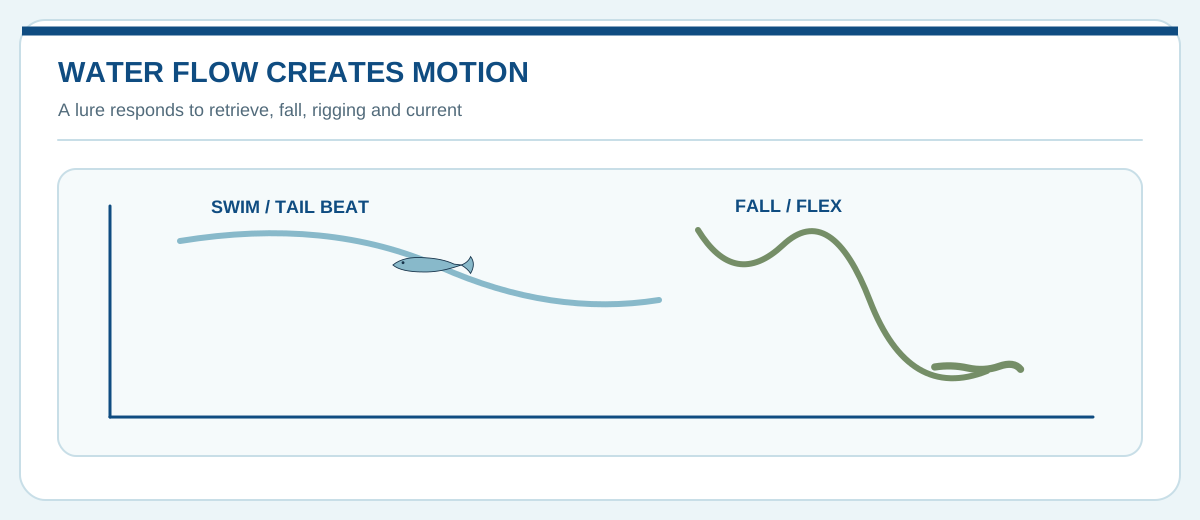
Most soft plastics have no diving lip or spinning metal blade. Their motion comes from flexible geometry meeting moving water, plus the angler's line tension and rod input. Pull a paddle tail and its broad end resists the flow; the thin joint bends, then reverses. A curly grub tail follows a different path because its curve and thin section are arranged differently. A straight worm may show little visible motion but can still move naturally during a pause.
Fall, Drag, and Swim
On a fall, gravity and buoyancy act on the entire rig, not just the plastic. A nose-heavy jighead often leads a bait downward. A weightless stickbait may fall more horizontally, while an offset hook or embedded salt can change its balance. Tensioned line draws an arc; slack line allows a freer descent but reduces immediate contact. On bottom, short hops make a craw rise and settle. On a steady retrieve, the same lure may roll, track straight, or spin if mounted poorly.
For the lure to work, fish must encounter it at a usable speed and depth. Visual contrast, silhouette, vibration, displacement, and perhaps scent may contribute, but their importance changes with species and conditions. There is no universal “best action.” Our guide to how fishing lures work covers the wider set of cues.
| Phase | What drives movement | Useful observation |
|---|---|---|
| Fall | Weight, buoyancy, line tension | Angle and tail response |
| Bottom contact | Rod lift and substrate | Hop height and glide |
| Steady swim | Retrieve speed and water flow | Tail kick without spinning |
| Pause | Current and remaining momentum | Natural settle or drift |
Six Common Soft Plastic Rigs
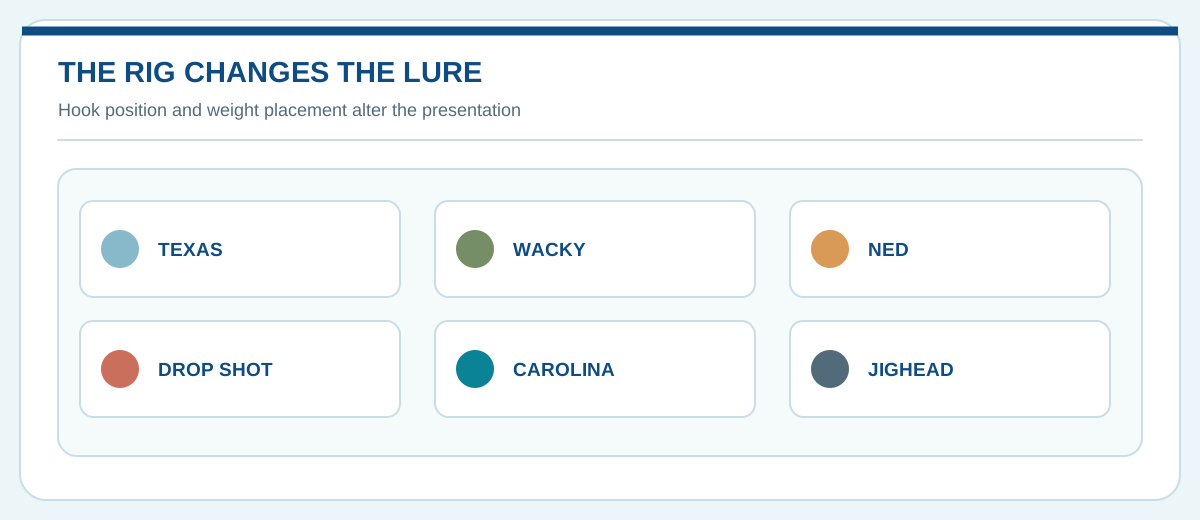
A rig is the combination of lure, hook, weight, line, and where those parts sit. A Texas rig threads the bait on an offset or similar hook, often with a bullet sinker ahead. The hook point can be kept close to the body for vegetation or wood. A Wacky rig hooks a stickbait near its middle, leaving both ends free to bend on a fall. It is comparatively exposed and can catch cover.
Bottom and Suspended Options
A Ned rig usually combines a compact soft bait with a small mushroom-style jighead for a controlled bottom presentation. A drop shot suspends the hook and plastic above a weight tied below it, useful when fish are holding just off bottom. A Carolina rig places the weight ahead of a leader and lure, giving the bait separation behind the sinker. A conventional jighead holds many grubs, minnows, and swimbaits for swimming or hopping.
None of these is a species-specific rule. A bass angler might use a Texas rig for grass and a drop shot for a deeper edge; a saltwater angler might start with a jighead and paddle tail. Depth, cover, target, and local rules decide the practical choice. Begin with a simple rig you can cast and feel. Change one component after observing a problem rather than assuming more weight, a larger hook, or a brighter bait is always the answer.
| Rig | Layout | Practical starting use |
|---|---|---|
| Texas | Bait on hook; optional bullet sinker | Target cover |
| Wacky | Hook near bait center | Slow open-water fall |
| Ned | Compact bait on small jighead | Bottom contact |
| Drop shot | Hook above lower weight | Hold bait off bottom |
| Carolina | Weight ahead of leader | Search open bottom |
| Jighead | Weight fixed at hook head | Swim or hop |
How to Rig a Soft Plastic Straight
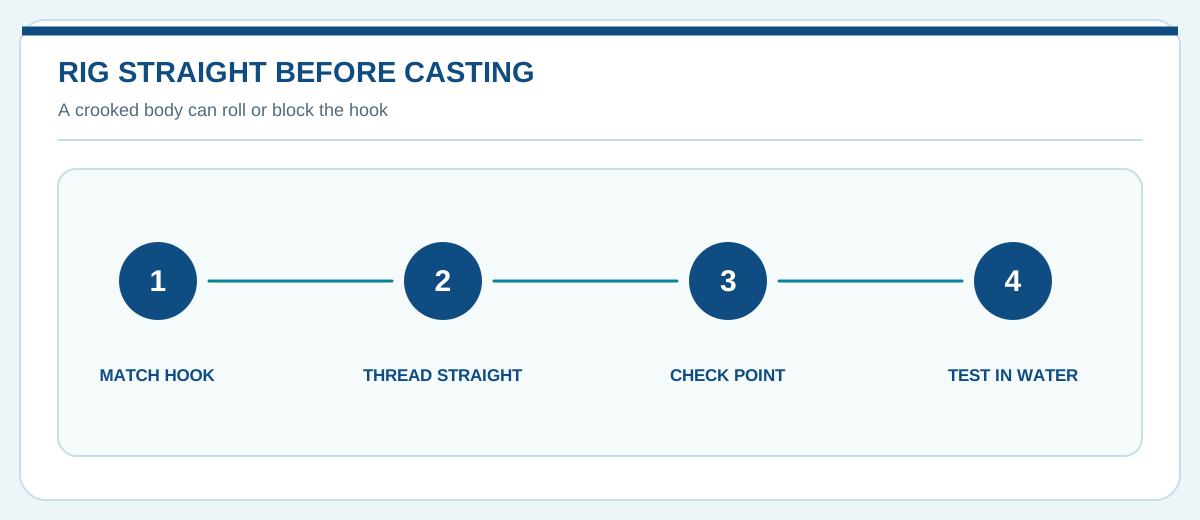
A crooked soft bait is one of the most common causes of rolling and weak action. Before piercing it, hold the hook against the body and note where the point should enter and exit. The body must remain centered on the shank without being stretched or compressed. A thick bait needs enough hook gap for its body to move out of the way when a fish takes it. Exact hook size depends on the model and hook pattern.
Texas Rig Sequence
- Choose a hook whose gap and length suit the bait and cover. Slide a bullet sinker onto the line first if the presentation needs one.
- Insert the point through the nose and exit a short distance down the centerline. Move the bait up to the offset or keeper.
- Rotate the bait, lay the hook alongside it, and mark where the point should re-enter.
- Pass the point through at that mark. Keep the body straight and the point flush or lightly skin-hooked for the cover.
- Pull the rig through shallow water. Rethread it if it twists or bows.
Jighead Sequence
For a jighead, measure the hook along the bait first, then enter through the exact center of the nose. Thread the body along the shank and exit at the measured point on its back. Push the nose against the head or keeper without bunching the plastic. A paddle tail must be free to swing. A straight bait on the correct hook is usually more important than adding a second color.
| Check | Pass condition |
|---|---|
| Nose | Hook enters on centerline |
| Exit point | Body neither stretched nor bunched |
| Hook gap | Room for plastic compression |
| Tail | Free from line and hook |
| Water test | Tracks without persistent roll |
Six Ways to Retrieve Soft Plastics
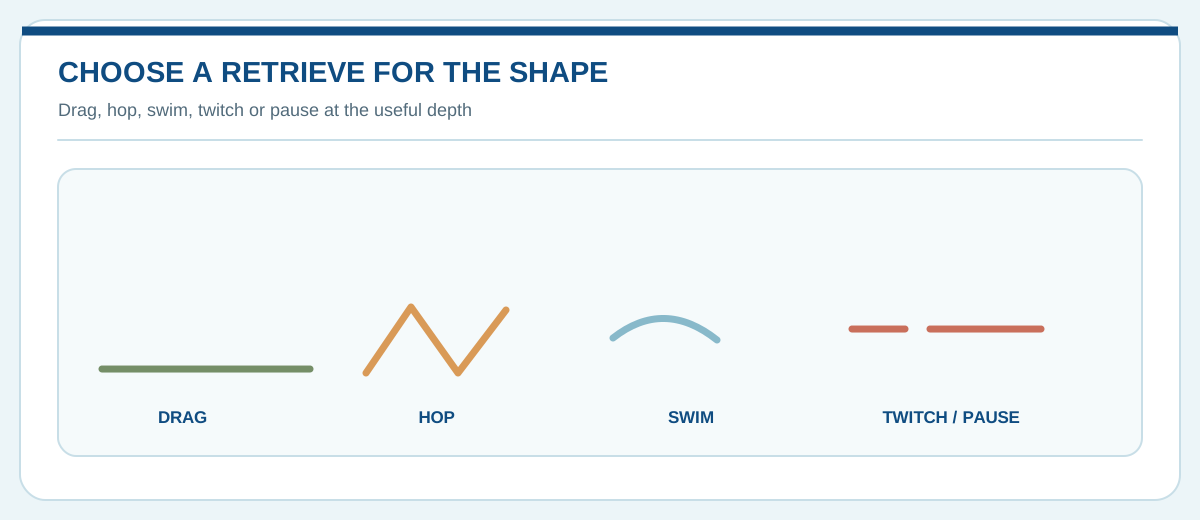
Start by watching the bait beside the bank or boat. A retrieve that makes a paddle tail kick may make a soft minnow look unnatural. Use just enough speed to activate the chosen shape at the intended depth. If the lure rolls, first check alignment and head weight. Then change speed. A retrieve is useful only when the lure remains in the zone where fish are likely to meet it.
Swimming and Falling
For a steady swim, cast beyond the target, let the lure reach its depth, and turn the handle at a pace that keeps the tail working. A lift-and-fall retrieve raises a jighead or weighted swimbait, then lets it descend under controlled slack. Count down when safe and note where bites occur. A soft toad's surface retrieve is different: keep it moving enough to make its legs work, then manage the pause and hookset according to the hook and fish.
Bottom and Midwater Changes
A slow drag follows bottom with minimal hops and can suit a worm, craw, or compact bait. Short hops lift the lure briefly, emphasizing its fall. Twitch-and-pause can make a soft minnow dart and then glide. A drop shot can hold a lure above bottom while subtle rod movement gives it life; there is no need to shake constantly. In current, a controlled drift may provide much of the action. Record which depth, speed, and phase drew the strike rather than remembering only the bait color.
| Retrieve | Useful shape | First adjustment |
|---|---|---|
| Steady swim | Paddle tail or grub | Speed |
| Lift and fall | Jighead minnow | Fall time |
| Bottom drag | Worm or craw | Contact and pause |
| Short hop | Creature or tube | Hop height |
| Twitch and pause | Soft jerkbait | Slack and pause length |
| Vertical hold | Drop-shot worm | Distance above bottom |
Fish Species and Habitats
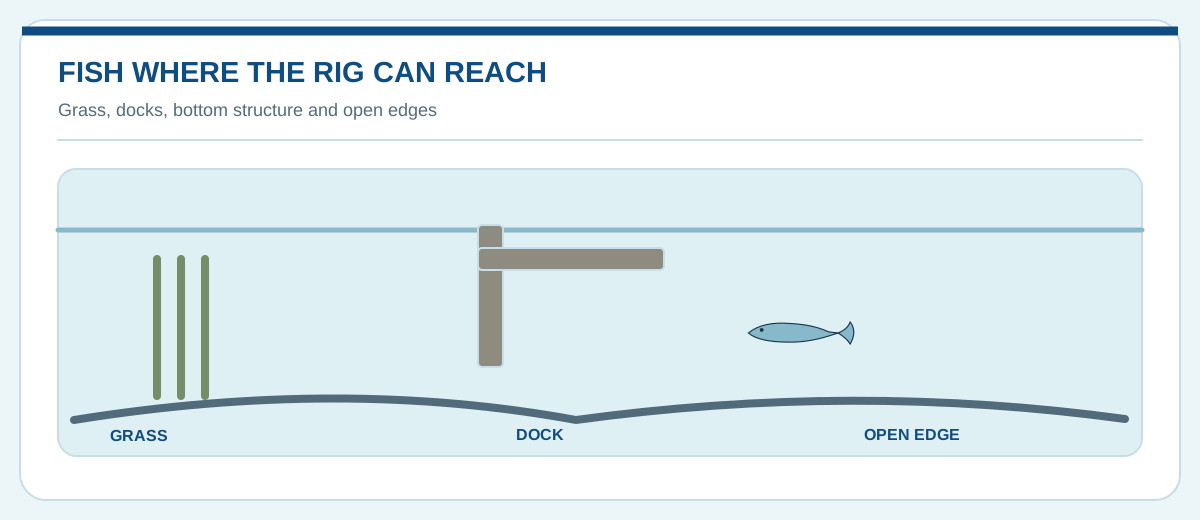
Soft plastics are used in freshwater and saltwater because their shapes and rigs can be adapted to many feeding zones. Bass anglers often present worms and creatures near vegetation, wood, docks, and rock. Smaller grubs or worms may suit panfish and trout. Walleye anglers commonly swim or hop a minnow or paddle tail on a jighead. These are starting associations, not promises that a species always prefers a particular body.
Match the Depth Before the Color
Inshore anglers may fish soft shrimp, minnows, or paddle tails for redfish, sea trout, and other local predators. A jighead, weedless hook, or suspended rig can place them near grass edges, oyster bars, channels, or shorelines when appropriate. Offshore soft baits can be much larger and require correspondingly different hooks and tackle. Check regional regulations, seasons, hook requirements, and species limits before fishing.
Habitat tells you what the rig must do. A weed-resistant setup may pass through grass where an exposed jighead catches. On clean sand or open rock, the exposed hook may provide a more direct hook point but can snag hard cover. Current adds a different challenge: the sinker needs enough control to reach the zone without making the presentation unnaturally fast. Decide where fish are holding, then select a body and rig that can travel through that exact place.
| Setting | Plastic to consider | Rig consideration |
|---|---|---|
| Bass near grass | Worm, craw, creature | Weed-resistant hook |
| Walleye on edge | Minnow or paddle tail | Jighead depth control |
| Panfish or trout | Small grub or worm | Light tackle and local rules |
| Inshore predators | Shrimp, minnow, paddle tail | Saltwater-suitable hardware |
| Open deep water | Profile matching forage | Weight and line control |
Choose Size, Color, Weight, and Tackle
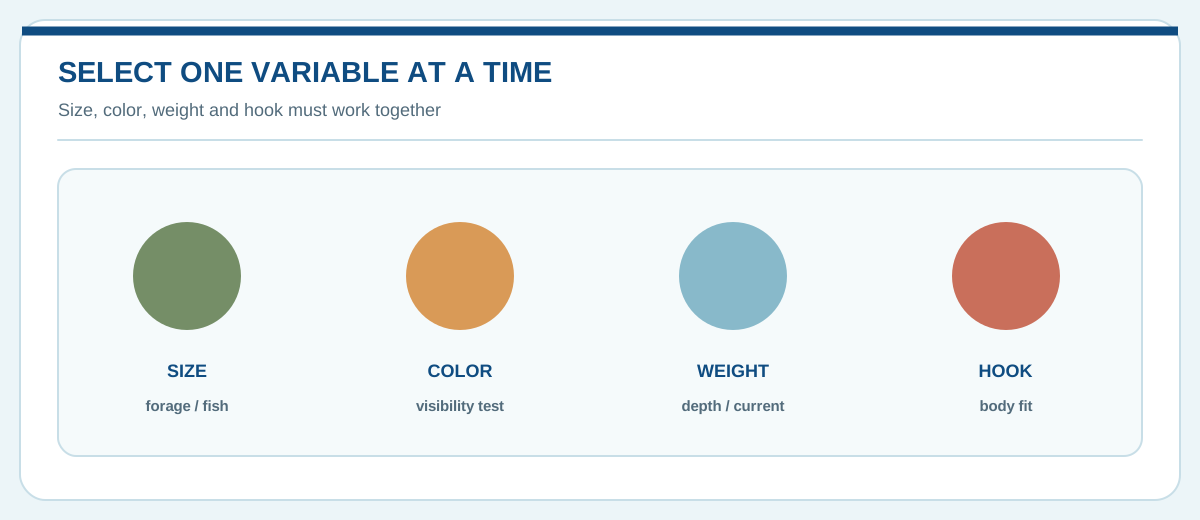
First decide the target species and the water layer you can realistically reach. A tiny grub may be appropriate for panfish; a larger swimbait may match a larger forage profile. Body size also affects hook gap, casting weight, and how easily fish can take the lure. A long bait does not always need a long hook if its flexible tail must remain free. Match the hook to the portion intended to hold it.
Color Is a Test, Not a Formula
Natural-looking translucent, green, or silver profiles are reasonable starting points in clear water, where fish can see details. In darker water, contrast or a stronger silhouette may be easier to notice. But available light, bottom color, depth, and local forage all change what a lure looks like underwater. Carry a few distinct options and test them at the same depth and speed before declaring one superior.
Weight controls more than casting distance. A heavier jighead often increases descent speed and bottom contact; it may also make a small tail work differently or cause repeated snags. A weightless rig can slow the fall but may be hard to cast or control in wind and current. Choose rod, reel, and line that cast the total rig, reveal a bite, and handle the cover. Abrasion around shell or rock calls for extra attention to line condition. Start with the lightest practical setup that reaches and controls the target zone, then adjust from actual performance.
| Decision | Question to answer |
|---|---|
| Profile | What size and outline matches the target? |
| Action | Do I need a kick, dart, glide, or subtle fall? |
| Color | What contrast will the fish see at depth? |
| Hook | Does the body leave enough usable gap? |
| Weight | Can the rig reach and hold the zone? |
| Tackle | Can I cast, detect, and land fish here? |
Storage, Durability, and Common Mistakes
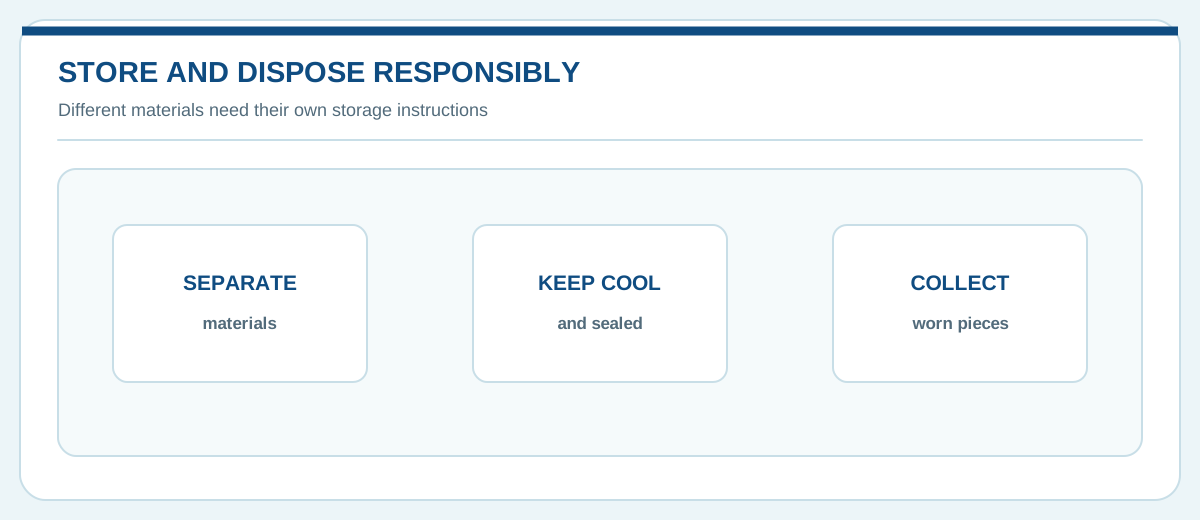
Keep soft plastics in labeled original bags or containers when possible. Store them away from excessive heat and direct sun. Some material combinations can react or adhere when mixed, especially particular TPE and traditional soft plastics, so follow each manufacturer's storage instructions and separate unfamiliar products. Scent-soaked products may need their sealed original containers. A molded bait left bent for a long period can take a set and later swim crooked.
Inspect, Repair the Rig, and Replace
Durability varies with formulation, thickness, hook placement, and fish or cover damage. A torn nose may slide down the shank; a damaged tail may stop moving. Re-rig a usable bait straight, replace it when it will no longer hold, and check the hook point. If a lure spins, do not assume the material is defective: inspect where the hook exits, the symmetry of the body, and retrieve speed. If it snags repeatedly, change the casting lane, hook exposure, or weight placement before abandoning the category.
Lost or discarded plastic can persist in aquatic places. Research on selected products has found leaching and biological effects under test conditions; that does not establish an identical impact for every formulation or waterway. Recover loose or torn pieces when safe, keep used baits out of the water and shoreline, and dispose of them according to local guidance. Treat any “biodegradable” claim as model-specific and verify it rather than assuming a soft body will disappear harmlessly.
| Problem | Likely check | Practical response |
|---|---|---|
| Bait rolls | Off-center hook or excess speed | Rerig; slow down |
| Tail does not kick | Speed, stiffness, or obstruction | Test near surface |
| Plastic slides | Torn nose or poor keeper | Replace or change keeper |
| Repeated snags | Hook exposure and route | Change rig or casting angle |
| Bait deforms in box | Heat or material contact | Separate and store cool |
| Worn bait left behind | Disposal habit | Retrieve and pack it out |
Research and further reading: Wired2Fish on soft plastic categories, Outdoor Life on Texas rigging, Shimano on jighead selection, Z-Man on a specific TPE formulation, research on tested soft lure material leaching, and research on ecological effects of tested lures. Product claims and study results apply to the models and conditions described by their sources.