Inline Spinner Anatomy

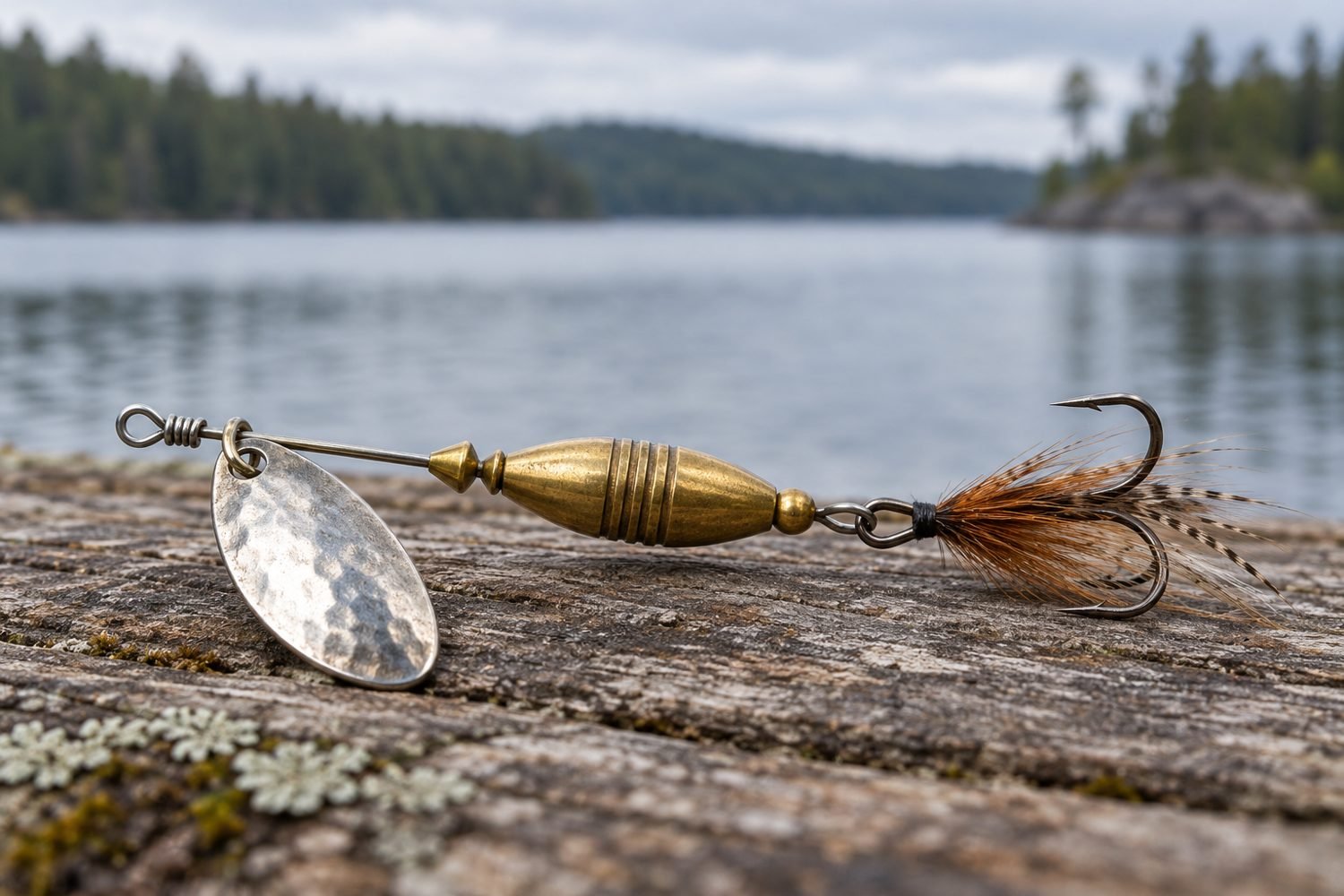
Shaft and line eye. The central wire keeps the lure's parts aligned and terminates in a front eyelet for the fishing line. It must be straight enough for the blade to turn and the body to track. A bent shaft or rough loop can change the action. Some models incorporate additional line-twist control or body pieces, so inspect the exact build.
Blade and mount. A metal blade is the primary moving component. On a traditional clevis-mounted model, the small U-shaped clevis rides on the shaft and supports the blade as it revolves. Beads or spacers may keep parts separated and reduce friction. Panther Martin also sells shaft-through designs: the wire passes directly through a shaped blade, so a conventional clevis is not necessary.
Body and hook. A weighted metal body helps the lure cast and sink. It may be turned brass, painted metal, or another construction. The rear hook may be a treble or single, bare or dressed with feather, hackle, hair, or synthetic fibers. A dressed hook changes outline and movement but is not the blade's drive mechanism. Confirm local hook rules before replacing hardware.
| Part | Function | Inspect |
|---|---|---|
| Front eyelet | Connects line | Closed and undamaged |
| Wire shaft | Central axis | Straight and secure |
| Blade | Rotates in water | Free of bends |
| Clevis or other mount | Allows blade motion | No binding |
| Beads or spacers | Separate components | Correct placement |
| Weighted body | Casting and depth | Secure on shaft |
| Rear hook | Catches fish | Sharp and legal |
How It Works Underwater

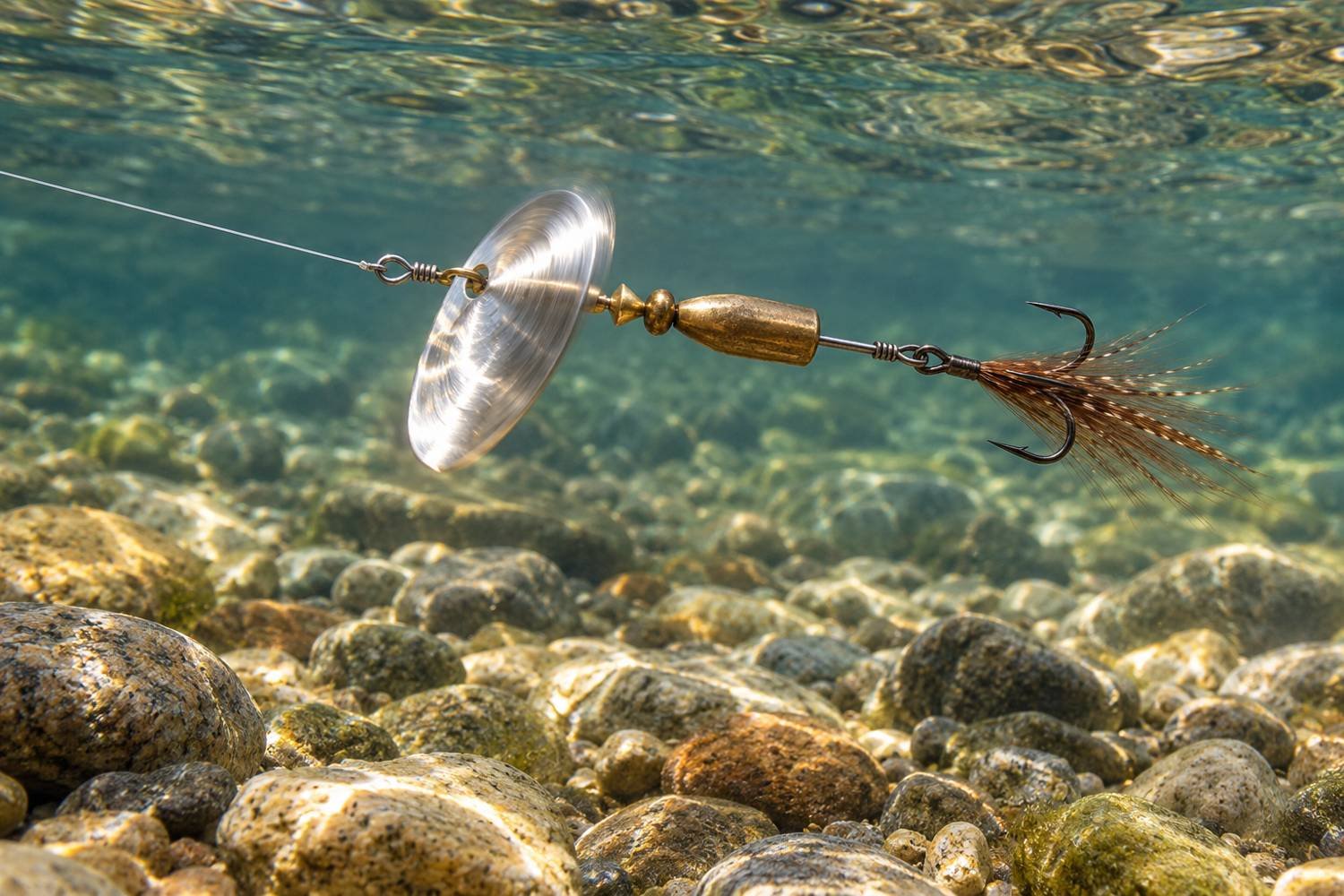
After the cast, most conventional weighted spinners begin to sink. As the angler reels, the lure moves relative to the water. Pressure on the blade's curved or angled surface starts it revolving around the shaft. Once it turns cleanly, each revolution changes the blade's angle to the light and pushes water in a repeated pattern. This is generally continuous rotation during a working retrieve, unlike the rapid side-to-side motion of a bladed jig's front plate.
A steady retrieve may be enough to maintain rotation. Current can also supply relative flow when the lure is held or moved at a suitable angle. At a dead stop, the blade may slow or stall and the lure normally descends. A quick initial handle turn can help the blade start, but a spinner that repeatedly needs violent jerks should be inspected for fouling or an unsuitable speed.
Flash is an optical effect: the blade reflects available light at changing angles. Vibration and water displacement are mechanical effects of the blade moving through water. The body and dressed hook can add motion, but the blade is the main source of spinner action. Feel for a consistent pulse through the rod and watch the lure during a short clear-water test.
| Stage | What happens | Field check |
|---|---|---|
| Splashdown | Weighted body sinks | Count only with bottom clearance |
| Start | Water catches blade | Blade turns promptly |
| Retrieve | Blade revolves around shaft | Pulse remains regular |
| Pause | Rotation slows; lure descends | Avoid snags |
| Restart | Relative flow returns | Action resumes |
French, Colorado, and Willowleaf Blades

A broad French or Aglia-style blade often revolves at a wider angle from the shaft, creating resistance and lift. Mepps describes its Aglia as suitable for slow retrieves and relatively shallow presentations. A rounded Colorado-style blade can offer a broad water-pushing profile, though an inline version's exact action depends on its mount and body. Comet-style blades occupy a middle range in Mepps' catalog.
Narrower willowleaf or Aglia Long-style blades usually run closer to the shaft and may suit stronger current or a lower retrieve path. Mepps gives model-specific blade-angle examples; these are useful comparisons within its range rather than universal angles for all manufacturers. A narrow blade on a light body can still ride high if reeling speed or current creates enough lift.
Blade finish also changes the visual cue. Smooth silver can give cool-toned flash in brighter conditions; brass or gold produces a warmer reflection; painted blades offer contrast and may flash less exposed metal. Water clarity and available light matter more than a fixed rule that one finish is “best.” Choose a profile for the desired resistance and depth, then refine color.
| Style | General tendency | Verify |
|---|---|---|
| French/Aglia | Wide angle, lift, slow-speed start | Model weight and current |
| Rounded Colorado-style | Broad resistance and pulse | Mounting design |
| Comet-style | Intermediate profile | Running layer |
| Willowleaf/Aglia Long | Narrower travel near shaft | Actual startup speed |
Clevis and Shaft-Through Designs

A clevis is a small metal link that carries the blade while its legs ride around the central wire. It gives the blade freedom to revolve as the lure is pulled. Many familiar spinners, including conventional Mepps Aglia and original Rooster Tail models, use a clevis. Beads or a bearing washer may help keep the mount separated from the weighted body.
In a shaft-through arrangement, the wire passes through an opening in the blade itself. Panther Martin describes this configuration on its WillowStrike line and specifically notes that it spins without a clevis. Both layouts qualify as inline spinners because the blade rotates around the central axis. They can differ in startup, blade angle, water resistance, and feel, but those outcomes depend on the actual shape and build, not only the name of the mount.
Startup matters on short casts, near a rock pocket, or in a narrow current seam. If a blade does not start until late in the retrieve, much of the useful path is wasted. Test the model at the slowest speed you intend to fish. Inspect a bent clevis, rough bearing surface, tangled feather, or damaged shaft before blaming the design. Avoid bending the blade blindly; that can make its action less consistent.
| Mount | How blade is carried | What to check |
|---|---|---|
| Clevis | Small link rides on shaft | Free travel and spacing |
| Shaft-through | Shaft passes through blade | No binding at opening |
| Either type | Blade revolves around axis | Prompt start at chosen speed |
Why Fish May Strike Inline Spinners

A revolving blade presents flashes as its surface changes angle to incoming light. It also displaces water and creates pressure changes. Fish can use vision and water-movement sensing to interpret their surroundings, but the relative importance of each cue varies with clarity, light, current, species, and location. A shiny blade in deep shade will not flash as it does in sunlight, while its mechanical rotation may continue.
The compact body and rear dressing can suggest a small moving prey item without perfectly imitating a single animal. A trout holding beside a current seam, a smallmouth near rock, or a panfish in a pond may inspect or strike when the lure passes close enough. Feeding activity, a sudden direction change, or the lure entering an ambush lane can all contribute. It is inaccurate to say that all fish attack spinners from hunger, aggression, or irritation.
Present the lure first where fish are likely to hold, then tune speed and depth. A bright blade can be a useful visual experiment in clear or moderately stained water; a darker blade may give a stronger silhouette in some light. If fish follow without taking, change the angle or pace before cycling through many colors. One successful cast does not prove which sensory cue caused the strike.
| Cue | Source | Depends on |
|---|---|---|
| Flash | Reflected light from rotating blade | Finish and available light |
| Water movement | Blade displacing water | Shape and rotation |
| Profile | Body, hook dressing, blade | Size and color |
| Path change | Retrieve or current seam | Casting angle |
Choose Size, Weight, Color, and Hooks

Start with the fish and water rather than a single advertised “best size.” Small, light spinners can suit narrow streams and panfish tackle; larger and heavier versions cast farther and may address deeper lakes, broader rivers, or larger predators. Blade size and total lure weight are separate specifications. A broad blade on a moderate body can lift more than a narrow blade at the same retrieve speed.
Silver, gold, and copper finishes reflect differently as light and water color change. Painted blades can provide bright contrast or a subdued silhouette. For a simple test, carry one reflective finish and one contrasting pattern in the same size, then compare at the same depth. Dressed hooks add bulk and movement; bare hooks retain a slimmer profile. The dressing can also hold water and alter how a small spinner casts.
A single hook may be required by local rules or preferred where release and snag avoidance matter. A treble offers several points but can be harder to remove and catches more cover. Changing hooks may affect balance, so use a size suited to the lure's intended hardware. Check barbless requirements, protected species rules, and permitted hook counts before fishing.
Manufacturer names describe specific products: Mepps Aglia is a classic French-blade example; Panther Martin includes shaft-through models; Yakima Bait's Rooster Tail adds a hackle dressing; Blue Fox Classic Vibrax has a two-part body intended to reduce line twist. Those features should not be assumed for all spinners.
| Decision | Starting thought | Verify |
|---|---|---|
| Size | Match forage and target fish | Actual blade and hook dimensions |
| Weight | Match cast and depth | Rod rating and current |
| Finish | Compare metal and painted | Light and clarity |
| Hook | Single or treble | Local rules and lure balance |
| Dressing | Slim or fuller outline | No tangles or drag |
What Fish Can You Catch?

Trout. Small inline spinners are commonly cast across stream seams, into pools, or along lake shorelines. Select a lure heavy enough to cast but light enough to avoid dragging exposed hooks across the bottom. A single hook may simplify release where regulations allow or require it.
Smallmouth and largemouth bass. Smallmouth can respond in rivers or along rocky lake edges; largemouth may take a spinner along open weed lines, docks, or pond banks. A compact spinner covers water but is not weedless. Larger profiles and appropriate line may help around bigger bass or more cover.
Panfish and other predators. Tiny models can be effective for bluegill, perch, or crappie where allowed. Suitable larger versions can be used for pike, walleye, salmon, or steelhead in the appropriate waters. Check local regulations, seasonal closures, hook rules, and tackle strength. Tooth-bearing fish may require a suitable leader; delicate ultralight gear is not a sensible match for every predator.
Species lists are possibilities, not catch promises. More useful than memorizing a long list is matching spinner weight and blade behavior to the water layer fish occupy. A properly chosen small blade passing a holding lane can be more useful than an oversized lure that runs above or below the fish.
| Fish | Typical water | First priority |
|---|---|---|
| Trout | Streams and lake edges | Current seam and legal hooks |
| Smallmouth bass | Rocky rivers and points | Controlled cross-current path |
| Largemouth bass | Pond banks and open weed edges | Avoid snagging cover |
| Panfish | Shallow open water | Small profile and light tackle |
| Pike or salmon | Appropriate larger waters | Gear strength and regulations |
Five Retrieves for Lakes and Ponds

Steady cast and retrieve. Cast past a likely fish position, allow the lure to settle briefly if necessary, then reel fast enough to keep the blade turning. Feel for a consistent pulse. This is the best first test because it establishes how that spinner works in still water.
Slow roll. Use the slowest retrieve that maintains blade rotation near a chosen deeper edge. A narrow blade or heavier body may help, but verify the lure's actual path. If the pulse stops and the hook catches bottom, increase speed or raise the rod slightly.
Countdown. Count seconds after splashdown before reeling to compare different layers with a sinking model. A count is not a precise depth measure: line tension, wind, blade lift, and body design affect the path. Repeat a productive count and pace rather than assuming one second equals a set distance.
Speed change. Accelerate for a few handle turns and return to a steady pace. The blade's rotation and running height may change, creating a new presentation. Avoid reeling so fast that the entire lure rolls or line twist builds.
Shoreline parallel. Cast along a bank, open weed line, or drop-off so the spinner stays near useful structure for more of the retrieve. Adjust rod position to keep it clear of grass and rock. If cover is too dense, switch to a lure with better snag resistance.
| Method | Main use | Monitor |
|---|---|---|
| Steady | Search open water | Blade pulse |
| Slow roll | Lower layer | Bottom clearance |
| Countdown | Compare depths | Repeatable sink count |
| Speed change | Alter pace and flash | Tracking and line twist |
| Parallel bank | Longer time near cover | Hook clearance |
How to Fish Rivers and Streams

Current supplies part of the relative flow that turns a blade. Casting upstream lets the lure move toward you with the water, so you may need to reel quickly enough to maintain tension and rotation. A cross-stream cast moves the spinner through current at an angle, allowing it to sweep across seams and pockets. Watch line bow: a strong downstream belly can lift or speed the lure beyond the intended lane.
A controlled swing can carry the spinner across a run as current presses on the blade. Begin upstream of the target, retrieve just enough to keep it working, and let it arc toward slower water. A pause near the end of the swing may change depth or stall rotation; keep a useful line angle. In very fast water, a narrow blade and suitable weight may track more steadily than a broad, high-lift design.
Focus on seams between fast and slow flow, eddies, behind boulders, and deeper pockets where fish can hold without constantly fighting the main current. Cast past the position and let the lure enter it naturally. Avoid standing in a dangerous current for a better angle; a fishable cast is never worth unsafe wading.
| Cast | Current relationship | Key control |
|---|---|---|
| Upstream | Lure returns with flow | Recover line fast enough |
| Cross-stream | Lure sweeps across seam | Manage line bow |
| Down-and-across swing | Current pulls broad arc | Keep blade turning |
| Pocket cast | Short travel near cover | Prompt startup |
When to Use an Inline Spinner

Inline spinners can be useful whenever an active moving lure can reach fish in a clear lane. In spring, shallow warming water and emerging forage may bring trout or bass within casting reach. Summer often calls for early or late shallow passes, deeper edges, or cooler streams. Fall can concentrate baitfish or migrating fish in selected waters. Winter may require a slow presentation, a deeper layer, and a model that starts reliably at reduced speed.
These are tendencies, not a calendar guarantee. Water temperature, species behavior, flow, access rules, and local forage matter more than the month alone. In clear water, a natural or modest finish and a longer cast may help avoid spooking fish. In stained water, a stronger silhouette or broad water-moving blade can be worth testing. A painted blade may show contrast even when reflected flash is limited.
Depth control remains central. Most conventional weighted spinners sink when stopped, while rotating blades create lift during retrieval. Choose weight and blade profile together, then adjust speed, rod angle, line diameter, cast direction, and sink time. In rivers, current can lift, stall, or accelerate the blade depending on angle. Watch or feel the lure; do not rely on a universal rated depth.
| Condition | First approach | Adjustment |
|---|---|---|
| Clear shallow water | Small natural finish | Longer cast, lower disturbance |
| Stained water | Visible or water-moving blade | Check fish response |
| Strong current | Narrower blade and suitable weight | Change casting angle |
| Cold deeper water | Measured slow retrieve | Confirm blade startup |
| Heavy weeds | Open edge or another lure | Avoid exposed-hook snags |
Inline Spinner vs Other Lures

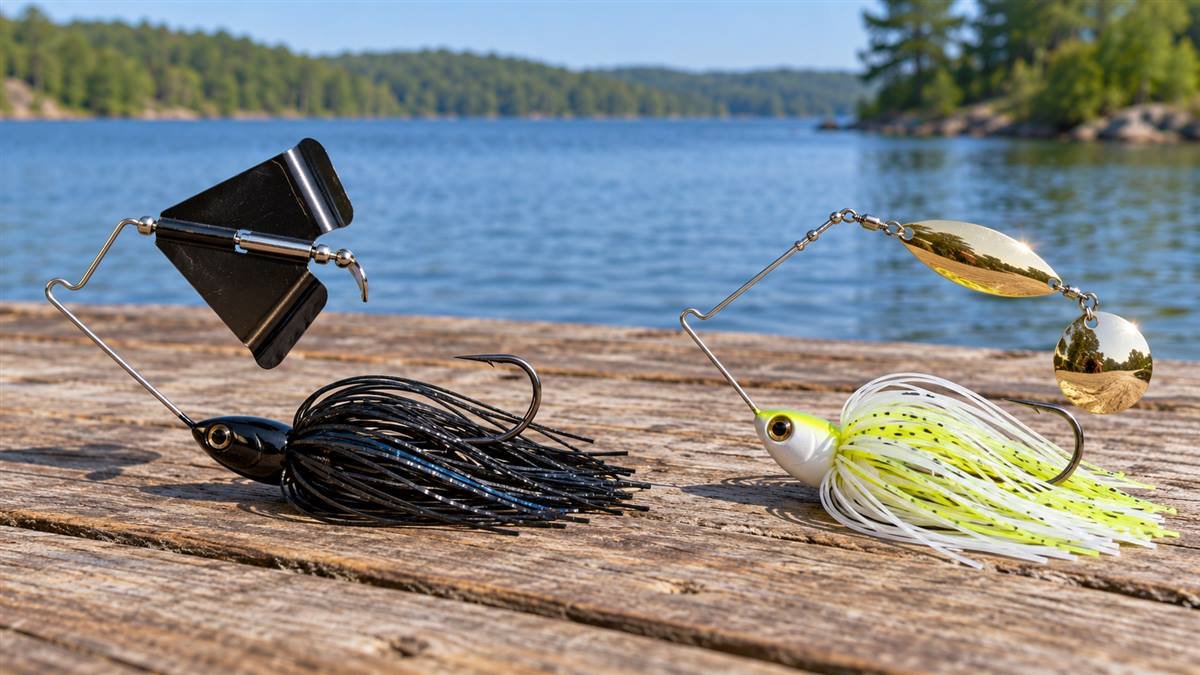
Spinnerbait. A conventional spinnerbait has a bent wire frame separating one or more rotating blades from a weighted jighead and single hook. An inline spinner puts the blade and rear hook along one central shaft. Both rotate metal blades, but their frames, cover clearance, and silhouettes differ.
Spoon. A spoon is a curved metal body that wobbles, rolls, or flutters as it moves. It does not rely on a separate blade revolving around a wire shaft. Both can flash, but the mechanism and fall behavior are different.
ChatterBait or bladed jig. Its front blade oscillates side to side beside a weighted jighead and skirt; it does not continuously orbit a central shaft. A metal blade bait usually uses a thin weighted plate that vibrates as the entire lure is pulled. A tailspinner has a rotating blade behind a weighted body rather than the classic inline spinner's front blade and central shaft layout.
Choose among them by where the hook must travel. A small inline spinner suits open stream pockets and long stretches of shoreline. A spinnerbait may pass selected shallow cover more easily; a spoon can flutter on a fall; a bladed jig can run along some grass edges. None is universally superior.
| Lure | Main moving element | Typical layout |
|---|---|---|
| Inline spinner | Blade revolves around shaft | Blade ahead of body and rear hook |
| Spinnerbait | One or more rotating blades | Bent wire arm above jighead |
| Spoon | Curved body wobbles or flutters | Single metal body |
| Bladed jig | Front blade oscillates | Blade beside weighted head and skirt |
| Blade bait | Weighted metal plate vibrates | Thin upright body |
Line Twist and Troubleshooting

Why line twists. The blade is supposed to revolve around the shaft; the entire lure does not need to spin continuously. Twist can develop when the whole body rolls, components bind, the hook dressing fouls, or rotation reaches the line through the eyelet. Watch a short retrieve in clear water. If the body rotates rather than tracking behind the blade, inspect alignment and try a different pace.
What a swivel can do. A small quality swivel placed appropriately can reduce some twist in selected rigs, but a bulky clip immediately ahead of a small spinner may affect balance or startup. Blue Fox describes a two-part Vibrax body designed to limit twist; that is a model-specific feature, not a cure for all line problems. Remove existing coils before testing new hardware.
Blade not spinning. Check a bent clevis or shaft, trapped weed, a bead jammed against the blade, or a damaged hook dressing. The retrieve may simply be too slow for that design or the current angle may be wrong. Reel a little faster or make a short acceleration to start rotation; if it still stalls, repair or replace the lure.
Use a rod and reel matched to the spinner's actual weight. Ultralight spinners may cast best on suitable light line, while larger versions and abrasive cover demand stronger gear. Keep hooks sharp, land fish without unnecessary handling, and dispose of cut line responsibly.
| Problem | Likely cause | First check |
|---|---|---|
| No blade pulse | Fouling or too little flow | Clear blade and adjust speed |
| Whole lure rolling | Bent shaft or fouled dressing | Inspect alignment |
| Line coils | Twist transmitted to line | Remove twist; test suitable swivel |
| Constant snag | Too deep or dense cover | Raise path or move lane |
| Missed strike | Dull hook or slack | Inspect hook and keep contact |